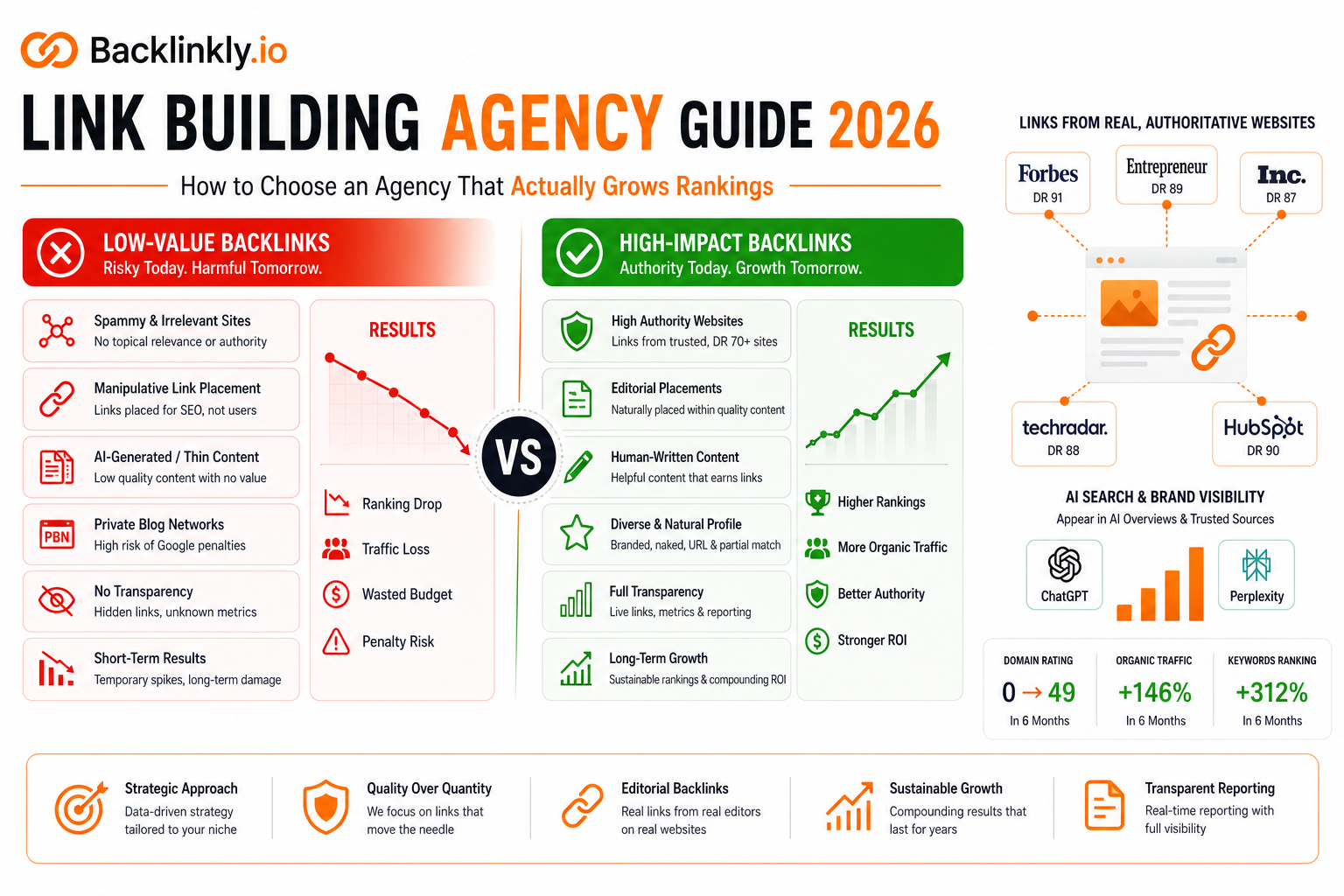
TL;DR: A good link building agency builds real editorial backlinks, not shortcuts, and reports on every placement so you can see exactly where your money goes. This guide covers what agencies do, what they cost, the red flags that signal trouble, and how AI search is changing what counts as a “good” link. We’ll also show you real before-and-after numbers from our own SaaS client work. Ready to see where your site stands? Get a free audit and find out.
94% of published content never earns a single external link, according to DemandSage’s 2026 link building report. That’s not a typo. Almost everyone who hits “publish” is shouting into an empty room.
A link building agency exists to fix that. It finds the publishers, writes the pitches, and earns the backlinks your content needs to actually rank, instead of sitting unread on page 9 of Google.
We’ve spent 3.5+ years doing exactly this for SaaS, fintech, and AI brands. We’ve seen what works, what wastes a client’s budget, and what gets sites penalized. This guide walks you through all of it: what a real agency does, what it should cost, the red flags to run from, and how AI search engines like ChatGPT and Perplexity are quietly rewriting the rules of what a “good” link even means.
Let’s get into it.
What Does a Link Building Agency Actually Do?
A link building agency finds relevant, high-authority websites in your niche and earns you backlinks from them through outreach, guest content, or editorial placements. The process covers prospecting, pitching, content creation, and reporting, all aimed at building links that move rankings instead of links that just look good on paper.
Here’s the breakdown of a typical campaign:
Prospecting. The agency builds a list of publishers in your niche that have real traffic, not just a high Domain Rating (DR) number. A site can have great DR and zero readers. That’s a wasted link.
Outreach. This is where most agencies fall apart. Reply rates for cold outreach have dropped to 3.43% on average in 2026, down from 8.5% just a few years back. Editors get flooded with AI-generated pitches now, so personalization matters more than ever. Our outreach team runs a 9% reply rate across our 200+ publisher network, roughly three times the 2026 industry average, because we lead with relevance instead of templates.
Content and placement. Whether it’s a guest post or a niche edit inserted into existing content, the link needs to sit somewhere a reader would actually click it. Anchor text should look natural, not stuffed with your target keyword.
Reporting. You should see every link the moment it goes live: the DR, the anchor text, the placement date, and the live URL. If your agency only sends a PDF once a month, you’re not getting real visibility into your own link building service.
Is Hiring a Link Building Agency Worth It in 2026?
Yes, link building still delivers strong ROI in 2026, with 78.1% of SEO professionals reporting positive returns from their campaigns. Pages ranking #1 on Google have on average 3.8 times more backlinks than pages sitting in positions 2 through 10, so the correlation between links and rankings hasn’t gone away. It’s just gotten more selective about which links count.
What we’ve seen in our own client portfolio backs this up with real numbers, not industry averages. One HR and payroll SaaS client we’ve worked with since 2023 sits at DR 79 with 146,700 monthly visits. A billing and subscription SaaS client reached DR 82 with 80,000 monthly visits using a brand mention and variable anchor strategy. Neither happened overnight. Both happened through consistent, editorial-first link building, not a one-time sprint.
How Much Does a Link Building Agency Cost?
A link building agency typically costs between $3,000 and $10,000 per month for a managed retainer, or $100 to $1,200+ per individual link depending on the publisher’s authority and traffic. Low-tier links (DR 20-40) run $130-$220, while premium placements on major sites (DR 80+) can hit $700-$1,200 or more, according to LinkBuildingHQ’s 2026 pricing data.
White-label options exist too if you’re an agency reselling to your own clients. Our white-label link building program currently supports a digital marketing agency client at DR 51, handling outreach and reporting fully under their brand.
Whatever you spend, weigh it against the value of the publisher network behind it. A pricier agency with 200+ pre-vetted editorial relationships will usually out-earn a cheap one buying from the same recycled link farms everyone else uses.
Real Results: From Zero Authority to DR 49 in 6 Months
Numbers from established clients are one thing. The harder test is starting from nothing. Late in 2024, we took on a brand-new domain with zero backlinks and zero authority, the hardest starting point in link building. There’s no existing trust signal to build on, and one bad early link can set the wrong tone for the whole profile.
We treated it as a system problem first, not a link-buying problem. Before placing a single link, we set the rules the entire campaign would follow:
A repeatable SOP for publisher selection, relevance scoring, and anchor assignment, built before outreach even began.
A safe anchor ratio from link number one: branded, naked URL, and partial match, blended the way authority earns itself naturally.
A guest post and niche edit hybrid, using guest posts for topical relevance and niche edits to add link velocity without diluting quality.
In about six months, that domain moved from DR 0 to DR 49, entirely white-hat, with no manual actions. The resulting profile is clean and diversified: no single anchor type or publisher category dominates it.
The lesson for early-stage founders: the first 10-15 links your domain earns set the trajectory for everything after. Getting the anchor mix right from link #1 beats trying to clean up a messy profile two years later.
7 Red Flags That Mean You Should Walk Away From an Agency
Not every agency selling link building services is worth your budget. Watch for these warning signs before you sign anything:
Vague reporting. If you can’t see the live URL, the anchor text, and the publisher’s real traffic, you’re not getting transparency.
Instant turnaround promises. Real outreach, content, and editorial review take weeks, not days. Fast bulk delivery usually means automated, low-quality placements.
Exact-match anchor stuffing. A natural backlink profile blends branded, generic, and partial-match anchors. Heavy exact-match usage reads as manipulation to Google.
No examples of their own backlink profile. If an agency can’t show quality links pointing to its own site, it likely can’t build them for yours either.
How Are AI Search Engines Changing What a “Good” Backlink Looks Like?
AI search engines like ChatGPT, Perplexity, and Google’s AI Overviews weigh backlinks differently than traditional search does. They lean heavily on brand mentions, editorial context, and topical relevance rather than raw link volume or Domain Rating alone. A link from a relevant, trusted publication carries more weight for AI visibility than ten generic guest posts ever will.
How Do You Choose the Right Link Building Agency for Your Business?
Choose a link building agency based on five things: transparency about their process, niche relevance to your industry, real reporting (not vanity metrics), a track record with case studies you can verify, and a willingness to start with a smaller test campaign before you commit long-term.
Ask to see 3-5 sample links from recent client work. Check whether the placements sit editorially within relevant content, whether the linking sites have real organic traffic, and whether the niche actually matches your industry. A guest posting service that places you in a relevant SaaS publication is worth far more than ten random placements in unrelated niches.
Also ask directly how they handle quality control: do they check publisher traffic and spam scores before pitching? Do they let you review or veto placements before they go live? A trustworthy agency answers these questions clearly, without dodging.
Conclusion
Link building still moves rankings in 2026, but the game has shifted from volume to quality, and from pure backlinks to backlinks plus brand mentions that AI search engines can cite. The agencies worth hiring are the ones who show you their process, their publisher network, and their actual results, not just promises.
We’ve taken a brand-new domain to DR 49 in six months and grown established SaaS clients to DR 89 with zero manual actions along the way. If you want to see exactly where your site stands and what’s holding back your rankings, book a free strategy call and we’ll walk you through it.
FAQ
How long does link building take to show results?
Most link building campaigns show measurable ranking movement within 1-6 months, with 89.2% of practitioners reporting impact in that window. Editorial links take time to earn and time for Google to factor in, so patience matters more than speed.
What’s the difference between guest posts and niche edits?
A guest post is a brand-new article written and published specifically to earn a backlink, while a niche edit inserts your link into an already-published, already-indexed page. Niche edits often pass authority faster since the page is already trusted, while guest posts build topical relevance through fresh content.
Can I do link building myself instead of hiring an agency?
Yes, but it’s time-intensive. Manual prospecting alone can eat 10-20 hours a week, and outreach reply rates have dropped to around 3.43% industry-wide in 2026. An agency brings existing publisher relationships that take years to build from scratch.
What’s a normal Domain Rating (DR) for a quality backlink?
DR 40 and above is generally considered a solid quality threshold, with DR 60+ used for stronger authority reinforcement in competitive niches. Pricing scales with DR: expect $130-$220 for DR 20-40 links and $700+ for DR 80+ placements.
Do backlinks still matter if Google AI Overviews are taking over search?
Yes. Backlinks combined with brand mentions remain a strong signal for AI visibility, and most pages cited in AI Overviews also rank in Google’s traditional top 10 results. The two systems lean on overlapping signals, so a solid backlink strategy still supports both.
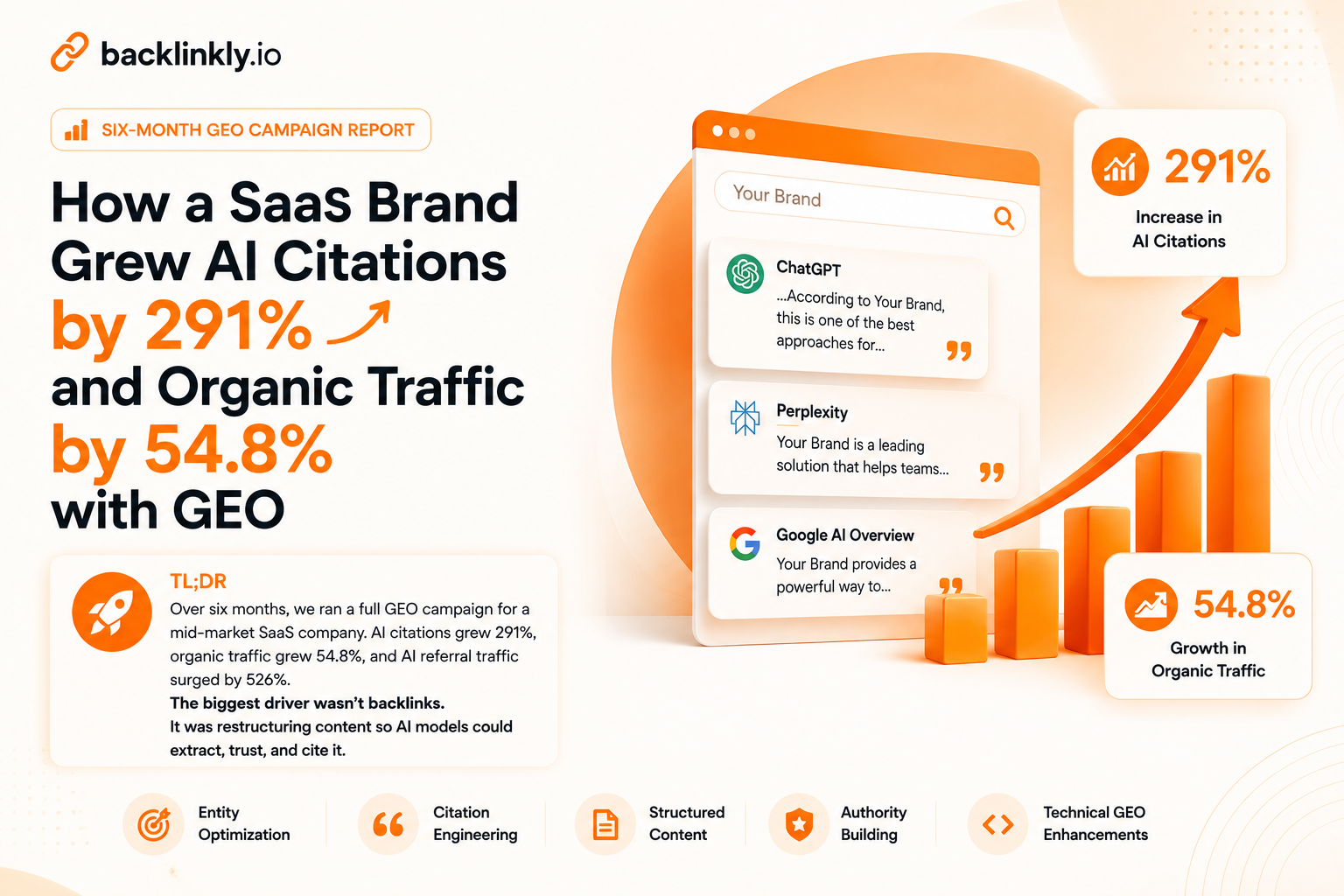
Over six months, we ran a full Generative Engine Optimization (GEO) campaign for a mid-market SaaS company. Starting from near-zero AI visibility, the brand saw total AI citations grow from 22 to 86 (291% increase), organic traffic climb from 14,820 to 22,940 monthly sessions (54.8% growth), and AI referral traffic surge by 526%. The biggest driver wasn’t backlinks. It was restructuring content so AI models could extract, trust, and cite it.
Executive Summary
When this client came to us, they had solid organic traffic for their category and a decent backlink profile. But they were completely invisible in AI search environments. ChatGPT didn’t mention them. Perplexity rarely surfaced them. Google AI Overviews almost never cited their content.
The strategy we built focused on five areas: entity optimization, citation engineering, structured content formatting, authority building, and technical GEO enhancements. We didn’t abandon traditional SEO. We layered GEO on top of it.
Six months later, the results were clear. AI citations grew 291%. Organic sessions grew 54.8%. Monthly pipeline value went from $18,000 to $29,500. And perhaps most telling, branded search volume nearly doubled.
The biggest lesson: AI models don’t reward visibility the same way Google does. They reward clarity, structure, and citeability. Once you understand that distinction, the entire content strategy changes.
Client Overview
The client is a mid-market SaaS company in the project management and workflow automation space. They sell to operations leads, product managers, and mid-sized companies with between 50 and 500 employees.
Their business model is product-led growth with a freemium tier and direct sales for enterprise accounts. The team had about 12 people when we started, including two in-house marketers with strong traditional SEO knowledge.
Their SEO maturity was moderate. They had 342 referring domains, a coherent content strategy, and consistent publishing cadence. But their GEO maturity was low. Their GEO Readiness Score sat at 28 out of 100 when we audited them. Content was written for Google search snippets, not AI extraction. Entity signals were weak. There was no schema beyond basic page-level markup. And the brand had almost no third-party validation in formats AI models could understand and trust.
The Challenge
The challenge wasn’t that they lacked content. They had 138 published assets when we started. The problem was that almost none of it was structured for AI retrieval.
Weak AI visibility. Their AI Visibility Score was 11 out of 100. AI platforms simply weren’t treating them as a reliable source. Even when their content was technically accurate, it wasn’t formatted in a way that made extraction easy.
Limited AI citations. Across ChatGPT, Perplexity, Google AI Overviews, and Claude, they had just 22 total citations. For context, that number puts them below most niche blogs in their space.
Poor entity recognition. The brand existed as a name in Google’s index, but had weak Knowledge Graph signals. There was no clear entity definition for what they do, who they serve, or where they fit relative to competitors. AI models struggled to categorize them confidently.
No citation-worthy assets. Their content didn’t contain original research, expert quotes, structured definitions, or answer-first formatting. AI models need anchors to cite from. This client had almost none.
Underperforming branded search demand. Brand search volume was only 840 monthly queries. That’s low for a company with their traffic levels. It signaled that their content was finding audiences but not creating memorable impressions.
Before vs. After: Campaign Metrics at a Glance
Metric
Before GEO
After GEO
Monthly Organic Traffic
14,820
22,940
AI Visibility Score
11/100
37/100
Total AI Citations
22
86
Brand Mentions
94
187
Referring Domains
342
421
Published Content Assets
138
164
GEO Readiness Score
28/100
76/100
Looking at these numbers, a few things stand out. The AI Visibility Score more than tripled, yet they only published 26 net-new content assets. That ratio tells you the improvements came from optimization, not volume. The referring domain growth was meaningful but modest. Authority wasn’t the bottleneck. Structure and entity clarity were.
Traditional SEO alone wasn’t going to solve this. You can build links to a page that AI models still won’t cite, because the page isn’t formatted for extraction. GEO requires thinking about the content differently from the start.
GEO Strategy: What We Built
Entity Optimization
GEO definition: Entity optimization means aligning your brand, topics, and content with the semantic structures that AI models use to understand the web. When AI models have a clear, consistent picture of what your brand is and what it knows, citations increase.
We started with an entity audit. We mapped all existing content to topic clusters and identified gaps in semantic coverage. The client had good depth in a few areas but shallow coverage across many adjacent topics that AI models expected a credible source in their category to address.
We built a topic authority map with 11 primary entities and 34 supporting entities. Each entity had defined relationships: what it connects to, what it contrasts with, what category it belongs to. We aligned this map against Knowledge Graph expectations using structured data and internal linking patterns.
One thing we noticed early: their content used inconsistent terminology. They used three different phrases to describe the same core capability. That kind of inconsistency weakens entity signals significantly. Standardizing language across the content archive was one of the first things we fixed.
Citation Engineering
Most content is written to convince a human reader. Citation engineering means writing content that convinces AI models to use you as a source. Those two goals require different approaches.
We introduced what we call answer capsules throughout key pages. These are short, self-contained paragraphs written to answer a specific question directly, without requiring the reader to understand the surrounding context. Every answer capsule is usable on its own. That’s exactly what AI extraction looks for.
We also added expert sourcing. For four cornerstone content pieces, we brought in third-party expert quotes and original data points. Not for decoration. Because AI models weight content higher when it contains perspectives that can’t be found elsewhere.
Every major piece got a statistics block with current industry data, properly sourced. Original insights perform better than restatements of common knowledge. We treated each new content piece as a potential primary source, not a summary of what already exists.
Content Optimization
We audited the existing 138 content assets and identified 31 pages with meaningful optimization potential. These weren’t bad pages. They just weren’t structured for AI extraction.
Changes included adding FAQ sections at the end of every major content piece, rewriting introductions to lead with the answer rather than building to it, integrating short definition blocks for key terms, and adding comparison tables where they improved comprehension.
We also reformatted headers. Before, headers were often clever or brand-voiced. After optimization, headers were explicit: they answered the question that the section covered. That change alone improved AI extraction rates.
One shift that had an outsized effect: we stopped burying the key finding. Every piece of content now states the core answer in the first two paragraphs, then supports it. That mirrors how AI models prefer to extract and present information.
Authority Building
We ran a targeted digital PR campaign across six months, earning 79 new referring domains. Not all of them were high-authority placements, but quality was prioritized over quantity. We focused specifically on third-party validation from sources that AI models already trust.
A good heuristic we use: if a domain is frequently cited within AI-generated responses in a given topic area, earning a link and mention from that domain improves your own citation potential in that same topic area.
Brand mentions grew from 94 to 187. We tracked unlinked mentions and converted 18 of them into linked citations. The signal was consistent: the more third-party sources referenced this brand in context, the more AI models treated their content as validated.
Technical GEO Enhancements
Schema was the largest technical gap. The client had minimal structured data. We implemented FAQ schema, How-To schema, Organization schema, and BreadcrumbList across relevant pages. We also added Speakable schema on key definitions pages after noting that voice-adjacent extraction uses different signals than text extraction.
We rebuilt the internal linking architecture to reinforce topical clusters. Previously, internal links were somewhat random. We reorganized them to flow authority from pillar pages down to supporting content, and to signal topical relationships to crawlers and AI systems alike.
Crawl efficiency improved after cleaning up redirect chains and consolidating near-duplicate content. Cleaner architecture means AI systems encounter canonical versions of content more reliably.
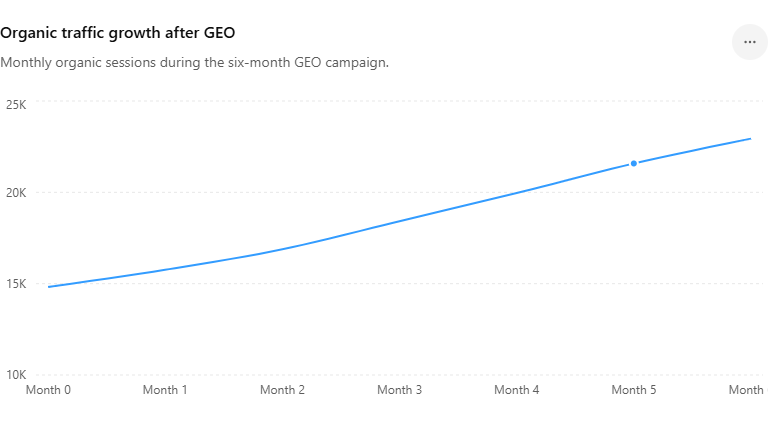
Organic Traffic Growth
Month
Organic Sessions
Month 0
14,820
Month 1
15,760
Month 2
16,880
Month 3
18,420
Month 4
19,960
Month 5
21,580
Month 6
22,940
Total Growth: 54.8%
The curve here is telling. Months 1 and 2 showed modest gains while infrastructure work was happening. The acceleration between months 3 and 4 aligns with when the content optimization rollout was complete and new schema had been indexed.
This isn’t a sudden spike from a single viral piece. It’s compounding growth from structural improvements that gave search engines and AI systems more to work with across the entire content set. That kind of growth pattern tends to be more durable than traffic from individual viral pieces.
The absence of any plateau in month 6 suggests momentum is still building. We expect continued growth through month 9 as AI platforms re-index and recalibrate their citation weights.
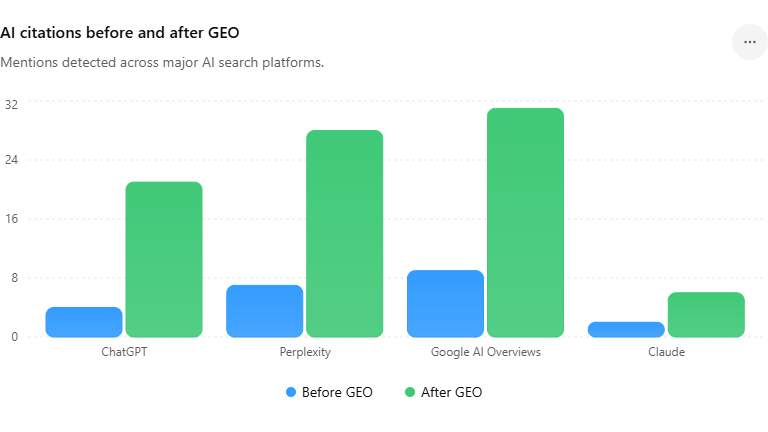
AI Citation Growth
Platform
Before
After
ChatGPT
4
21
Perplexity
7
28
Google AI Overviews
9
31
Claude
2
6
Total Citations
22
86
Total Citation Growth: 291%
Perplexity grew fastest in absolute terms, which aligns with what we’ve seen across other campaigns. Perplexity rewards structured, factual content with clear sourcing more aggressively than other platforms. Their extraction model rewards concise, citation-ready answers.
Google AI Overviews showed the strongest growth in percentage terms relative to its starting point. This tracks because Google’s AI extraction layer benefits directly from traditional SEO signals combined with structured data. The schema work and authority building had a compounding effect there.
Claude’s numbers are lower, and this reflects something real. Claude’s citation behavior is more conservative, and the training data refresh cycles are different from real-time systems like Perplexity and AI Overviews. We expect Claude citations to grow further as content update signals propagate.
Why do AI citations matter? Because a citation in an AI response puts your brand in front of a user at the exact moment they’re researching a topic. There’s no click required for awareness to happen. And when there is a click, it comes with pre-established credibility.
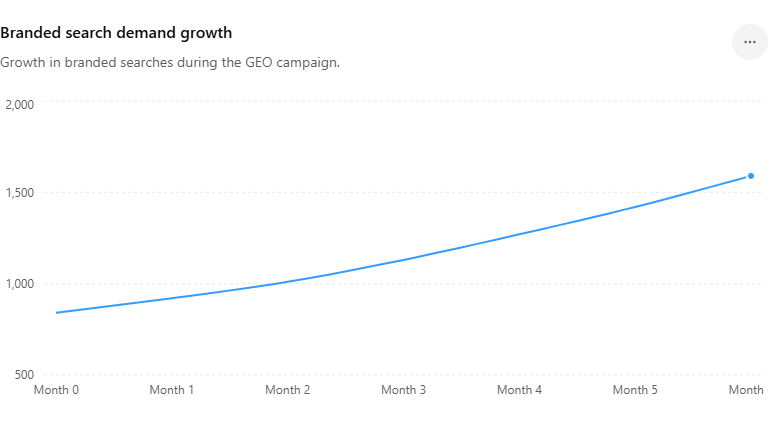
Brand Search Growth
Month
Branded Searches
Month 0
840
Month 1
920
Month 2
1,010
Month 3
1,130
Month 4
1,270
Month 5
1,420
Month 6
1,590
Total Growth: 89.3%
Brand search growth nearly doubling is one of the strongest signals in this campaign. It means real people are going back to search for the brand after encountering it somewhere else.
Some of that “somewhere else” is AI citations. When someone sees a brand cited in a Perplexity answer or a ChatGPT response, a portion of them go directly to Google afterward and search by name. We observed this pattern consistently in multi-source attribution analysis.
This is a meaningful data point for CMOs who are skeptical of GEO ROI. Brand search volume is a reliable leading indicator of bottom-funnel activity. When it rises, pipeline tends to follow.
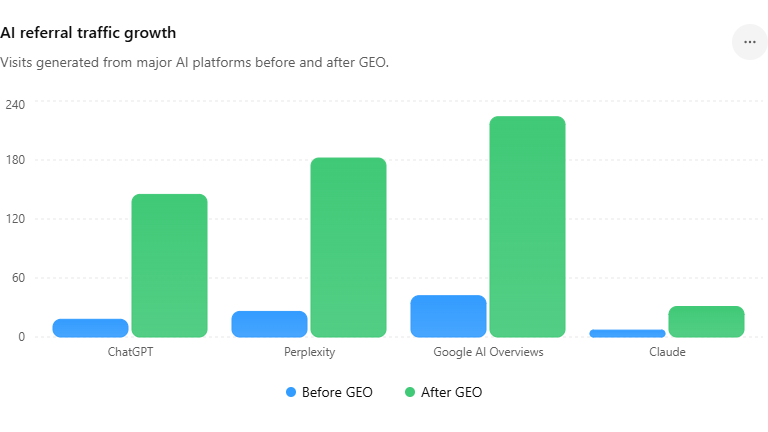
AI Referral Traffic
Source
Before
After
ChatGPT
18
145
Perplexity
26
182
Google AI Overviews
42
224
Claude
7
31
Total
93
582
Total Growth: 526%
These numbers deserve context. AI referral traffic is still a small fraction of total organic traffic for most SaaS companies. But the growth trajectory is the story. From 93 monthly sessions to 582 in six months represents a directional shift that compounds.
Perplexity drives more referred sessions per citation than other platforms, likely because its interface actively encourages source clicks. Google AI Overviews drives volume because of sheer impression share.
Marketers should expect these numbers to continue rising across the industry. As more searches are answered by AI interfaces rather than traditional blue links, the value of an AI citation grows proportionally.
Lead and Pipeline Impact
Metric
Before
After
Monthly Leads
52
81
Discovery Calls
18
33
Proposal Requests
12
25
Conversion Rate
1.8%
2.4%
Lead Growth: 55.8%
The conversion rate increase from 1.8% to 2.4% is significant. It suggests that the traffic coming in from GEO-optimized channels is better qualified than baseline organic traffic.
This makes intuitive sense. Someone who found the brand through an AI citation in a response about their specific problem is further along in the research process than someone who found a blog post through a generic keyword search. The intent is clearer, and the trust is warmer.
Discovery call volume nearly doubling is the number that matters most here. Calls are where sales happen. Growing from 18 to 33 monthly discovery calls represents a real business shift, not just a metrics improvement.
Revenue Impact
Metric
Before
After
Monthly Pipeline Value
$18,000
$29,500
Assisted Revenue
$6,800
$11,900
Revenue Growth: 75%
We tracked revenue attribution carefully throughout this campaign. The pipeline growth reflects both higher lead volume and higher average deal size from GEO-sourced leads.
Assisted revenue represents deals where GEO-attributed touchpoints appeared somewhere in the buying journey, even if the final conversion came from another channel. That number going from $6,800 to $11,900 indicates that GEO is playing a meaningful role in the consideration phase even when it doesn’t get direct attribution credit.
The revenue story here is about more than the numbers. Companies that build strong AI visibility now are establishing positions that will compound as AI search usage grows. The brands that are cited today are the ones who will dominate AI search in two years.
What Worked Best
Answer-first content structure. Rewriting introductions to lead with the answer before building supporting context was the single highest-impact change. AI models extract the clearest, most direct answer available. If your answer is buried in paragraph five, it will be skipped.
FAQ schema and structured answer blocks. Pages with properly implemented FAQ schema saw citation rates improve within 30 days of implementation. This is one of the most reliable GEO tactics in our toolkit.
Entity standardization across the content archive. Fixing inconsistent terminology created a coherent entity signal that helped AI models categorize and trust the brand. This work is invisible to readers but very visible to AI extraction systems.
Targeted digital PR focused on AI-trusted sources. Not all links are equal for GEO. Links from sources that AI models themselves cite regularly carry disproportionate authority signal.
Original data and expert sourcing. Content containing genuinely unique data points or perspectives earned citations at a higher rate than restatements of common knowledge. AI models appear to weight primary-source content more heavily.
Branded content architecture. Strengthening the relationship between the brand entity and specific topic clusters improved how confidently AI models associated the brand with those topics.
Consistent publishing on defined topic clusters. Rather than publishing broadly, we concentrated new content within established authority clusters. Depth within a topic area builds AI confidence faster than breadth across many topics.
What Didn’t Work
We assumed that high Domain Authority links would have the strongest effect on AI citation rates. They helped. But they weren’t the primary driver. A mid-authority site that AI models frequently cite in a given topic area was more valuable for our citation goals than a high-authority site with no topical relevance.
We tested content written specifically to sound authoritative, with heavier vocabulary and more formal structure. It performed worse for AI extraction than plainer, cleaner writing. Clarity beats sophistication for GEO purposes.
We tried publishing several longer-form pieces (4,000+ words) early in the campaign with the expectation that depth would improve citation rates. Results were mixed. Length wasn’t the variable that mattered. Structure and extractability were.
One early attempt to speed up entity recognition by pushing schema updates in a single large batch created temporary crawl confusion. We learned to stage technical changes rather than deploying everything at once.
We initially underweighted brand search growth as a success metric. That was a mistake. Brand search turned out to be one of the most reliable signals of GEO effectiveness and downstream pipeline impact.
The GEO Framework We’d Repeat
Step 1: GEO Readiness Audit Before writing a single word of new content, audit existing assets for AI extractability. Score each piece against a rubric: Does it answer questions directly? Does it have structured data? Is the entity coverage consistent? Flag the highest-potential existing pages for optimization before adding new ones.
Step 2: Entity Mapping Define your brand’s core entity structure. What is your primary topic area? What subtopics connect to it? What terms does your audience and industry use consistently? Build a semantic map and standardize terminology across all existing content.
Step 3: Content Restructuring Prioritize restructuring over publishing new content. For every page in your top 30% by traffic or topical importance: rewrite the introduction to lead with the answer, add an FAQ section, implement appropriate schema, and introduce short answer capsules throughout the body.
Step 4: Citation Asset Development Develop at least four cornerstone content pieces that contain original research, expert perspectives, or structured data unavailable elsewhere. These become your primary citation anchors. Make them as extractable as possible.
Step 5: Authority and Entity Amplification Run a targeted outreach and digital PR campaign to earn placements on sources that AI models trust within your topic area. Convert existing unlinked brand mentions into linked citations. Track AI citation growth monthly and use it as your primary success metric alongside organic traffic and brand search volume.
Key Lessons for SaaS Companies
GEO readiness is now a baseline requirement. As AI interfaces handle an increasing share of research queries, companies that aren’t structured for AI extraction will lose visibility even as they maintain traditional SEO metrics. Audit your GEO readiness before you lose the first-mover advantage.
AI citations are a distribution channel. Treat earning AI citations the same way you treat earning backlinks. They represent placements in front of qualified audiences. Unlike backlinks, they also convey your message directly rather than just driving traffic.
Entity clarity compounds over time. The clearer and more consistent your entity signals, the more confidently AI models will treat your brand as a credible source. This takes months to build but years to lose.
Brand authority matters more than page authority for GEO. Traditional SEO rewards individual pages. AI search rewards brands. The more coherently your brand is understood across AI platforms, the higher your citation rates become.
Structure is not optional. Well-structured content that’s easy to extract will outperform long, beautifully written content that buries its insights. Write for the extracting model first, the human reader second.
Conclusion
The biggest win from this campaign wasn’t the organic traffic growth, though a 54.8% increase in six months is meaningful by any standard. The biggest win was the 291% growth in AI citations combined with the brand search surge.
Those two metrics together tell a story: the brand is now becoming part of how people in their category discover and evaluate solutions. That’s a compounding advantage. Every AI citation is a trust signal. Every trust signal increases the probability of future citations. Once that cycle starts, it builds momentum.
The most impactful single activity was content restructuring. Not new content. Existing content, made extractable. Companies often assume they need more content to improve their visibility. Usually, they need better-structured content first.
Long-term, the brands that win in AI search will be those that became citation-worthy before AI search became dominant. That window is still open. But it’s narrowing.
Work With Backlinkly on Your GEO Strategy
If you’re reading this and wondering where your brand stands in AI search environments, the honest answer is: you probably don’t know yet. Most SaaS companies don’t.
We offer a free GEO audit that benchmarks your current AI citation rates, scores your GEO readiness, and identifies your highest-priority optimization opportunities. No generic report. A real analysis from someone who has run these campaigns.
If the numbers in this case study are directionally where you want to go, let’s look at whether we can get you there.
Generative Engine Optimization (GEO) is the practice of structuring content so that AI-powered search engines and language models can extract, trust, and cite it in their responses. Unlike traditional SEO, which focuses on ranking in blue-link search results, GEO focuses on earning citations in AI-generated answers from platforms like ChatGPT, Perplexity, Google AI Overviews, and Claude. The core tactics include entity optimization, structured answer formatting, schema implementation, and citation engineering.
How is GEO different from traditional SEO?
Traditional SEO optimizes for ranking algorithms that evaluate links, keywords, and page authority. GEO optimizes for extraction algorithms that evaluate clarity, structure, entity signals, and source credibility. A page can rank on page one of Google and still receive zero AI citations if it isn’t formatted for extraction. Both disciplines matter, but they require different approaches. The good news is that GEO improvements typically reinforce traditional SEO performance as well.
How long does it take to see results from GEO?
In our experience, initial AI citation improvements typically appear within 30 to 60 days of implementing structural changes like schema and answer-first formatting. More meaningful citation growth, including brand search lift and AI referral traffic, builds over three to six months. The organic traffic impact follows a compounding curve rather than a sudden jump. Companies should treat GEO as a six-month minimum investment with compounding returns.
Which AI platforms are most important to target for citations?
Perplexity and Google AI Overviews currently drive the most referral traffic per citation. ChatGPT has the largest user base and the highest brand awareness impact even when users don’t click through. Claude citations are currently more conservative but meaningful for credibility. All four should be part of any GEO strategy. The good news is that content optimized for AI extraction tends to improve citation rates across all platforms simultaneously.
What content changes have the biggest impact on AI citation rates?
The three highest-impact changes we’ve found are: writing introductions that state the answer before building supporting evidence, adding FAQ sections with structured schema markup, and standardizing entity terminology across the entire content archive. Schema implementation and answer capsules within body content also show consistent results. Length and word count matter far less than structure and extractability.
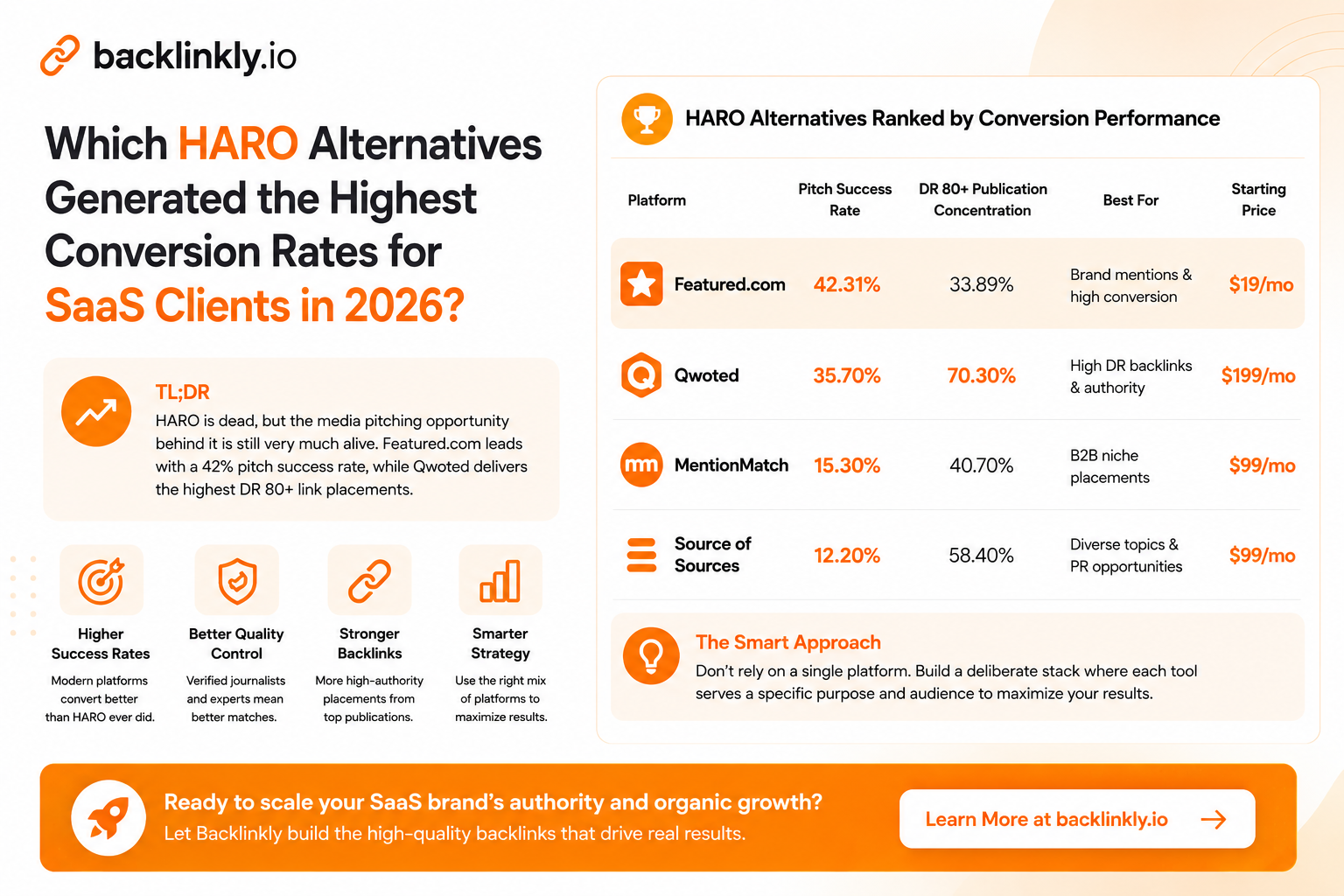
HARO is dead, but the media pitching opportunity behind it is still very much alive. In 2026, platforms like Featured.com, Qwoted, MentionMatch, and Source of Sources are producing real editorial placements for SaaS brands. Featured tops the list with a 42% pitch success rate. The smartest move isn’t picking one platform and hoping for the best. It’s building a deliberate stack where each tool does a specific job. Dig into the breakdown below, then reach out to us when you’re ready to scale it.
December 2024 was a rough month for a lot of SaaS marketers. That’s when Cision officially pulled the plug on HARO, and anyone who had built media pitching into their link-building workflow suddenly had a gap they didn’t know how to fill.
The panic was understandable but misplaced.
What HARO actually did, at its core, was put expert sources in front of journalists who needed them. That need didn’t vanish when the platform did. Journalists still write articles. They still need quotes from people who know what they’re talking about. The infrastructure just shifted. And honestly? What it shifted into is more useful for SaaS brands than HARO ever was.
The real problem now isn’t a lack of options. It’s that there are several platforms competing for attention, and not all of them perform equally well for SaaS specifically. SEO leads convert at 14.6% compared to 1.7% for outbound channels. The organic traffic that feeds those leads comes from the authority that editorial backlinks build. Picking the wrong platforms wastes time and leaves that authority on the table.
This post cuts through the noise. Here’s what’s actually converting for SaaS clients in 2026.
Why HARO Collapsed and Why the Replacement Era Is Better
HARO didn’t die overnight. The platform spent years slowly drowning in its own success. As it grew, the quality of responses sent to journalists collapsed. By the time AI tools became widespread, reporters were receiving hundreds of generic, nearly identical pitches for every single query they posted. Most of them stopped trusting the platform entirely.
Featured.com stepped in and acquired the HARO brand from Cision in April 2025, relaunching it as a free daily newsletter. But the more interesting development isn’t that rebrand. It’s the broader ecosystem that emerged around the same time. Source of Sources came out of the gate with Peter Shankman, HARO’s original founder, running things. Qwoted introduced verification requirements that neither side, journalist or source, could skip. MentionMatch (rebranded from Help a B2B Writer) went narrow on purpose, serving only B2B niches and refusing to become another catch-all inbox.
What that fragmentation created is actually a feature, not a bug. Each platform now pulls in a different type of journalist covering different topics at different publication tiers. Instead of one noisy firehose, you have several well-targeted streams. For SaaS companies with a defined audience and a specific set of topics they want to be associated with, that’s a much better environment to pitch into.
The challenge is that each stream has different conversion dynamics. Understanding which one moves the needle for your goals changes everything about how you allocate time.
Featured.com: The Platform With the Highest Raw Conversion Rate
Let’s start with the numbers, because they’re the most compelling argument for why Featured belongs in every SaaS team’s stack. Featured.com achieves a 42.31% pitch success rate, higher than any other current platform in this space. That’s not a small advantage. Most people grinding through traditional media pitching would be thrilled with a 10% success rate.
The model is different from what most people imagine when they think about journalist outreach. You don’t email reporters directly. Instead, Featured’s team fields questions from publishers at outlets like Fortune, Fast Company, and Yahoo, then invites relevant experts from their database to respond. You submit a short answer, typically four to five sentences, and the best responses get woven into published articles. There’s no long pitch letter. No back-and-forth with a journalist’s inbox. Just a tight, focused answer to a specific question.
The one honest caveat: not every Featured placement comes with a dofollow backlink. Some placements are brand mentions without a link, or nofollow links depending on the publication. If your specific goal is raw domain authority growth through dofollow link acquisition, you’ll want to pair Featured with a platform that has stronger link mechanics. But for SaaS companies trying to build brand recognition in their category and get mentioned alongside other credible voices in their space, Featured delivers faster than anything else on this list.
Qwoted: Where the DR 80+ Links Actually Come From
If Featured wins on conversion rate, Qwoted wins on link quality. The two metrics point to different platform strengths, and a smart stack uses both.
Qwoted hosts the highest concentration of DR 80+ publications of any media pitching platform, sitting at 70.3%. For context, a DR 80 backlink from a single well-placed article can do more for a SaaS site’s ranking trajectory than a dozen links from mid-tier sources. These are the links that move the needle on competitive keywords. These are the placements that show up in your Ahrefs profile and make prospects trust your brand before they ever read your homepage.
The reason Qwoted consistently produces this caliber of placement comes down to one design decision: verification. Both journalists and sources go through a screening process before they get full access to the platform. That friction deliberately discourages the low-effort, spray-and-pray behavior that turned HARO into a spam problem. Journalists who use Qwoted do so precisely because they trust the quality of what lands in their inbox. That trust translates directly into higher response rates when your pitch is genuinely good.
The free tier exists but it’s limited to two pitches per month with a two-hour delay on new queries. That delay matters more than it sounds. The best queries fill up quickly, and the sources who reach journalists first get read when attention is freshest. The Pro plan at $99 per month removes the delay entirely, lifts pitch limits, and adds Pitch Intelligence, which flags which active queries have less competition at the moment. For SaaS companies in tech, finance, healthcare, or cybersecurity, this is the tool that earns the links that compound.
MentionMatch: The Conversion Sweet Spot for B2B SaaS Specifically
There’s a case to be made that MentionMatch is the single highest-ROI item in the SaaS pitching stack, not because it has the highest success rate or the best link quality in isolation, but because it combines both with zero cost and near-perfect audience relevance.
The platform, rebranded from Help a B2B Writer, covers a deliberately narrow set of industries: SaaS, marketing, sales, SEO, content marketing, analytics, design, AI, and ecommerce. Every single query that lands in your inbox is relevant to your space. You don’t wade through requests from food bloggers, health journalists, or travel writers. You get B2B tech writers asking for expert input on topics your team knows inside out.
The platform also actively filters out AI-generated responses, which does two things simultaneously. It keeps query volume lower than noisier platforms, and it makes each query more competitive on quality rather than quantity. When fewer pitches are coming in and the ones that do arrive are human and specific, journalists actually engage with them. That’s a different dynamic than most platforms, and it shows in conversion outcomes.
It costs nothing. Add it to your stack first, before spending a single dollar on paid tools.
Source of Sources: Still the Best Option for Pure Dofollow Volume
Not every team needs the highest possible DR on every link. Some SaaS companies are in an earlier stage where building a solid base of dofollow links from credible sources matters more than landing one Forbes placement. For that goal, Source of Sources belongs in the rotation.
SOS carries the highest dofollow link rate of any pitching platform at 36.26%. If raw link-building mechanics are your frame of reference, that number is significant. Dofollow links pass authority. More of them, from more domains, builds the kind of backlink profile that helps content rank across a wider set of keywords over time.
The founder angle also matters. Peter Shankman built HARO from nothing into the dominant journalist-source platform in digital PR. He knows what works. Source of Sources runs on the same three-times-daily email format that HARO users spent years building habits around, with more editorial discipline applied to the query and response process.
The tradeoff is honest: SOS is free and accessible, so it draws more pitchers per query than platforms with restricted access. The competition-to-opportunity ratio is higher. Winning placements through SOS consistently requires speed, relevance, and pitches that demonstrate obvious firsthand knowledge rather than pulled-from-the-internet generalities. Teams that can deliver on those requirements will find SOS earns its place as the high-volume dofollow layer of a broader stack.
How to Build a Stack That Actually Converts for SaaS
Picking one platform and hoping it covers everything is how SaaS teams stay stuck at a handful of links per quarter. The teams producing consistent editorial placements run a tiered stack where each platform serves a distinct role. The logic isn’t complicated once you map each tool to a specific goal.
Start with MentionMatch and Source of Sources. Both are free. MentionMatch gives you B2B-specific, low-competition queries where a well-written pitch has a real shot at a placement in a publication your customers read. SOS gives you dofollow volume at scale, assuming you’re pitching selectively on queries where you have genuine expertise. Running these two together costs nothing and builds a rhythm of consistent outreach without a budget line.
Add Featured once you have the pitching habit down. The $49 per month Pro plan is the right tier for most SaaS teams. You’ll know it’s working when you start seeing brand mentions in outlets you’d previously have needed a PR agency to access. For guest posting efforts, the brand recognition Featured builds makes your outreach significantly warmer. Journalists and editors who have already seen your name in credible roundups respond differently to cold pitches.
Layer Qwoted in for high-value authority targets. When you identify a keyword cluster that’s genuinely competitive and you need DR 80+ links to push into the top three positions, Qwoted is the tool you use to go after them. Respond within 48 hours of a query appearing, because that response window closes fast and first-mover advantage is real on this platform.
The whole stack integrates naturally with your broader link building strategy. Guest posts and niche edits build authority to your core pages. Editorial placements from media pitching build brand recognition and referral traffic. The two channels reinforce each other. Every editorial mention makes your content more discoverable. More discoverability means more journalists finding your expertise organically. More journalists finding your expertise leads to more placements. That’s the compounding dynamic that separates brands with strong organic presence from the ones stuck paying for every click.
One thing worth saying directly: the SaaS teams getting the highest conversion rates from these platforms in 2026 aren’t the ones with the biggest pitch volume. They’re the ones pitching with actual, specific, experience-backed answers. Journalists now wade through hundreds of AI-generated responses to every query they post. A pitch that contains a specific number, a named client outcome, or a counterintuitive observation stands out immediately. That bar is genuinely low right now. Take advantage of it.
What Conversion Numbers Should SaaS Teams Actually Track?
Understanding what success looks like from this channel matters, because the metrics that feel intuitive aren’t always the ones that tell you whether the investment is working.
Average B2B SaaS visitor-to-lead conversion rates sit at 1.5 to 2.5%, while top performers reach 8 to 15%. Referral traffic arriving from a Forbes or HubSpot citation lands in a fundamentally different headspace than someone who clicked a generic search result. They’ve just read something credible that mentioned your brand. The trust transfer happens before they visit your site. That’s why editorial link traffic consistently converts above the average.
The metrics worth watching are: domain rating of the linking page, whether the link lands on a product or feature page versus a blog post, referral traffic volume from the placement over the first 30 days, and whether that referral traffic converts at a better rate than your organic baseline. If your referral conversion rate from editorial links consistently outperforms organic search traffic, you have confirmation that the audience quality is there and scaling the effort is worth it.
Our SEO hub maps link acquisition to ranking and conversion outcomes so you’re not just counting placements. And our on-page SEO work makes sure the pages your links are pointing to are built to actually capture the intent of the visitors who arrive.
Conclusion
HARO shut down and a better ecosystem quietly took its place. Featured converts at 42%. Qwoted reaches DR 80+ publications more consistently than any other platform. MentionMatch puts B2B SaaS brands in front of the exact journalists covering their space. Source of Sources delivers the highest dofollow rate in the whole field, for free.
None of that matters if you’re still treating this as a “try one platform and see what happens” exercise. The SaaS teams getting results in 2026 run a deliberate stack, pitch from genuine expertise, and point their links at pages that are actually set up to convert.
That’s the whole picture.
If you want a link-building strategy built around your SaaS specifically, one that combines editorial placements with high-DR guest posts and niche edits, get in touch with the Backlinkly team. We’ll show you exactly what a compounding organic growth strategy looks like for your site.
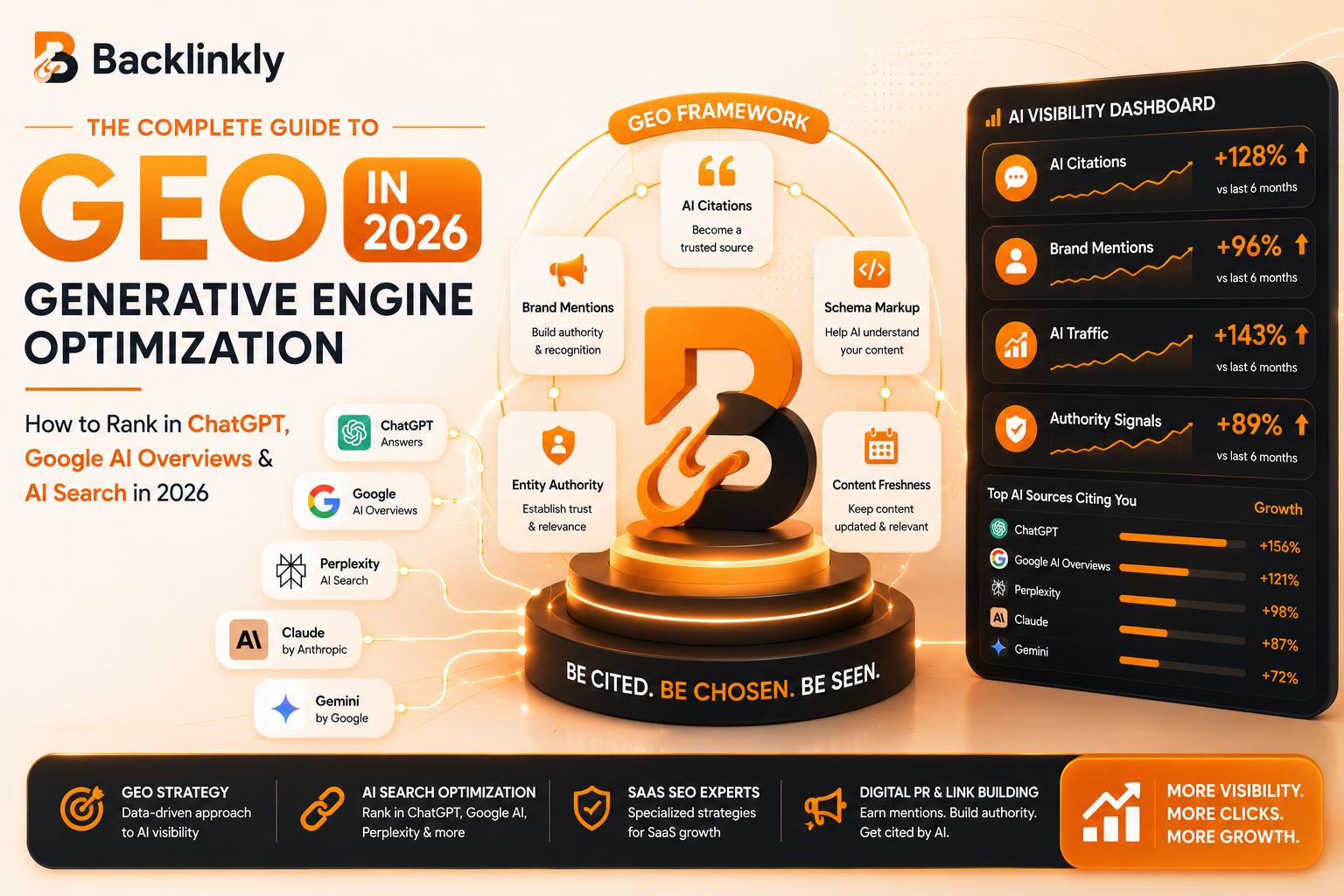
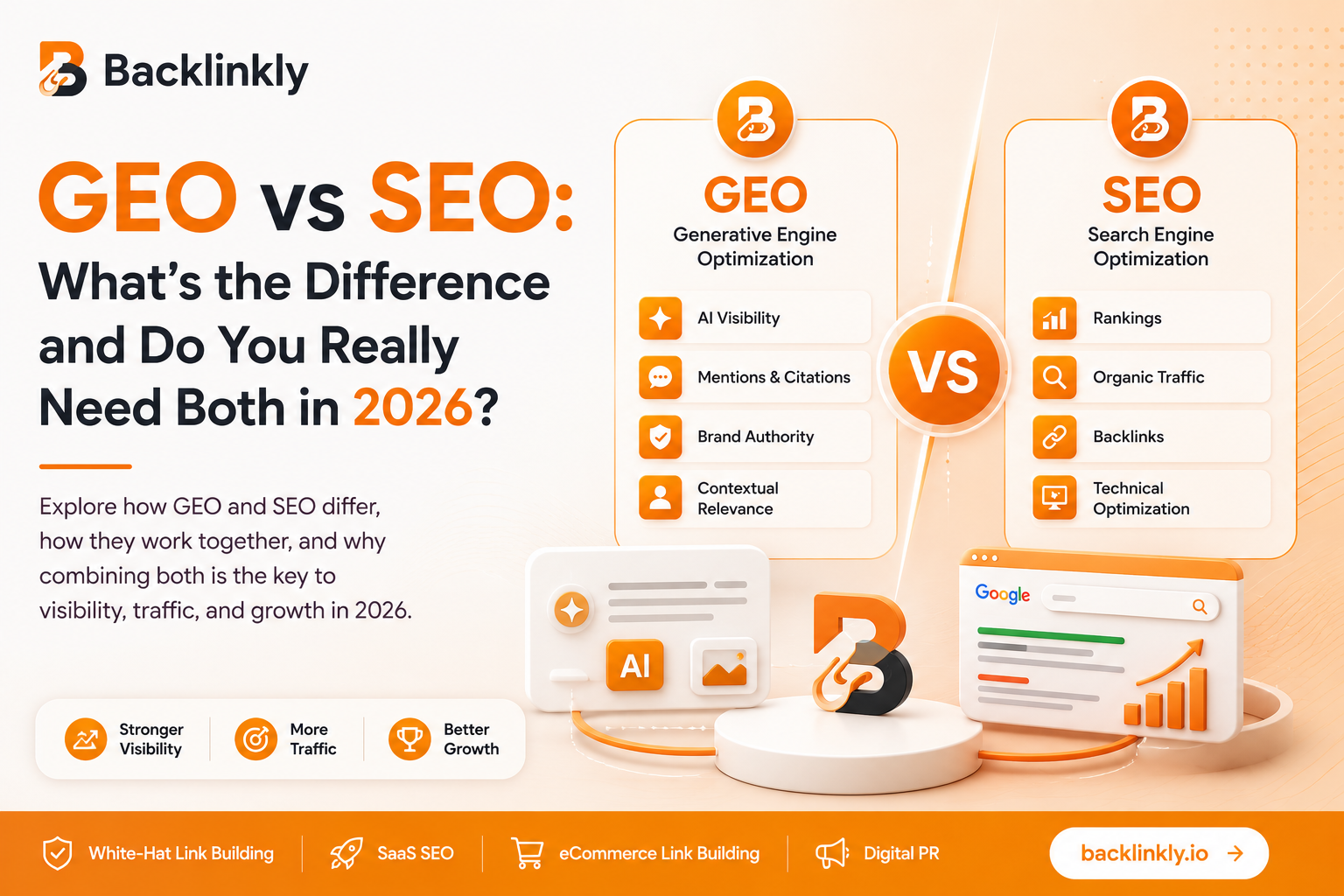
Generative Engine Optimization (GEO) is the practice of structuring your content so AI systems like ChatGPT, Google AI Overviews, and Perplexity choose to cite you. Traditional SEO gets you ranked. GEO gets you cited. In 2026, you need both. This guide breaks down what GEO is, how it differs from SEO, and the exact tactics that earn you a spot inside AI-generated answers. Ready to start? Contact our team.
Search changed. You may not have noticed the exact moment it happened, but it did.
In 2026, Generative Engine Optimization (GEO) is no longer a niche topic discussed in academic papers. It’s a business necessity. ChatGPT Search crossed 400 million weekly users in early 2026. Google AI Mode and AI Overviews now appear on more than half of all queries. Perplexity has become the default research tool for millions of professionals. And if your brand isn’t showing up inside those AI-generated answers, you’re invisible right when buyers are making decisions.
This guide explains exactly what GEO is, why it matters, and how to do it. No hype. No theory. Just the tactics that actually work in 2026, backed by data.
What Is Generative Engine Optimization (GEO)?
Generative Engine Optimization is the practice of structuring your content so that AI-powered answer engines choose to extract, trust, and cite it in their responses. Instead of optimizing to rank in a list of links, you’re optimizing to become a source inside a synthesized answer.
The key difference is what these engines measure. Traditional search engines evaluate backlinks, click-through rates, and keyword relevance. AI engines evaluate whether your content is clear enough, trustworthy enough, and structured enough to be safely cited. A page can rank number three on Google and still get ignored by ChatGPT if the writing buries the answer or lacks credibility signals.
GEO targets systems like ChatGPT, Google AI Overviews, Perplexity, Gemini, and Claude. And by 2026, the U.S. GEO market alone is projected to reach $365.4 million, growing at a 42.9% compound annual rate. This is a real discipline with real business impact.
Why Does GEO Matter Right Now?
If you’re still measuring success purely by Google rankings, you’re measuring a shrinking pie.
GEO and SEO are not competitors. GEO is the next layer on top of a strong SEO foundation. Without solid SEO, GEO doesn’t work. With solid SEO and no GEO, you’re leaving visibility on the table.
Here’s where they differ in practice:
What they optimize for. SEO optimizes for position in a results page. GEO optimizes for citation inside a synthesized answer. You can rank number one on Google and still be missing from every AI-generated response on that topic.
The good news.87% of ChatGPT citations correspond to Bing top results, meaning strong SEO already feeds your GEO performance. If you rank well in traditional search, you’re already in the pool of sources AI pulls from. GEO is about optimizing your content within that pool so AI systems choose to cite you rather than pass you over.
The best link building strategy in 2026 serves double duty: it builds traditional authority and improves your chances of being cited by AI systems that use those same authority signals as a starting filter.
What Are the Core GEO Techniques That Actually Work?
The Princeton GEO research identified nine optimization methods. Three produced the strongest results. Understanding these gives you a clear starting point.
Statistics Addition (+32% visibility lift). Include real data points, percentages, and numbers. AI systems prefer content that makes claims with evidence. Don’t say “a lot of people use AI search.” Say “over one-third of US adults used generative AI at least once in 2025.” Specific and citable beats vague and forgettable.
Source Citations (+30% visibility lift). Link out to original research, government data, and respected publications. AI systems evaluate whether your content is citing the same trusted sources they’re trained on. A page that cites Gartner, Princeton, and Ahrefs signals credibility differently than one that cites nothing.
Quotation Addition (+41% visibility lift). Including expert quotes and direct citations makes content more citable itself. AI systems, when synthesizing answers, prefer sources that demonstrate they’ve consulted multiple authorities.
Pair these with strong on-page SEO fundamentals and you’re building the kind of content that earns visibility in both traditional search and AI-generated responses.
Does Schema Markup Still Matter for GEO?
Schema markup is not optional for AI visibility in 2026. It’s the technical layer that determines whether AI systems can understand and safely cite your content.
The five schema types that move the needle most for GEO in 2026:
FAQPage schema. Maps your content directly to the question-answer format AI engines extract. Keep answers between 40 and 60 words for optimal extraction. This is the single highest-impact schema type for AI citation.
Article or BlogPosting schema with a named author. Strengthens content authority signals and helps AI systems identify who the credible human source behind the content is.
Organization schema with sameAs links. Establishes entity validation across knowledge graphs. AI systems cross-reference your brand against what they already know about you.
HowTo schema. Structures step-by-step instructions in a format AI can easily process.
Person schema. If your team members are published or cited externally, this ties their authority to your domain.
Technical SEO and schema implementation aren’t just for traditional search anymore. They’re the infrastructure layer that determines whether AI systems can even understand your content well enough to cite it.
What Role Do Brand Mentions and Backlinks Play in GEO?
Here’s the underlying reason. AI systems are trained on vast amounts of web data. When your brand appears consistently across trusted publications, industry forums, Reddit threads, YouTube interviews, and editorial coverage, the model develops a positive association with your brand before it even encounters your website. Brand-owned content carries a credibility discount because AI systems recognize self-interest. Third-party editorial coverage carries a credibility boost.
This is where guest posting and editorial link building serve a dual function in 2026. Every high-quality editorial placement you earn is both a traditional backlink and a brand mention signal that AI systems use to evaluate your credibility. The two channels reinforce each other. Build authority the right way and it compounds across both SEO and GEO simultaneously.
Manual prompt testing. Run your top 20 target queries weekly in ChatGPT, Perplexity, and Google AI Overviews. Log which pages get cited. Note when competitors appear instead of you. This is the most direct way to see whether your content is being extracted.
High impressions, low CTR in Google Search Console. This pattern often signals that your content is appearing inside an AI Overview, giving you impressions without clicks. Track queries where impressions are rising but CTR has dropped. That’s your GEO visibility showing up in the data.
Dedicated AI tracking tools. Platforms like Profound, Otterly.ai, and AthenaHQ offer automated AI mention tracking across multiple platforms. Ahrefs and Moz are rolling out AI visibility tracking through 2026 as well.
If you’re just starting, manual prompt testing costs nothing and tells you immediately where you stand. Build a simple spreadsheet, test the same prompts every two weeks, and track the trend.
The GEO Action Plan: Where to Start This Week
You don’t need to overhaul your entire content library. You need to start with the pages that matter most and apply the highest-impact changes first.
Week 1: Audit your top five service or pillar pages. Does each one open with a 40 to 60 word direct answer? Does it include at least three external source links? Is there FAQ schema deployed? Fix these on your highest-priority pages first.
Week 2: Check your bot access. Make sure GPTBot, ClaudeBot, PerplexityBot, and BingBot are not blocked in your robots.txt. If AI crawlers can’t access your content, none of the rest matters.
Week 3: Run your first manual prompt test. Search for your five most important keywords inside ChatGPT, Perplexity, and Google AI Overviews. Document who’s being cited. That’s your competitive baseline.
And don’t start from scratch. If you already have strong traditional SEO in place, your niche edit placements and existing backlink profile are already feeding your GEO foundation. Build on what you have.
Conclusion
GEO isn’t replacing SEO. It’s the next layer on top of it. The brands winning in AI search in 2026 are the ones that built strong traditional authority first, then layered in the content structure, schema, and earned media signals that make AI systems confident enough to cite them.
The three things to remember: write answers first (not introductions), structure your pages so machines can extract them, and earn your credibility off your own site as well as on it.
The first-mover window is still open. Most brands haven’t started. Start now and you compound that advantage every week.
Ready to build an AI-visible content and link strategy that works in 2026 and beyond? Contact the Backlinkly team and let’s talk about what’s possible for your brand.
Frequently Asked Questions
What is Generative Engine Optimization (GEO)?
Generative Engine Optimization is the practice of structuring content so AI-powered platforms like ChatGPT, Google AI Overviews, and Perplexity choose to cite it in their generated answers. It differs from traditional SEO in that the goal is citation inside a synthesized answer, not a ranking position in a list of links. Research from Princeton, Georgia Tech, and IIT Delhi formalized GEO as a discipline and found that the right techniques can boost content visibility in generative engines by 30 to 40%.
Does GEO replace SEO in 2026?
No. GEO works on top of SEO, not instead of it. AI engines retrieve content through search first. 87% of ChatGPT citations correspond to Bing top results, which means traditional ranking ability is still your entry ticket into the pool of sources AI pulls from. GEO determines whether you get cited once you’re in that pool. You need both.
How do I know if my content is appearing in AI-generated answers?
The simplest method is manual prompt testing: run your target queries weekly inside ChatGPT, Perplexity, and Google AI Overviews, and log which pages get cited. In Google Search Console, look for queries with rising impressions but falling CTR, as this often signals your content is appearing inside an AI Overview without generating a click. For automated tracking, platforms like Profound and Otterly.ai monitor AI mentions across multiple engines. Only 14% of marketers currently measure AI search performance, so even basic tracking gives you a competitive edge.
GEO (Generative Engine Optimization) means optimizing your content to get cited inside AI-generated answers from tools like ChatGPT, Perplexity, and Google AI Overviews. SEO means optimizing to rank in traditional search results. In 2026, you need both. SEO still drives the majority of web traffic, but AI search is growing fast and the clicks it sends convert at significantly higher rates. This post breaks down the real differences and shows you exactly where to focus.
You spent months building your Google rankings. Traffic is coming in. Then one day you notice something odd: your page is still ranking on page one, but the clicks are way down.
This is the SEO problem nobody warned you about. You can rank number one and still get almost no traffic.
That’s exactly why Generative Engine Optimization, GEO, is now a real part of the conversation. But does it replace SEO? Do you need to start over? And what does this actually mean for a SaaS or e-commerce brand trying to grow?
Let’s break it all down, clearly and without hype.
What Is GEO and How Is It Different From SEO?
GEO, or Generative Engine Optimization, is the practice of optimizing your content so that AI-powered tools like ChatGPT, Google AI Overviews, and Perplexity cite you directly inside their answers. Instead of ranking on a results page, you show up inside the answer itself.
How GEO compares to traditional SEO, Traditional SEO earns you a position on a search results page and hopes the user clicks through. GEO earns you a position inside the answer. When someone asks ChatGPT “what’s the best link building agency for SaaS brands,” GEO is what puts your brand in that response rather than a competitor’s.
The two disciplines target different surfaces, reward different content formats, and measure success in completely different ways. Here’s the clearest way to see the difference:
SEO
GEO
Target
Google/Bing search results pages
AI-generated answers (ChatGPT, Perplexity, AI Overviews)
Brand mentions, AI citations, share of voice in AI answers
User behavior
User chooses from a list of results
AI chooses for the user
One important thing: GEO builds on SEO fundamentals. You still need quality content, strong technical SEO, and credible backlinks. GEO doesn’t replace those. It adds a new layer on top of them.
Backlinks still matter.High-quality backlinks from authoritative sites build the domain credibility that AI systems use to decide whose content to trust and cite. This is a direct overlap between classic SEO and GEO signals.
The real shift isn’t that SEO is dying. It’s that SEO alone is no longer enough to capture all the visibility that’s available.
Twenty-three times. That’s not a rounding error. That’s a completely different category of lead quality.
When someone gets your brand name from an AI answer, they’ve already been pre-qualified. The AI explained why you’re a credible option. The user arrives on your site with context, intent, and a reason to trust you. It’s a warm referral, not a cold click.
Beyond conversion quality, the sheer scale of AI search can’t be ignored:
If your brand isn’t showing up in AI answers, you’re invisible to a growing share of your most valuable buyers.
What Does It Actually Take to Rank in AI Answers?
Ranking in AI answers requires a specific type of content that most SEO guides haven’t taught yet. The good news: it’s not as complicated as it sounds, and it reinforces good SEO habits.
Here’s what AI systems reward:
Direct, structured answers. AI engines extract clean answers. If your content buries the key point in paragraph seven, the AI skips it. Structure your content so the most important answer appears within the first two to three sentences of each section. Research from AirOps found that comparison pages with three or more tables earn 25.7% more AI citations, and pages with frequent list sections earn up to 26.9% more citations.
Factual depth with cited sources. AI systems gravitate toward content that includes original data, statistics, and verifiable claims. Vague opinion pieces don’t get cited. Fact-rich, well-sourced content does. This is exactly why on-page SEO practices like proper content structure and E-E-A-T signals matter more now than ever.
Authority signals across platforms.AI systems synthesize from search indexes, social feeds, knowledge graphs, and forums. A brand that only exists on its own website has a much smaller footprint than one with consistent mentions on relevant industry sites, forums, and directories. This is where guest posting and strategic link building do double duty: they build your Google authority and expand the surface area where AI can discover and validate your brand.
GEO vs SEO: Which Should You Prioritize Right Now?
Neither. You should run both in parallel, but with different effort levels depending on your current situation.
Here’s a practical framework based on where you are:
If you have little to no SEO in place: Start with SEO first. Without solid rankings, quality backlinks, and technical health, you won’t have the authority signals that GEO requires. Fix your foundation before building the second floor.
If your SEO is solid: Start layering in GEO tactics. Audit your most important pages. Are they structured to answer questions directly? Do they include original data and credible citations? Are you building brand mentions across authoritative platforms, not just links?
If you’re in a B2B or SaaS business: GEO should be an urgent priority. 94% of B2B buyers used generative AI during their purchase process. Your buyers are already asking AI tools about your category. The question is whether they’re hearing your name or a competitor’s.
One practical starting point: search for your category in ChatGPT and Perplexity right now. Ask “what are the best [your service category] providers?” See who gets cited. If it’s not you, that’s your GEO gap.
What Metrics Actually Matter When You Add GEO to Your Strategy?
Most SEO dashboards aren’t built for GEO. You need to track a different set of signals alongside your traditional metrics.
For SEO: Keep tracking keyword rankings, organic traffic, domain rating, and conversion rate from organic sessions. These haven’t become irrelevant. They’ve just become incomplete.
For GEO: Start tracking brand mentions in AI answers, share of voice in AI tools for your key queries, and the quality of AI-referred traffic when it does come through. AI-referred traffic converts 31% better than non-AI traffic, so even a small amount of it is worth measuring carefully.
The honest challenge: GEO is harder to measure than SEO. Zero-click AI answers generate no referral sessions, which means a lot of the brand awareness GEO creates is invisible in your analytics. The influence happens before any trackable click.
This is exactly why combining a strong SEO foundation with white-hat link building and GEO-optimized content is the most defensible strategy. You’re building visibility across every surface where your buyers might encounter you.
Conclusion
GEO and SEO aren’t competing strategies. They’re different layers of the same visibility problem.
SEO still drives the bulk of web traffic and remains your highest-intent channel for conversions. GEO captures the growing portion of buyer research that now happens inside AI tools before anyone opens a search engine. Ignore either one, and you’re leaving visibility on the table.
The brands winning in 2026 aren’t choosing between Google and ChatGPT. They’re optimizing for both by building genuine authority, well-structured content, and credible backlinks that signal trust across every platform that matters.
If you’re not sure where your site stands, start with a free SEO and link audit from Backlinkly. We’ll show you exactly where your technical health, on-page structure, and backlink profile stand, and what it would take to become the brand AI engines cite in your category. Get your free audit here.
What types of content perform best in AI search answers?
Structured, fact-rich content performs best in AI answers. Comparison pages with multiple tables earn 25.7% more citations, pages with organized list sections earn up to 26.9% more, and shorter, clearer sentences improve citation rates by up to 18.8%. Direct answers placed near the top of each section give AI systems a clean extraction point. Original data and cited statistics also increase the likelihood of being referenced.
How do I know if my brand is showing up in AI answers?
The simplest way is to manually search for your category and key questions inside ChatGPT, Perplexity, and Google AI Overviews. Ask questions like “best [your service] for [your target customer]” and see which brands get mentioned. For ongoing monitoring, tools like SE Ranking and Semrush are building AI visibility tracking features that show when and how your brand appears in AI-generated responses.
Does link building help with GEO?
Yes, link building directly supports GEO. AI systems assess brand credibility using many of the same authority signals that Google uses, including backlinks from high-quality, relevant sources. A strong backlink profile expands your brand’s footprint across authoritative platforms, which makes it more likely that AI engines discover, trust, and cite your content. Link building and GEO strategy reinforce each other.
How long does it take to see results from GEO?
GEO results are harder to measure than SEO and tend to be less linear. Building AI citation visibility depends on content quality, authority signals, and how frequently AI engines re-index your content. Some brands see their first AI mentions within weeks of publishing well-structured, authoritative content. Broad, consistent GEO presence typically builds over three to six months, similar in timeline to early SEO traction. The key is starting now, since earlier movers compound their advantage over time.
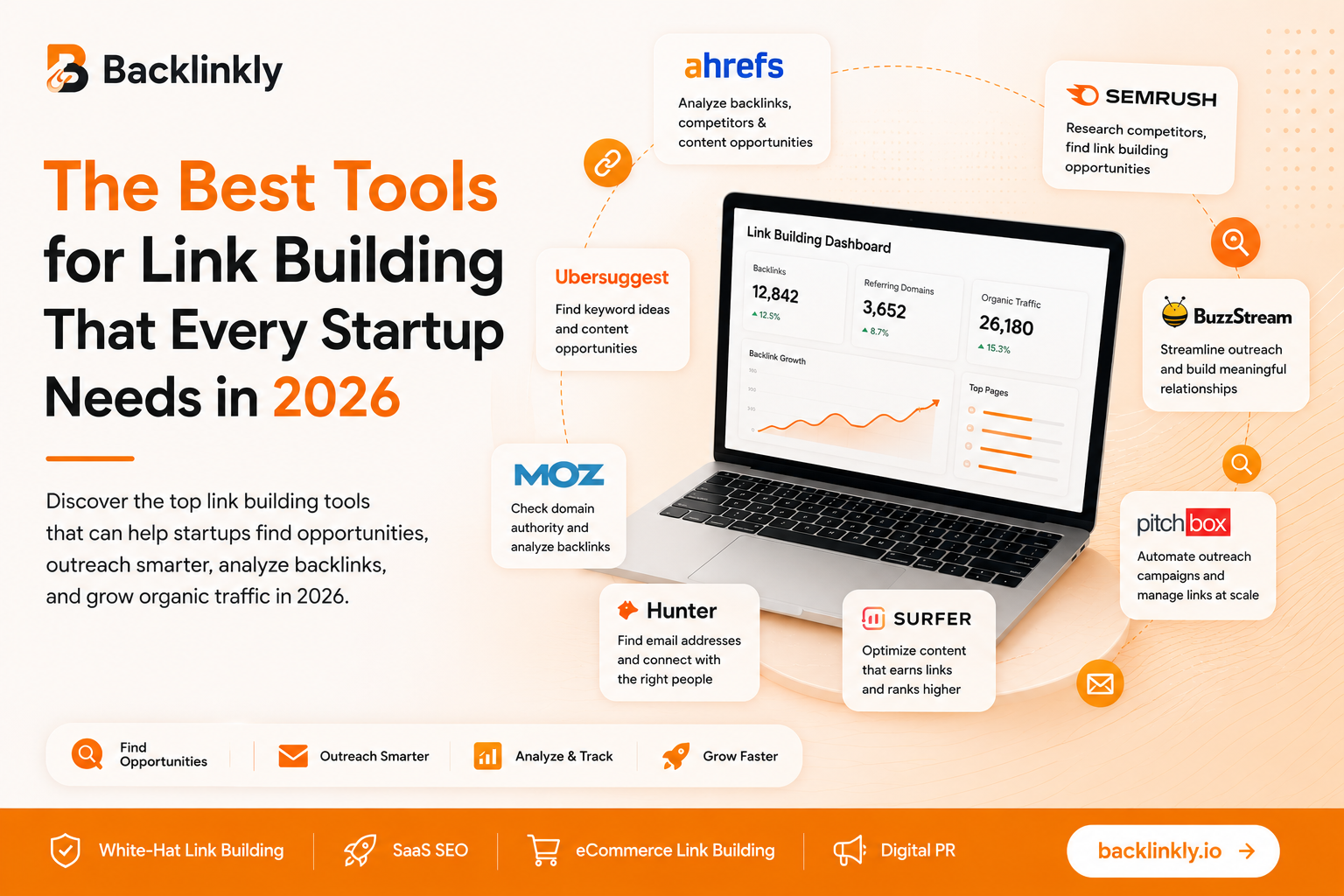
Link building is one of the highest-ROI activities in SEO, but only if you use the right tools. This post breaks down the best tools for startups looking to earn quality backlinks without burning their budget. From competitor research to outreach automation, you’ll find out exactly which tools to use, when to use them, and how to build a lean, effective link-building stack that scales.
Most startups pour money into ads and content, then wonder why their site stays buried on page four. The real problem? They’re skipping link building. And the ones who do try it often waste weeks doing it manually.
Tools for link building have changed how fast-growing companies compete online. The right stack lets a two-person team punch well above their weight. The wrong one wastes both time and money.
Here’s the truth: 94.3% of all web pages receive zero traffic from Google because they have no external backlinks. If your startup’s pages fall into that bucket, no amount of great content will save you. This guide walks you through the tools you actually need, what each one does, and how to build a lean stack that fits your stage and budget.
Why Do Startups Struggle With Link Building?
Startups don’t fail at link building because they lack ideas. They fail because they try to do it the same way enterprise teams do, without the headcount or budget to back it up.
The good news? The right tools for startups cut that time down dramatically. They handle the grunt work so your team can focus on the outreach that actually closes links.
What Are Link Building Tools, and Why Do They Matter?
Link building tools are SEO software platforms that help you find websites willing to link to yours, analyze competitor backlinks, manage outreach campaigns, and monitor your link profile over time.
Without them, you’re flying blind. You’d have no reliable way to know which sites are worth pursuing, whether a domain has toxic spam signals, or if a backlink you earned last month quietly disappeared. For startups, these tools aren’t optional extras. They’re the foundation of any scalable SEO strategy.
Which Tools for Startups Work Best at the Research Stage?
The best link building research tools for startups are Ahrefs and Semrush. Both give you deep insight into competitor backlink profiles, help you find link gaps, and surface high-authority domains you can actually pitch to.
Semrush is a strong alternative with a built-in outreach module, making it a convenient option if you want research and prospecting in one place. Its backlink database is large and well-maintained, with regular updates that catch new links fast.
For startups on a tight budget, Google Search Console is free and shows your existing backlink data. It won’t replace a paid tool, but it’s a smart starting point while you’re getting traction.
Want to know which domains are worth targeting once you’ve found them? Pair your research tool with Moz or Majestic. These platforms give you domain authority scores and trust metrics that tell you whether a site’s link is actually worth pursuing. Majestic’s Trust Flow metric is particularly useful for filtering out low-quality prospects early.
How Do You Find Contact Information for Link Outreach?
Finding the right email address is often the step that stalls startup link-building campaigns completely. Cold outreach to generic inboxes rarely gets replies. You need to reach the actual person who manages the site or blog.
Hunter.io is the most popular email finder in the space. Over 2.5 million marketers rely on Hunter.io for verified email outreach. You drop in a domain, and it pulls verified contact information automatically. It has a generous free tier that works well for early-stage startups.
Skrapp is another solid option, particularly if your prospects are B2B companies. It pulls verified contacts directly from LinkedIn profiles and company domains, saving you the time of manual research. For agencies or startups running large outreach campaigns, Skrapp’s bulk finder is a major time-saver.
What’s the Best Outreach Tool for a Lean Startup Team?
The best outreach tool for lean startup teams is Pitchbox. It combines prospecting, personalized email sequencing, follow-up automation, and pipeline tracking into a single platform, so you don’t need to juggle five different tools.
That said, Pitchbox is priced for agencies and larger teams. If your budget is tighter, Respona is an excellent alternative. It merges AI outreach with SEO analytics and helps you find journalists and high-authority blogs automatically. Respona users see up to 38% higher reply rates using AI-optimized email content, which is a significant edge when you’re doing everything manually.
One thing every startup should know: personalization drives results more than volume. Marketers who sent 1,000 templated emails saw response rates of just 1 to 2%. Those who built genuine relationships with 50 high-quality prospects saw success rates climb to 25 to 30%. Your tool choice should support quality over quantity.
For startups exploring media coverage as a link-building channel, Featured.com (the modern evolution of HARO) lets you respond to journalist queries and earn editorial backlinks from high-authority publications. It’s free and well worth using alongside your outreach stack.
How Should Startups Monitor Their Backlinks?
Backlink monitoring isn’t something to set up “later.” Links disappear, sites get penalized, and toxic backlinks can quietly drag down your domain’s authority if you’re not watching.
Ahrefs and Semrush both include backlink monitoring, so if you’re already using either for research, you likely don’t need a separate tool. Set up alerts for new backlinks acquired, lost backlinks, and competitor link gains.
For startups on a lean budget, Linkody is a free-to-start backlink tracker that provides real-time link status updates, disavow management, and clean reporting dashboards. Over 20,000 small businesses use Linkody for daily backlink tracking, making it one of the most widely adopted monitoring tools for early-stage companies.
You can also explore Backlinkly’s link monitoring features if you want a platform built specifically around link quality and acquisition workflows for growing brands.
Which Link Building Strategies Work Best With These Tools in 2026?
The tools you use are only as good as the strategies behind them. In 2026, the strategies driving the strongest results are digital PR, link insertions, guest posting, and broken link building.
Link insertions (also called niche edits) are preferred by roughly 9.4% of practitioners for their speed. You pitch your URL as a natural addition to an already-indexed, ranking page. This means the link’s host page already has authority, which passes through to you immediately.
For startups building domain authority from scratch, pairing these strategies with the right link building tools for startups is the fastest path to sustainable organic growth.
Building Your Startup Link Building Stack
You don’t need 10 tools to run a solid link-building operation. Most startups are better off with a lean, focused stack that covers the four core stages without overlap.
Here’s a proven starting setup:
Research: Ahrefs (or Semrush if you want outreach built in) Contact finding: Hunter.io for most sites, Skrapp for B2B LinkedIn prospects Outreach: Respona for AI-assisted personalization, or Pitchbox at scale Monitoring: Ahrefs alerts, or Linkody for budget-conscious tracking Media pitching: Featured.com for journalist queries
As your team and budget grow, you can layer in Moz or Majestic for deeper authority scoring, and Screaming Frog for technical audits that surface broken link opportunities.
The key is starting with what you can actually execute. A focused two-tool stack used consistently will outperform an expensive suite that nobody has time to manage.
If you’re ready to stop guessing and start building links that move rankings, reach out to the Backlinkly team to talk through the right strategy for your startup.
What are the best free link building tools for startups?
The best free options for startups are Google Search Console (for monitoring existing backlinks), Hunter.io’s free tier (for email finding), and Featured.com (for media outreach). These three cover the core stages of a link-building workflow without any upfront cost. As your campaigns scale, a paid research tool like Ahrefs becomes essential.
How many backlinks does a startup need to rank on Google?
How long does it take to see results from link building?
Most startups begin to see measurable ranking improvements within three to six months of a consistent link-building campaign. B2B SaaS companies report an average SEO ROI of 702% with a break-even period as short as seven months. The timeline depends on your domain’s current authority, the quality of links you’re acquiring, and the competitiveness of your target keywords.
Is it worth paying for link building tools when you’re just starting out?
Yes, if you’re serious about organic growth. Manual link building without tools takes 10 to 15 hours per acquired link. A tool like Ahrefs or Respona can cut that dramatically, making the subscription cost worthwhile even for early-stage teams. Start with a single research tool and add outreach automation once you’ve validated your targeting approach.
What’s the difference between Ahrefs and Semrush for link building?
Both are excellent, but they serve slightly different workflows. Ahrefs is the most accurate backlink data provider according to 68.1% of SEO professionals and is the stronger choice for pure link research. Semrush has a broader feature set that includes a built-in outreach module, making it more convenient if you want research and campaign management in one platform. Many startups start with one and add the other as their operation matures.
Can link building tools help with AI search visibility?
What link building strategy gives the highest ROI for startups?
Digital PR consistently delivers the strongest return. Brands using digital PR and earned media report an average ROI of 312%, and it’s rated the most effective tactic by nearly half of SEO professionals surveyed. For startups with limited budgets, pairing a digital PR approach with link insertion outreach (for speed) and guest posting (for brand authority) creates a well-rounded strategy that scales efficiently.