
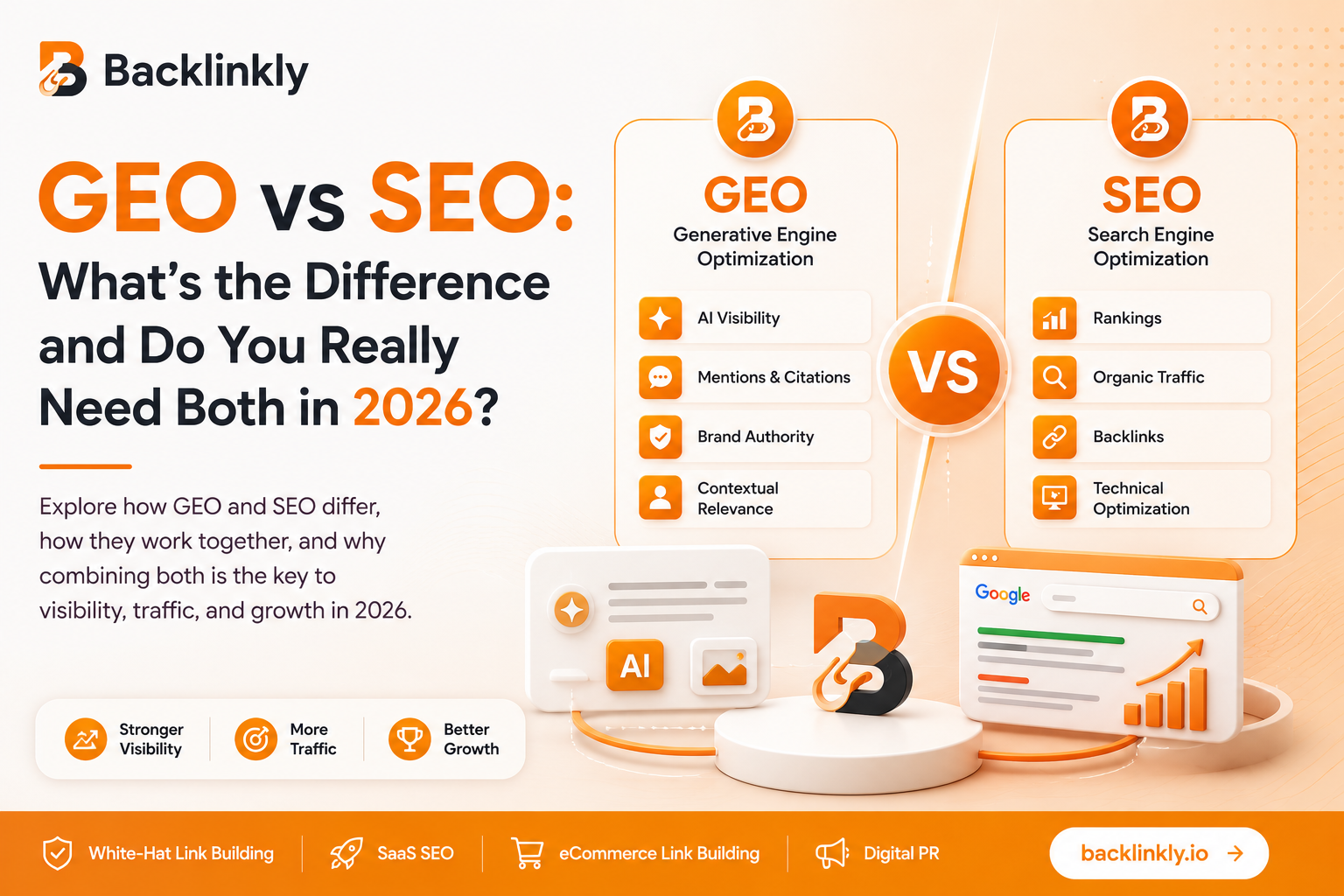
GEO (Generative Engine Optimization) means optimizing your content to get cited inside AI-generated answers from tools like ChatGPT, Perplexity, and Google AI Overviews. SEO means optimizing to rank in traditional search results. In 2026, you need both. SEO still drives the majority of web traffic, but AI search is growing fast and the clicks it sends convert at significantly higher rates. This post breaks down the real differences and shows you exactly where to focus.
You spent months building your Google rankings. Traffic is coming in. Then one day you notice something odd: your page is still ranking on page one, but the clicks are way down.
You’re not imagining it. Organic CTR dropped 61% on queries where Google AI Overviews appear, falling from 1.76% to just 0.61%. Meanwhile, 93% of searches done inside Google AI Mode end without a single click to any external website.
This is the SEO problem nobody warned you about. You can rank number one and still get almost no traffic.
That’s exactly why Generative Engine Optimization, GEO, is now a real part of the conversation. But does it replace SEO? Do you need to start over? And what does this actually mean for a SaaS or e-commerce brand trying to grow?
Let’s break it all down, clearly and without hype.
What Is GEO and How Is It Different From SEO?
GEO, or Generative Engine Optimization, is the practice of optimizing your content so that AI-powered tools like ChatGPT, Google AI Overviews, and Perplexity cite you directly inside their answers. Instead of ranking on a results page, you show up inside the answer itself.
How GEO compares to traditional SEO, Traditional SEO earns you a position on a search results page and hopes the user clicks through. GEO earns you a position inside the answer. When someone asks ChatGPT “what’s the best link building agency for SaaS brands,” GEO is what puts your brand in that response rather than a competitor’s.
The two disciplines target different surfaces, reward different content formats, and measure success in completely different ways. Here’s the clearest way to see the difference:
| SEO | GEO | |
|---|---|---|
| Target | Google/Bing search results pages | AI-generated answers (ChatGPT, Perplexity, AI Overviews) |
| Goal | Earn a ranking and a click | Get cited inside the AI’s response |
| What it rewards | Backlinks, keywords, technical health | Authority signals, structured answers, factual depth |
| Measured by | Rankings, organic traffic, CTR | Brand mentions, AI citations, share of voice in AI answers |
| User behavior | User chooses from a list of results | AI chooses for the user |
One important thing: GEO builds on SEO fundamentals. You still need quality content, strong technical SEO, and credible backlinks. GEO doesn’t replace those. It adds a new layer on top of them.
Is Traditional SEO Still Worth It in 2026?
Yes. Traditional SEO is still absolutely worth investing in, and the data proves it. Google sends roughly 345 times more traffic to websites than ChatGPT, Gemini, and Perplexity combined. Organic search still accounts for around 53% of all website traffic across every industry.
The brands panicking and abandoning SEO entirely are making a serious mistake. Here’s why:
Transactional searches still go through Google. When someone is ready to buy, they mostly use Google. 93.7% of ChatGPT searches are informational, and only 0.1% are transactional. If you sell something, Google is still your highest-intent traffic source.
AI Overviews pull from top-ranking pages. 76.1% of URLs cited in AI Overviews also rank in the top 10 of Google search results. Your SEO work is a direct input into your GEO visibility. The two aren’t separate. They’re stacked.
Backlinks still matter. High-quality backlinks from authoritative sites build the domain credibility that AI systems use to decide whose content to trust and cite. This is a direct overlap between classic SEO and GEO signals.
The real shift isn’t that SEO is dying. It’s that SEO alone is no longer enough to capture all the visibility that’s available.
Why GEO Matters More Than Most People Realize
Here’s the stat that should stop you mid-scroll: AI-referred traffic converts at 23 times the rate of regular organic search visitors.
Twenty-three times. That’s not a rounding error. That’s a completely different category of lead quality.
When someone gets your brand name from an AI answer, they’ve already been pre-qualified. The AI explained why you’re a credible option. The user arrives on your site with context, intent, and a reason to trust you. It’s a warm referral, not a cold click.
Beyond conversion quality, the sheer scale of AI search can’t be ignored:
- 2 billion monthly users now engage with Google AI Overviews across 200+ countries
- ChatGPT reached 900 million weekly active users in February 2026, up from 400 million just one year earlier
- 44% of AI-powered search users say AI is now their primary source of information, ahead of traditional search at 31%
- 94% of B2B buyers used generative AI during their purchase process in 2025
If your brand isn’t showing up in AI answers, you’re invisible to a growing share of your most valuable buyers.
What Does It Actually Take to Rank in AI Answers?
Ranking in AI answers requires a specific type of content that most SEO guides haven’t taught yet. The good news: it’s not as complicated as it sounds, and it reinforces good SEO habits.
Here’s what AI systems reward:
Direct, structured answers. AI engines extract clean answers. If your content buries the key point in paragraph seven, the AI skips it. Structure your content so the most important answer appears within the first two to three sentences of each section. Research from AirOps found that comparison pages with three or more tables earn 25.7% more AI citations, and pages with frequent list sections earn up to 26.9% more citations.
Factual depth with cited sources. AI systems gravitate toward content that includes original data, statistics, and verifiable claims. Vague opinion pieces don’t get cited. Fact-rich, well-sourced content does. This is exactly why on-page SEO practices like proper content structure and E-E-A-T signals matter more now than ever.
Authority signals across platforms. AI systems synthesize from search indexes, social feeds, knowledge graphs, and forums. A brand that only exists on its own website has a much smaller footprint than one with consistent mentions on relevant industry sites, forums, and directories. This is where guest posting and strategic link building do double duty: they build your Google authority and expand the surface area where AI can discover and validate your brand.
Shorter sentences where it counts. Shortlist pages averaging 10 words or fewer per sentence earn 18.8% more citations in AI answers. Clear, tight writing performs better in AI than dense editorial prose.
GEO vs SEO: Which Should You Prioritize Right Now?
Neither. You should run both in parallel, but with different effort levels depending on your current situation.
Here’s a practical framework based on where you are:
If you have little to no SEO in place: Start with SEO first. Without solid rankings, quality backlinks, and technical health, you won’t have the authority signals that GEO requires. Fix your foundation before building the second floor.
If your SEO is solid: Start layering in GEO tactics. Audit your most important pages. Are they structured to answer questions directly? Do they include original data and credible citations? Are you building brand mentions across authoritative platforms, not just links?
If you’re in a B2B or SaaS business: GEO should be an urgent priority. 94% of B2B buyers used generative AI during their purchase process. Your buyers are already asking AI tools about your category. The question is whether they’re hearing your name or a competitor’s.
One practical starting point: search for your category in ChatGPT and Perplexity right now. Ask “what are the best [your service category] providers?” See who gets cited. If it’s not you, that’s your GEO gap.
What Metrics Actually Matter When You Add GEO to Your Strategy?
Most SEO dashboards aren’t built for GEO. You need to track a different set of signals alongside your traditional metrics.
For SEO: Keep tracking keyword rankings, organic traffic, domain rating, and conversion rate from organic sessions. These haven’t become irrelevant. They’ve just become incomplete.
For GEO: Start tracking brand mentions in AI answers, share of voice in AI tools for your key queries, and the quality of AI-referred traffic when it does come through. AI-referred traffic converts 31% better than non-AI traffic, so even a small amount of it is worth measuring carefully.
The honest challenge: GEO is harder to measure than SEO. Zero-click AI answers generate no referral sessions, which means a lot of the brand awareness GEO creates is invisible in your analytics. The influence happens before any trackable click.
This is exactly why combining a strong SEO foundation with white-hat link building and GEO-optimized content is the most defensible strategy. You’re building visibility across every surface where your buyers might encounter you.
Conclusion
GEO and SEO aren’t competing strategies. They’re different layers of the same visibility problem.
SEO still drives the bulk of web traffic and remains your highest-intent channel for conversions. GEO captures the growing portion of buyer research that now happens inside AI tools before anyone opens a search engine. Ignore either one, and you’re leaving visibility on the table.
The brands winning in 2026 aren’t choosing between Google and ChatGPT. They’re optimizing for both by building genuine authority, well-structured content, and credible backlinks that signal trust across every platform that matters.
If you’re not sure where your site stands, start with a free SEO and link audit from Backlinkly. We’ll show you exactly where your technical health, on-page structure, and backlink profile stand, and what it would take to become the brand AI engines cite in your category. Get your free audit here.
Frequently Asked Questions
Is GEO replacing SEO?
No, GEO is not replacing SEO. GEO adds a new optimization layer on top of SEO fundamentals. Traditional search rankings still drive the majority of web traffic. Google sends roughly 345 times more traffic than AI tools combined, and 76.1% of URLs cited in AI Overviews rank in Google’s top 10. Strong SEO is still a prerequisite for strong GEO performance.
What types of content perform best in AI search answers?
Structured, fact-rich content performs best in AI answers. Comparison pages with multiple tables earn 25.7% more citations, pages with organized list sections earn up to 26.9% more, and shorter, clearer sentences improve citation rates by up to 18.8%. Direct answers placed near the top of each section give AI systems a clean extraction point. Original data and cited statistics also increase the likelihood of being referenced.
How do I know if my brand is showing up in AI answers?
The simplest way is to manually search for your category and key questions inside ChatGPT, Perplexity, and Google AI Overviews. Ask questions like “best [your service] for [your target customer]” and see which brands get mentioned. For ongoing monitoring, tools like SE Ranking and Semrush are building AI visibility tracking features that show when and how your brand appears in AI-generated responses.
Does link building help with GEO?
Yes, link building directly supports GEO. AI systems assess brand credibility using many of the same authority signals that Google uses, including backlinks from high-quality, relevant sources. A strong backlink profile expands your brand’s footprint across authoritative platforms, which makes it more likely that AI engines discover, trust, and cite your content. Link building and GEO strategy reinforce each other.
How long does it take to see results from GEO?
GEO results are harder to measure than SEO and tend to be less linear. Building AI citation visibility depends on content quality, authority signals, and how frequently AI engines re-index your content. Some brands see their first AI mentions within weeks of publishing well-structured, authoritative content. Broad, consistent GEO presence typically builds over three to six months, similar in timeline to early SEO traction. The key is starting now, since earlier movers compound their advantage over time.
- The Complete Guide to Generative Engine Optimization (GEO)
- How a SaaS Brand Grew AI Citations by 291% and Organic Traffic by 54.8% with GEO
