
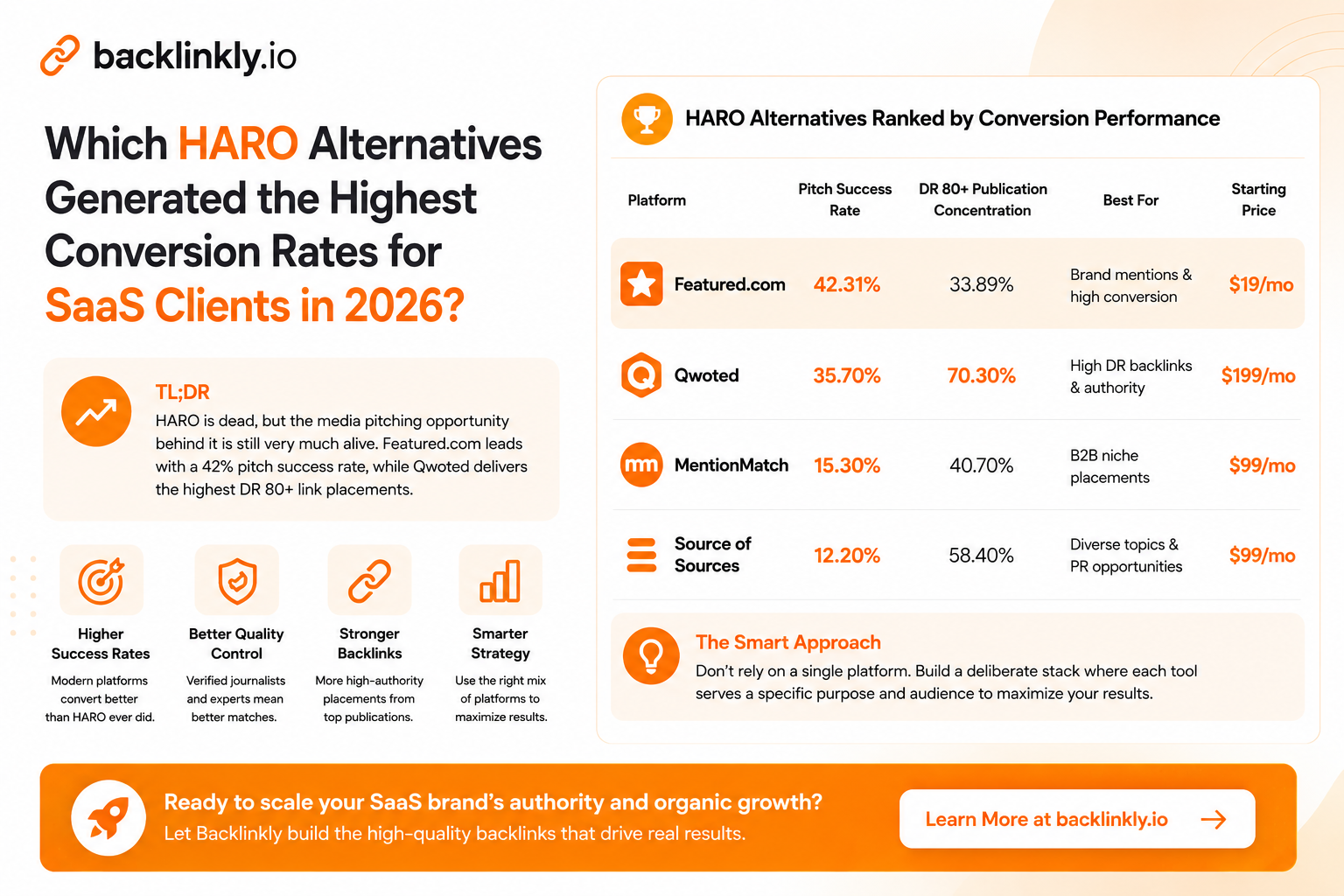
HARO is dead, but the media pitching opportunity behind it is still very much alive. In 2026, platforms like Featured.com, Qwoted, MentionMatch, and Source of Sources are producing real editorial placements for SaaS brands. Featured tops the list with a 42% pitch success rate. The smartest move isn’t picking one platform and hoping for the best. It’s building a deliberate stack where each tool does a specific job. Dig into the breakdown below, then reach out to us when you’re ready to scale it.
December 2024 was a rough month for a lot of SaaS marketers. That’s when Cision officially pulled the plug on HARO, and anyone who had built media pitching into their link-building workflow suddenly had a gap they didn’t know how to fill.
The panic was understandable but misplaced.
What HARO actually did, at its core, was put expert sources in front of journalists who needed them. That need didn’t vanish when the platform did. Journalists still write articles. They still need quotes from people who know what they’re talking about. The infrastructure just shifted. And honestly? What it shifted into is more useful for SaaS brands than HARO ever was.
The real problem now isn’t a lack of options. It’s that there are several platforms competing for attention, and not all of them perform equally well for SaaS specifically. SEO leads convert at 14.6% compared to 1.7% for outbound channels. The organic traffic that feeds those leads comes from the authority that editorial backlinks build. Picking the wrong platforms wastes time and leaves that authority on the table.
This post cuts through the noise. Here’s what’s actually converting for SaaS clients in 2026.
Why HARO Collapsed and Why the Replacement Era Is Better
HARO didn’t die overnight. The platform spent years slowly drowning in its own success. As it grew, the quality of responses sent to journalists collapsed. By the time AI tools became widespread, reporters were receiving hundreds of generic, nearly identical pitches for every single query they posted. Most of them stopped trusting the platform entirely.
Featured.com stepped in and acquired the HARO brand from Cision in April 2025, relaunching it as a free daily newsletter. But the more interesting development isn’t that rebrand. It’s the broader ecosystem that emerged around the same time. Source of Sources came out of the gate with Peter Shankman, HARO’s original founder, running things. Qwoted introduced verification requirements that neither side, journalist or source, could skip. MentionMatch (rebranded from Help a B2B Writer) went narrow on purpose, serving only B2B niches and refusing to become another catch-all inbox.
What that fragmentation created is actually a feature, not a bug. Each platform now pulls in a different type of journalist covering different topics at different publication tiers. Instead of one noisy firehose, you have several well-targeted streams. For SaaS companies with a defined audience and a specific set of topics they want to be associated with, that’s a much better environment to pitch into.
The challenge is that each stream has different conversion dynamics. Understanding which one moves the needle for your goals changes everything about how you allocate time.
Featured.com: The Platform With the Highest Raw Conversion Rate
Let’s start with the numbers, because they’re the most compelling argument for why Featured belongs in every SaaS team’s stack. Featured.com achieves a 42.31% pitch success rate, higher than any other current platform in this space. That’s not a small advantage. Most people grinding through traditional media pitching would be thrilled with a 10% success rate.
The model is different from what most people imagine when they think about journalist outreach. You don’t email reporters directly. Instead, Featured’s team fields questions from publishers at outlets like Fortune, Fast Company, and Yahoo, then invites relevant experts from their database to respond. You submit a short answer, typically four to five sentences, and the best responses get woven into published articles. There’s no long pitch letter. No back-and-forth with a journalist’s inbox. Just a tight, focused answer to a specific question.
That simplicity is why the conversion rate is so high. Paid plans start at $19 per month on the Lite tier with unlimited responses at $49 per month on Pro. The platform also shows you which pitches got selected and when they go live, so you can actually study what’s working and refine your approach rather than just sending into a void.
The one honest caveat: not every Featured placement comes with a dofollow backlink. Some placements are brand mentions without a link, or nofollow links depending on the publication. If your specific goal is raw domain authority growth through dofollow link acquisition, you’ll want to pair Featured with a platform that has stronger link mechanics. But for SaaS companies trying to build brand recognition in their category and get mentioned alongside other credible voices in their space, Featured delivers faster than anything else on this list.
Qwoted: Where the DR 80+ Links Actually Come From
If Featured wins on conversion rate, Qwoted wins on link quality. The two metrics point to different platform strengths, and a smart stack uses both.
Qwoted hosts the highest concentration of DR 80+ publications of any media pitching platform, sitting at 70.3%. For context, a DR 80 backlink from a single well-placed article can do more for a SaaS site’s ranking trajectory than a dozen links from mid-tier sources. These are the links that move the needle on competitive keywords. These are the placements that show up in your Ahrefs profile and make prospects trust your brand before they ever read your homepage.
The reason Qwoted consistently produces this caliber of placement comes down to one design decision: verification. Both journalists and sources go through a screening process before they get full access to the platform. That friction deliberately discourages the low-effort, spray-and-pray behavior that turned HARO into a spam problem. Journalists who use Qwoted do so precisely because they trust the quality of what lands in their inbox. That trust translates directly into higher response rates when your pitch is genuinely good.
The free tier exists but it’s limited to two pitches per month with a two-hour delay on new queries. That delay matters more than it sounds. The best queries fill up quickly, and the sources who reach journalists first get read when attention is freshest. The Pro plan at $99 per month removes the delay entirely, lifts pitch limits, and adds Pitch Intelligence, which flags which active queries have less competition at the moment. For SaaS companies in tech, finance, healthcare, or cybersecurity, this is the tool that earns the links that compound.
MentionMatch: The Conversion Sweet Spot for B2B SaaS Specifically
There’s a case to be made that MentionMatch is the single highest-ROI item in the SaaS pitching stack, not because it has the highest success rate or the best link quality in isolation, but because it combines both with zero cost and near-perfect audience relevance.
The platform, rebranded from Help a B2B Writer, covers a deliberately narrow set of industries: SaaS, marketing, sales, SEO, content marketing, analytics, design, AI, and ecommerce. Every single query that lands in your inbox is relevant to your space. You don’t wade through requests from food bloggers, health journalists, or travel writers. You get B2B tech writers asking for expert input on topics your team knows inside out.
Regular users of MentionMatch have earned placements in HubSpot, Semrush, and other high-authority B2B publications. Those aren’t random wins. They’re consistent with what the platform was designed to produce, because HubSpot and Semrush writers are exactly the people using MentionMatch to find expert sources for their articles. Your content reaches the outlets your buyers already read and trust.
The platform also actively filters out AI-generated responses, which does two things simultaneously. It keeps query volume lower than noisier platforms, and it makes each query more competitive on quality rather than quantity. When fewer pitches are coming in and the ones that do arrive are human and specific, journalists actually engage with them. That’s a different dynamic than most platforms, and it shows in conversion outcomes.
It costs nothing. Add it to your stack first, before spending a single dollar on paid tools.
Source of Sources: Still the Best Option for Pure Dofollow Volume
Not every team needs the highest possible DR on every link. Some SaaS companies are in an earlier stage where building a solid base of dofollow links from credible sources matters more than landing one Forbes placement. For that goal, Source of Sources belongs in the rotation.
SOS carries the highest dofollow link rate of any pitching platform at 36.26%. If raw link-building mechanics are your frame of reference, that number is significant. Dofollow links pass authority. More of them, from more domains, builds the kind of backlink profile that helps content rank across a wider set of keywords over time.
The founder angle also matters. Peter Shankman built HARO from nothing into the dominant journalist-source platform in digital PR. He knows what works. Source of Sources runs on the same three-times-daily email format that HARO users spent years building habits around, with more editorial discipline applied to the query and response process.
The tradeoff is honest: SOS is free and accessible, so it draws more pitchers per query than platforms with restricted access. The competition-to-opportunity ratio is higher. Winning placements through SOS consistently requires speed, relevance, and pitches that demonstrate obvious firsthand knowledge rather than pulled-from-the-internet generalities. Teams that can deliver on those requirements will find SOS earns its place as the high-volume dofollow layer of a broader stack.
How to Build a Stack That Actually Converts for SaaS
Picking one platform and hoping it covers everything is how SaaS teams stay stuck at a handful of links per quarter. The teams producing consistent editorial placements run a tiered stack where each platform serves a distinct role. The logic isn’t complicated once you map each tool to a specific goal.
Start with MentionMatch and Source of Sources. Both are free. MentionMatch gives you B2B-specific, low-competition queries where a well-written pitch has a real shot at a placement in a publication your customers read. SOS gives you dofollow volume at scale, assuming you’re pitching selectively on queries where you have genuine expertise. Running these two together costs nothing and builds a rhythm of consistent outreach without a budget line.
Add Featured once you have the pitching habit down. The $49 per month Pro plan is the right tier for most SaaS teams. You’ll know it’s working when you start seeing brand mentions in outlets you’d previously have needed a PR agency to access. For guest posting efforts, the brand recognition Featured builds makes your outreach significantly warmer. Journalists and editors who have already seen your name in credible roundups respond differently to cold pitches.
Layer Qwoted in for high-value authority targets. When you identify a keyword cluster that’s genuinely competitive and you need DR 80+ links to push into the top three positions, Qwoted is the tool you use to go after them. Respond within 48 hours of a query appearing, because that response window closes fast and first-mover advantage is real on this platform.
The whole stack integrates naturally with your broader link building strategy. Guest posts and niche edits build authority to your core pages. Editorial placements from media pitching build brand recognition and referral traffic. The two channels reinforce each other. Every editorial mention makes your content more discoverable. More discoverability means more journalists finding your expertise organically. More journalists finding your expertise leads to more placements. That’s the compounding dynamic that separates brands with strong organic presence from the ones stuck paying for every click.
One thing worth saying directly: the SaaS teams getting the highest conversion rates from these platforms in 2026 aren’t the ones with the biggest pitch volume. They’re the ones pitching with actual, specific, experience-backed answers. Journalists now wade through hundreds of AI-generated responses to every query they post. A pitch that contains a specific number, a named client outcome, or a counterintuitive observation stands out immediately. That bar is genuinely low right now. Take advantage of it.
What Conversion Numbers Should SaaS Teams Actually Track?
Understanding what success looks like from this channel matters, because the metrics that feel intuitive aren’t always the ones that tell you whether the investment is working.
Average B2B SaaS visitor-to-lead conversion rates sit at 1.5 to 2.5%, while top performers reach 8 to 15%. Referral traffic arriving from a Forbes or HubSpot citation lands in a fundamentally different headspace than someone who clicked a generic search result. They’ve just read something credible that mentioned your brand. The trust transfer happens before they visit your site. That’s why editorial link traffic consistently converts above the average.
High-quality backlinks can lift SEO ROI by up to 500% over 12 months. For SaaS specifically, where organic acquisition can come in at roughly $120 per customer versus $800 through paid channels, the math compounds quickly. The placement you earn today keeps sending traffic for two or three years. Paid ads stop the moment your budget does.
The metrics worth watching are: domain rating of the linking page, whether the link lands on a product or feature page versus a blog post, referral traffic volume from the placement over the first 30 days, and whether that referral traffic converts at a better rate than your organic baseline. If your referral conversion rate from editorial links consistently outperforms organic search traffic, you have confirmation that the audience quality is there and scaling the effort is worth it.
Our SEO hub maps link acquisition to ranking and conversion outcomes so you’re not just counting placements. And our on-page SEO work makes sure the pages your links are pointing to are built to actually capture the intent of the visitors who arrive.
Conclusion
HARO shut down and a better ecosystem quietly took its place. Featured converts at 42%. Qwoted reaches DR 80+ publications more consistently than any other platform. MentionMatch puts B2B SaaS brands in front of the exact journalists covering their space. Source of Sources delivers the highest dofollow rate in the whole field, for free.
None of that matters if you’re still treating this as a “try one platform and see what happens” exercise. The SaaS teams getting results in 2026 run a deliberate stack, pitch from genuine expertise, and point their links at pages that are actually set up to convert.
That’s the whole picture.
If you want a link-building strategy built around your SaaS specifically, one that combines editorial placements with high-DR guest posts and niche edits, get in touch with the Backlinkly team. We’ll show you exactly what a compounding organic growth strategy looks like for your site.
- Link Building Agency: How to Pick One That Actually Grows Your Rankings in 2026
- The Best Tools for Link Building That Every Startup Needs in 2026
