
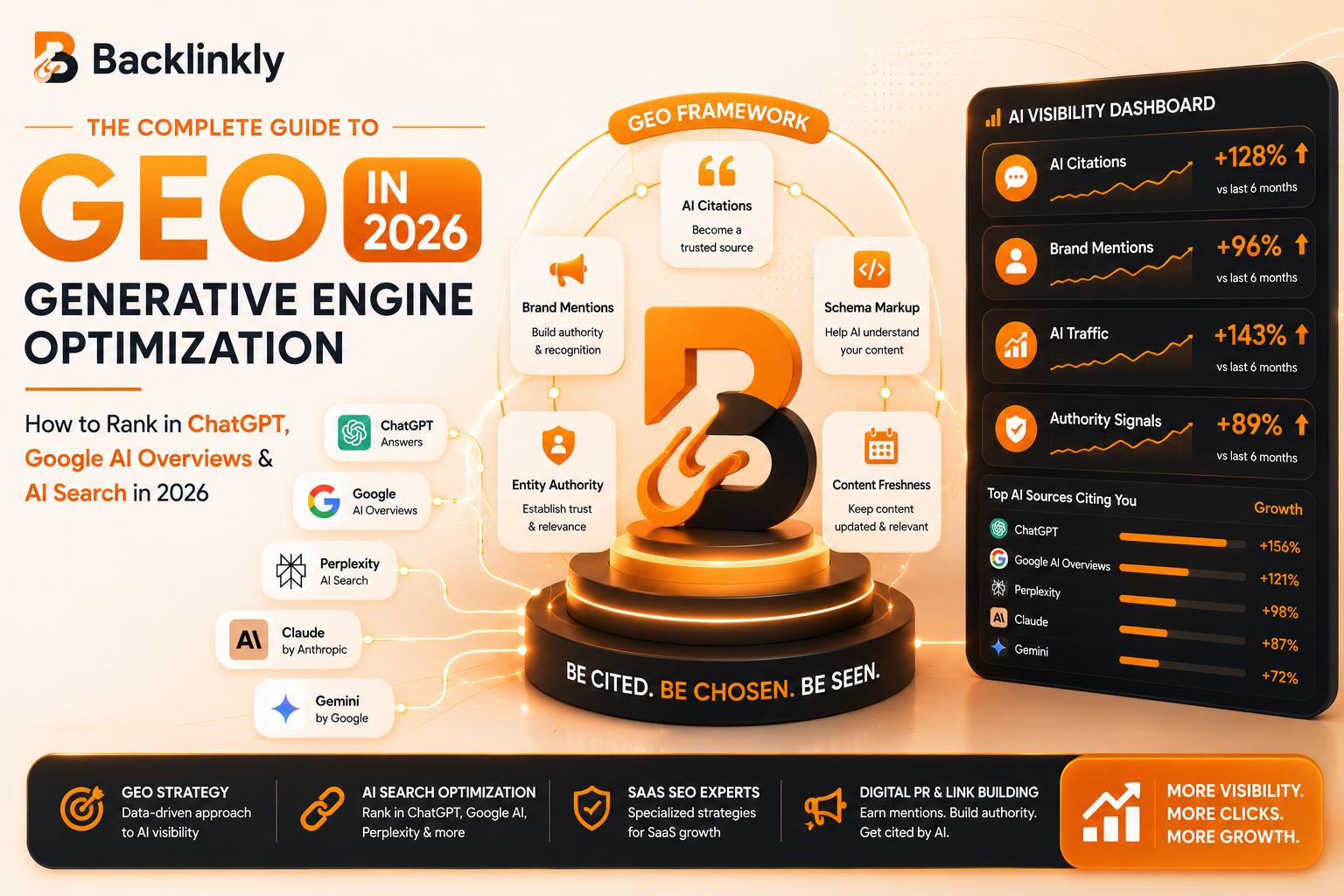
Generative Engine Optimization (GEO) is the practice of structuring your content so AI systems like ChatGPT, Google AI Overviews, and Perplexity choose to cite you. Traditional SEO gets you ranked. GEO gets you cited. In 2026, you need both. This guide breaks down what GEO is, how it differs from SEO, and the exact tactics that earn you a spot inside AI-generated answers. Ready to start? Contact our team.
Search changed. You may not have noticed the exact moment it happened, but it did.
In 2026, Generative Engine Optimization (GEO) is no longer a niche topic discussed in academic papers. It’s a business necessity. ChatGPT Search crossed 400 million weekly users in early 2026. Google AI Mode and AI Overviews now appear on more than half of all queries. Perplexity has become the default research tool for millions of professionals. And if your brand isn’t showing up inside those AI-generated answers, you’re invisible right when buyers are making decisions.
This guide explains exactly what GEO is, why it matters, and how to do it. No hype. No theory. Just the tactics that actually work in 2026, backed by data.
What Is Generative Engine Optimization (GEO)?
Generative Engine Optimization is the practice of structuring your content so that AI-powered answer engines choose to extract, trust, and cite it in their responses. Instead of optimizing to rank in a list of links, you’re optimizing to become a source inside a synthesized answer.
The term was formalized by researchers at Princeton, Georgia Tech, and IIT Delhi in their 2024 peer-reviewed study published at KDD, which tested GEO strategies across 10,000 queries in 25 domains. They found that the right optimization techniques can boost content visibility in generative engines by 30 to 40%. That’s not a small number.
The key difference is what these engines measure. Traditional search engines evaluate backlinks, click-through rates, and keyword relevance. AI engines evaluate whether your content is clear enough, trustworthy enough, and structured enough to be safely cited. A page can rank number three on Google and still get ignored by ChatGPT if the writing buries the answer or lacks credibility signals.
GEO targets systems like ChatGPT, Google AI Overviews, Perplexity, Gemini, and Claude. And by 2026, the U.S. GEO market alone is projected to reach $365.4 million, growing at a 42.9% compound annual rate. This is a real discipline with real business impact.
Why Does GEO Matter Right Now?
If you’re still measuring success purely by Google rankings, you’re measuring a shrinking pie.
Gartner predicts traditional search engine volume will drop 25% by 2026, with a 50% reduction in traditional organic traffic expected by 2028. Zero-click searches on Google grew from 56% to 69% in a single year after AI Overviews rolled out. And 82% of AI citations come from earned media, not owned content or paid placements. That last point is critical and we’ll come back to it.
The opportunity, though, is just as significant as the threat. Brands cited inside AI answers earn roughly 120% more organic clicks per impression than uncited competitors on the same query. And AI traffic converts at 4.4 to 23 times the rate of standard organic, because the user has already done their research inside the AI interface and arrived at your site with intent. The volume is smaller, but the quality is dramatically higher.
The window to build a GEO advantage is still open, but not for long. Only 14% of marketers actually measure AI search performance in 2026, even though 43% claim to be optimizing for it. That gap is your competitive edge right now.
How Is GEO Different From SEO?
GEO and SEO are not competitors. GEO is the next layer on top of a strong SEO foundation. Without solid SEO, GEO doesn’t work. With solid SEO and no GEO, you’re leaving visibility on the table.
Here’s where they differ in practice:
What they optimize for. SEO optimizes for position in a results page. GEO optimizes for citation inside a synthesized answer. You can rank number one on Google and still be missing from every AI-generated response on that topic.
What signals matter. Traditional SEO relies heavily on backlinks as proof of authority. GEO shifts weight toward content clarity, structured formatting, and topical alignment. Brand mentions correlate more strongly with AI visibility than backlinks alone.
Where citations come from. Only 6.82% of ChatGPT results appear in Google’s top 10, and 83% of AI Overview citations come from outside the organic top 10. These are separate visibility channels with significant overlap in fundamentals but different optimization requirements.
The good news. 87% of ChatGPT citations correspond to Bing top results, meaning strong SEO already feeds your GEO performance. If you rank well in traditional search, you’re already in the pool of sources AI pulls from. GEO is about optimizing your content within that pool so AI systems choose to cite you rather than pass you over.
The best link building strategy in 2026 serves double duty: it builds traditional authority and improves your chances of being cited by AI systems that use those same authority signals as a starting filter.
What Are the Core GEO Techniques That Actually Work?
The Princeton GEO research identified nine optimization methods. Three produced the strongest results. Understanding these gives you a clear starting point.
Statistics Addition (+32% visibility lift). Include real data points, percentages, and numbers. AI systems prefer content that makes claims with evidence. Don’t say “a lot of people use AI search.” Say “over one-third of US adults used generative AI at least once in 2025.” Specific and citable beats vague and forgettable.
Source Citations (+30% visibility lift). Link out to original research, government data, and respected publications. AI systems evaluate whether your content is citing the same trusted sources they’re trained on. A page that cites Gartner, Princeton, and Ahrefs signals credibility differently than one that cites nothing.
Quotation Addition (+41% visibility lift). Including expert quotes and direct citations makes content more citable itself. AI systems, when synthesizing answers, prefer sources that demonstrate they’ve consulted multiple authorities.
Answer-first structure. Placing a concise, self-contained answer in the opening paragraph can improve citation likelihood by up to 115%. Write as if the first paragraph could be copy-pasted directly into a ChatGPT answer. Lead with the answer, then expand.
Content freshness. Perplexity demotes stale content aggressively. 85% of AI Overview citations come from content published within the last two years, and recently updated content appears 4.3 times more often in AI answers. If a key page hasn’t been updated in 12 months, it’s working against you.
Pair these with strong on-page SEO fundamentals and you’re building the kind of content that earns visibility in both traditional search and AI-generated responses.
Does Schema Markup Still Matter for GEO?
Schema markup is not optional for AI visibility in 2026. It’s the technical layer that determines whether AI systems can understand and safely cite your content.
AI engines don’t read your website the way a human does. They receive raw text and try to extract meaning. Schema markup gives them an explicit framework: “this is an organization,” “this is a question and answer,” “this is a step-by-step guide.” Without it, your content is harder to parse, and harder to cite confidently.
The numbers here are significant. Content with proper schema markup has a 2.5 times higher chance of appearing in AI-generated answers. Pages with FAQPage markup are 3.2 times more likely to appear in Google AI Overviews. FAQPage schema improves AI citation rates by 30% on average.
The five schema types that move the needle most for GEO in 2026:
FAQPage schema. Maps your content directly to the question-answer format AI engines extract. Keep answers between 40 and 60 words for optimal extraction. This is the single highest-impact schema type for AI citation.
Article or BlogPosting schema with a named author. Strengthens content authority signals and helps AI systems identify who the credible human source behind the content is.
Organization schema with sameAs links. Establishes entity validation across knowledge graphs. AI systems cross-reference your brand against what they already know about you.
HowTo schema. Structures step-by-step instructions in a format AI can easily process.
Person schema. If your team members are published or cited externally, this ties their authority to your domain.
Technical SEO and schema implementation aren’t just for traditional search anymore. They’re the infrastructure layer that determines whether AI systems can even understand your content well enough to cite it.
What Role Do Brand Mentions and Backlinks Play in GEO?
Brand mentions are the off-page signal that matters most for AI visibility. And Ahrefs analyzed 75,000 brands and found brand mentions correlate 3 times more strongly with AI visibility than backlinks alone (correlation of 0.664 vs. 0.218). That’s a significant shift from how traditional SEO weights these signals.
Here’s the underlying reason. AI systems are trained on vast amounts of web data. When your brand appears consistently across trusted publications, industry forums, Reddit threads, YouTube interviews, and editorial coverage, the model develops a positive association with your brand before it even encounters your website. Brand-owned content carries a credibility discount because AI systems recognize self-interest. Third-party editorial coverage carries a credibility boost.
Distributing content through third-party news outlets increased AI citation rates by 325% in one controlled study. That’s not incremental. That’s structural.
This is where guest posting and editorial link building serve a dual function in 2026. Every high-quality editorial placement you earn is both a traditional backlink and a brand mention signal that AI systems use to evaluate your credibility. The two channels reinforce each other. Build authority the right way and it compounds across both SEO and GEO simultaneously.
Practically, this means getting active in the places AI systems pull from: 48% of AI citations come from community platforms like Reddit, YouTube, and LinkedIn. Publishing original data, contributing to expert roundups, and earning coverage in respected publications aren’t just PR tactics anymore. They’re GEO tactics.
How Do You Measure GEO Performance?
Measuring GEO is less straightforward than measuring traditional rankings, but it’s doable. And only 14% of marketers actually measure AI search performance, which means setting up even basic tracking gives you a data advantage.
Here’s what to track:
Manual prompt testing. Run your top 20 target queries weekly in ChatGPT, Perplexity, and Google AI Overviews. Log which pages get cited. Note when competitors appear instead of you. This is the most direct way to see whether your content is being extracted.
AI referral traffic in GA4. Filter referral traffic from chatgpt.com, perplexity.ai, and other AI sources. Conductor’s 2026 data shows AI referral traffic at 1.08% of all website traffic, with ChatGPT driving 87.4% of that. Tracking this separately from organic search lets you see GEO traction over time.
High impressions, low CTR in Google Search Console. This pattern often signals that your content is appearing inside an AI Overview, giving you impressions without clicks. Track queries where impressions are rising but CTR has dropped. That’s your GEO visibility showing up in the data.
Dedicated AI tracking tools. Platforms like Profound, Otterly.ai, and AthenaHQ offer automated AI mention tracking across multiple platforms. Ahrefs and Moz are rolling out AI visibility tracking through 2026 as well.
If you’re just starting, manual prompt testing costs nothing and tells you immediately where you stand. Build a simple spreadsheet, test the same prompts every two weeks, and track the trend.
The GEO Action Plan: Where to Start This Week
You don’t need to overhaul your entire content library. You need to start with the pages that matter most and apply the highest-impact changes first.
Week 1: Audit your top five service or pillar pages. Does each one open with a 40 to 60 word direct answer? Does it include at least three external source links? Is there FAQ schema deployed? Fix these on your highest-priority pages first.
Week 2: Check your bot access. Make sure GPTBot, ClaudeBot, PerplexityBot, and BingBot are not blocked in your robots.txt. If AI crawlers can’t access your content, none of the rest matters.
Week 3: Run your first manual prompt test. Search for your five most important keywords inside ChatGPT, Perplexity, and Google AI Overviews. Document who’s being cited. That’s your competitive baseline.
Ongoing: Publish original data. Commission a survey, run an experiment, or document a client result you can share. Original statistics with sources increase visibility in AI responses by up to 32%. Primary sources get cited more than secondary ones, every time.
And don’t start from scratch. If you already have strong traditional SEO in place, your niche edit placements and existing backlink profile are already feeding your GEO foundation. Build on what you have.
Conclusion
GEO isn’t replacing SEO. It’s the next layer on top of it. The brands winning in AI search in 2026 are the ones that built strong traditional authority first, then layered in the content structure, schema, and earned media signals that make AI systems confident enough to cite them.
The three things to remember: write answers first (not introductions), structure your pages so machines can extract them, and earn your credibility off your own site as well as on it.
The first-mover window is still open. Most brands haven’t started. Start now and you compound that advantage every week.
Ready to build an AI-visible content and link strategy that works in 2026 and beyond? Contact the Backlinkly team and let’s talk about what’s possible for your brand.
Frequently Asked Questions
-
What is Generative Engine Optimization (GEO)?
Generative Engine Optimization is the practice of structuring content so AI-powered platforms like ChatGPT, Google AI Overviews, and Perplexity choose to cite it in their generated answers. It differs from traditional SEO in that the goal is citation inside a synthesized answer, not a ranking position in a list of links. Research from Princeton, Georgia Tech, and IIT Delhi formalized GEO as a discipline and found that the right techniques can boost content visibility in generative engines by 30 to 40%.
-
Does GEO replace SEO in 2026?
No. GEO works on top of SEO, not instead of it. AI engines retrieve content through search first. 87% of ChatGPT citations correspond to Bing top results, which means traditional ranking ability is still your entry ticket into the pool of sources AI pulls from. GEO determines whether you get cited once you’re in that pool. You need both.
-
What content changes most improve GEO visibility?
The three highest-impact content changes are: opening every key page with a direct 40 to 60 word answer, adding real statistics with source links throughout the content, and implementing FAQPage schema so AI systems can extract your question-answer pairs directly. The Princeton GEO research found that adding statistics improves AI visibility by 32%, citing sources by 30%, and including expert quotations by 41%. These changes don’t require a full content rewrite. They can be added to existing pages.
-
Do backlinks still matter for GEO?
Yes, but brand mentions matter more. Ahrefs analyzed 75,000 brands and found brand web mentions correlate 3 times more strongly with AI visibility than backlinks alone. Backlinks remain essential for traditional rankings, which still feed AI retrieval. But for GEO specifically, editorial brand mentions in trusted publications, forums, and community platforms carry stronger citation signals than raw link count.
-
How do I know if my content is appearing in AI-generated answers?
The simplest method is manual prompt testing: run your target queries weekly inside ChatGPT, Perplexity, and Google AI Overviews, and log which pages get cited. In Google Search Console, look for queries with rising impressions but falling CTR, as this often signals your content is appearing inside an AI Overview without generating a click. For automated tracking, platforms like Profound and Otterly.ai monitor AI mentions across multiple engines. Only 14% of marketers currently measure AI search performance, so even basic tracking gives you a competitive edge.
- GEO vs SEO: What’s the Difference and Do You Really Need Both in 2026?
- How a SaaS Brand Grew AI Citations by 291% and Organic Traffic by 54.8% with GEO
