
Your client wants more backlinks. Your team doesn’t have the bandwidth, the publisher relationships, or honestly the patience to chase down another round of outreach replies. This is the exact fork in the road where most SEO agencies end up looking at white label link building — and where most of the guides they find are either thinly disguised “top 10 providers” rankings or vague explainers that never get to the part that actually matters: what this costs, how the handoff works day to day, and how you avoid putting your agency’s name behind work that gets your client penalized.
That’s what this guide is for. No provider ranking, no affiliate list. Just the mechanics, the real pricing, and a straight answer on how to vet a partner before you hand them your client relationship.
What White Label Link Building Actually Means
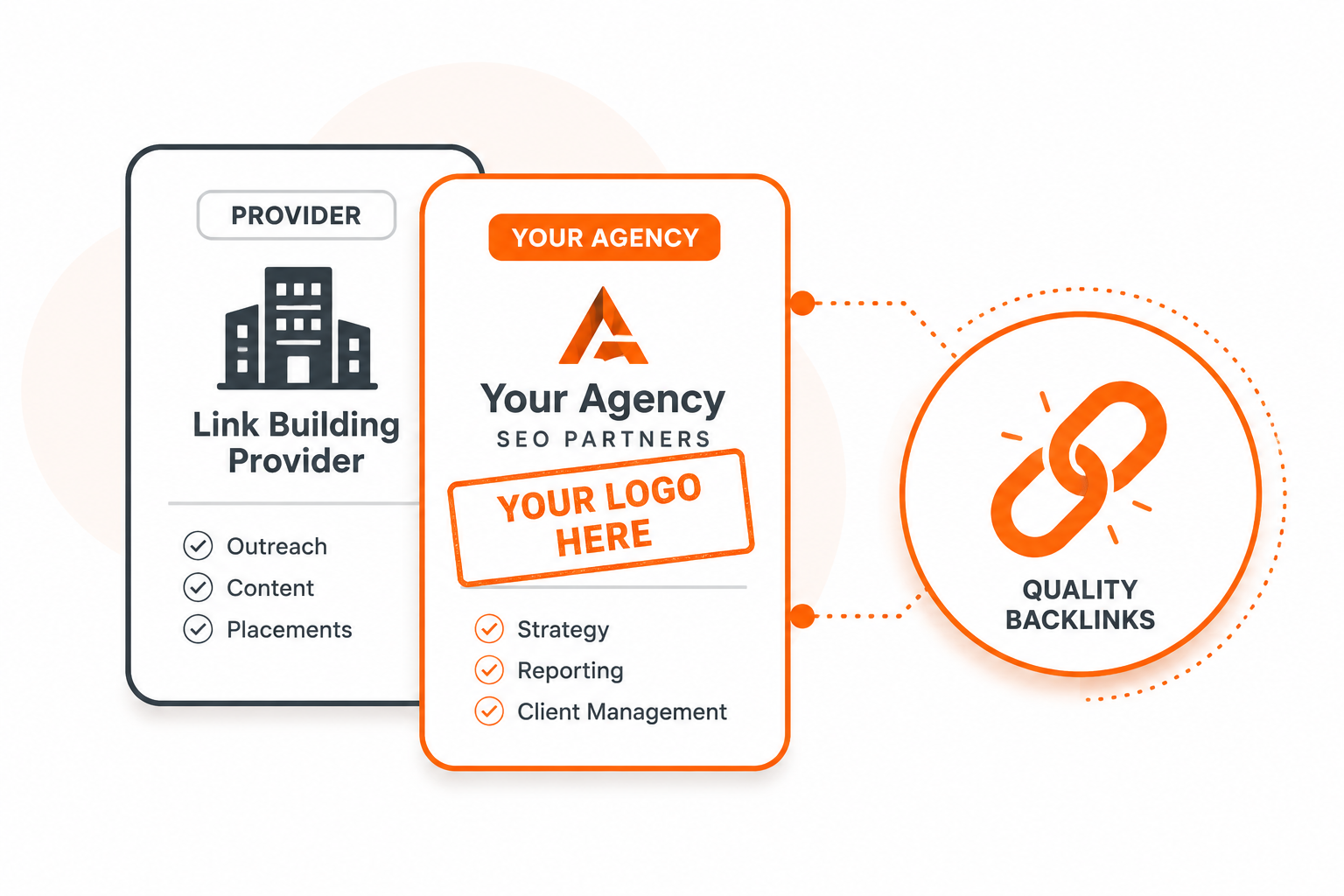
White label link building is a provider doing the outreach, content, and placement work for backlinks, then handing it to you unbranded so you can present it as your own agency’s deliverable. Your client never sees the provider’s name on an invoice, a report, or an email thread. You set the strategy, manage the client relationship, and mark up the price. The provider does the actual grunt work of finding sites, pitching editors, and getting links live.
It sounds simple because it is simple — this part of the model isn’t the hard part. The hard part is picking a provider whose definition of “quality link” matches yours, because you’re the one whose name is on the report when something goes wrong.
There’s also a hybrid version worth knowing about: some agencies keep target-URL selection and anchor strategy in-house and only outsource the outreach and placement legwork. That middle ground works well if you already have SEO strategists on staff but no one with active publisher relationships — you keep the strategic thinking close and rent the execution capacity.
Why Agencies Outsource This Instead of Hiring
The math usually settles it before the quality argument even comes up. Bringing on a single in-house link builder runs somewhere between $4,000 and $20,000 in onboarding and ramp-up costs before that person places a single link, plus a $50,000–$85,000 salary and a few hundred dollars a month in outreach tooling. And publisher relationships take real time to build from zero — you’re paying that full cost while your new hire is still cold-emailing editors who don’t know your agency exists yet.
Outsourcing flips that. You’re renting a provider’s existing publisher network and outreach infrastructure instead of building your own from scratch, which means the cost scales with volume instead of sitting on your books as fixed overhead whether you place five links that month or fifty.
There’s a capacity problem too, separate from the cost problem. A solid in-house outreach specialist tops out around 8-12 quality placements a month. If you’re running fifteen active client retainers that each expect meaningful monthly link volume, one person on your payroll simply can’t produce enough — you either hire a full team or you outsource the overflow.
Looking for a white-label partner instead of building this in-house? See Backlinkly’s Agency Partnership Program →
What White Label Link Building Actually Costs in 2026
Pricing varies more than most buyers expect, and the spread tells you something about quality tiers. Individual link placements generally run from roughly $180 to $700+ depending on the publisher’s authority and niche, with budget providers dipping under $100 a link — which is usually a red flag in itself, since a real editorial placement on a legitimate site costs the provider real time and relationship capital to secure. Below a certain price floor, something in the process is being cut: usually the site’s actual traffic and relevance, sometimes the legitimacy of the placement entirely.
Most agencies don’t buy one link at a time anyway. Retainers in the $2,000–$10,000/month range are the norm, because a recurring commitment gives the provider predictable pipeline to plan outreach around, and it reads to your client as an ongoing strategic investment rather than a one-off purchase they’ll question every month.
Whatever you pay the provider, your markup needs room to cover your account management time, reporting, and the risk you’re carrying by putting your name on someone else’s outreach. A common mistake agencies make early on is pricing white label links close to provider cost and then discovering the margin doesn’t cover the client calls and monthly reporting that come with reselling them.
How to Vet a Provider Before You Hand Them Your Client
This is the section that actually protects your agency, so don’t skip it because a provider’s website looks polished.
Ask to see real, live placements — not screenshots. Any provider can show you a screenshot of a metric. A live, indexed URL on a real site with actual organic traffic is a different thing entirely. Check the linking page itself: does it read like genuine editorial content, or does it look like it exists solely to host outbound links?
Ask directly whether they use PBNs, expired domain networks, or link farms. A provider using private blog networks might get away with it for a while, and then your client’s site takes the hit when Google’s next spam update catches up with the network — not the provider’s site, yours. If a provider hedges on this question instead of giving you a direct no, that’s your answer. Ask it plainly, in writing, and keep the reply. If the relationship ever goes sideways after a client’s rankings drop, you want a paper trail showing what you were told, not just a verbal assurance from a sales call months earlier.
Check whether links go on sites with actual organic traffic and topical relevance to your client’s niche, not just a high Domain Rating number sitting on an otherwise dead or off-topic site. A DR 70 site that gets no real visitors and has nothing to do with your client’s industry passes a metrics check and fails an actual scrutiny check.
Get a straight answer on turnaround and reporting cadence before you sign anything. Vague answers here (“it varies”) usually mean the provider doesn’t have a repeatable process, which is exactly the thing you’re paying them to have.
Ask what happens if a link gets removed or the site goes down. Reputable providers replace dead placements as part of the service. If that’s not addressed anywhere in the agreement, ask before you commit a client budget to it.
We built our own white label offering around exactly these questions, because we spent years on the other side of them as the agency asking. Every placement we deliver comes with the live URL, the traffic snapshot at time of placement, and a replacement guarantee if it drops — you can see the structure on our white-label link building service page.
Which Link Types Are Worth Reselling
Not every link type ages the same way, and this matters more now than it did a few years ago because Google’s spam updates through 2024 and 2025 specifically targeted the cheap, high-volume tactics that used to dominate this space.
Guest posts remain the most reliable format when the publisher is genuinely relevant to your client’s niche and the content adds something real to that site, not just a paragraph built around an anchor text. Niche edits — getting a link inserted into an already-published, already-ranking article — tend to pass authority faster since the page already has established trust with Google, but they only work when the surrounding content is actually relevant to what you’re linking to.
Digital PR placements, where the link comes attached to a genuine news story, data piece, or expert commentary rather than a straightforward guest contribution, are increasingly what separates providers worth paying a premium for from commodity link sellers. These take more work to secure and cost more per placement, but they’re far more resistant to future algorithm changes because they’re not really “SEO links” in the old sense — they’re real media coverage that happens to include a link.
Steer clients away from anything positioned as guaranteed rankings tied to a specific link volume or timeline. No legitimate provider controls Google’s algorithm, and any pitch that implies otherwise is a sign the provider is selling volume, not results.
How to Price It for Margin, Not Just Cover Cost
The mistake most agencies make in their first few months of reselling isn’t picking a bad provider — it’s pricing too close to what the provider charges. If a provider bills you $2,500 for a monthly retainer and you resell it to your client at $2,900, that $400 has to cover your account manager’s time, the monthly client call, the reporting deck, and the risk you’re absorbing if a placement underdelivers. It almost never does.
A more sustainable structure treats the provider cost as a wholesale input, not a baseline to nudge up slightly. Most agencies that make this work long-term price client-facing link building retainers at somewhere between 1.5x and 3x the provider cost, with the multiple depending on how much strategic work — target selection, competitor gap analysis, reporting narrative — your team adds on top of what the provider delivers. If you’re doing real strategic work around the links, price closer to 3x. If you’re mostly forwarding the provider’s output with your logo on it, that markup is harder to justify and clients tend to notice eventually.
Build in room for churn, too. Not every placement lands exactly as planned — publishers occasionally pull content, sites go down, a niche edit gets reverted during a redesign. If your pricing has zero cushion for a provider needing to replace two or three placements a quarter, a normal part of this business becomes a monthly argument about margin instead of a routine service adjustment.
Reporting: The Part That Determines Whether You Keep the Client
The link is only half the deliverable. What you hand your client — the report, the framing, the explanation of why this placement matters for their specific goals — is the other half, and it’s the half that’s entirely on you, not your provider.
Don’t just forward a spreadsheet of URLs and Domain Ratings. Translate each placement into what it means for the client: which page it’s pointing at, why that page was prioritized, and how it connects to the keyword or business goal they actually care about. A client who sees “DR 58 placement on [industry publication], pointed at your pricing page to support the ‘X vs Y’ comparison keyword we’re targeting” understands their money’s working. A client who sees a bare URL in a spreadsheet starts wondering what they’re paying for, even when the link itself is excellent.
Agencies that lose white label clients rarely lose them because the links were bad. They lose them because the client couldn’t tell what they were paying for month over month, and eventually that uncertainty gets read as the agency not really knowing either.
The Bottom Line
White label link building works when you treat the provider relationship the way you’d want a client to treat theirs with you — real scrutiny before signing, clear expectations, and someone on your side translating the technical work into something a client actually understands and values. It falls apart the same way any outsourced relationship falls apart: picking on price alone and skipping the questions that would have surfaced a problem before your client’s rankings did.
If you want to see exactly what a placement looks like before committing budget, we’re happy to walk you through a live example on a call, or you can start with our free link audit if you’d rather see what a current client site’s link gaps look like first. Either way, get in touch and we’ll tell you plainly whether we’re a fit for what you’re trying to resell.
Ready to see the program in detail — pricing tiers, partnership levels, and how fulfilment actually works? Visit the Backlinkly White-Label Partnership Program page.
What is white label link building?
White label link building is a service where a specialist provider handles outreach, content, and placement for backlinks, then delivers the work unbranded so an agency can present it to clients as its own. The end client never sees the provider’s name — the agency owns the relationship and the reporting.
How much does white label link building cost?
Individual placements typically range from around $180 to $700+ depending on the publisher’s authority, traffic, and niche relevance, with most agencies buying through monthly retainers of $2,000–$10,000 rather than one-off links. Pricing well below that range is usually a sign of lower-quality, less relevant placements.
Is white label link building safe for client SEO, or does it risk penalties?
It’s as safe as the specific provider’s methods. Manual outreach to real, relevant publishers carries minimal risk. Providers relying on private blog networks, link farms, or automated placement carry real penalty risk that lands on the client’s site, not the provider’s, so vetting the provider’s actual link sources matters more than any pricing comparison.
How is white label link building different from hiring an in-house link builder?
In-house hiring typically costs $4,000–$20,000 in onboarding plus a $50,000–$85,000 salary before factoring in the months it takes a new hire to build publisher relationships from scratch. White label providers already have those relationships and existing outreach infrastructure, so cost scales with the volume of links you actually need instead of sitting on your payroll as fixed overhead.
How many links should an agency expect to deliver per client each month?
This depends entirely on the client’s budget, competitive niche, and goals, but a useful reference point is that a single in-house specialist typically caps out around 8-12 quality placements a month. Agencies running several active retainers usually need to outsource at least part of that volume to keep pace without overloading one person’s outreach capacity.
What should I ask a white label link building provider before signing a contract?
Ask to see live, indexed placements rather than screenshots, get a direct answer on whether they use PBNs or expired domains, confirm links go on sites with genuine organic traffic and topical relevance, and clarify their process if a placement gets removed after delivery. Vague or evasive answers to any of these are a reason to keep looking.
