
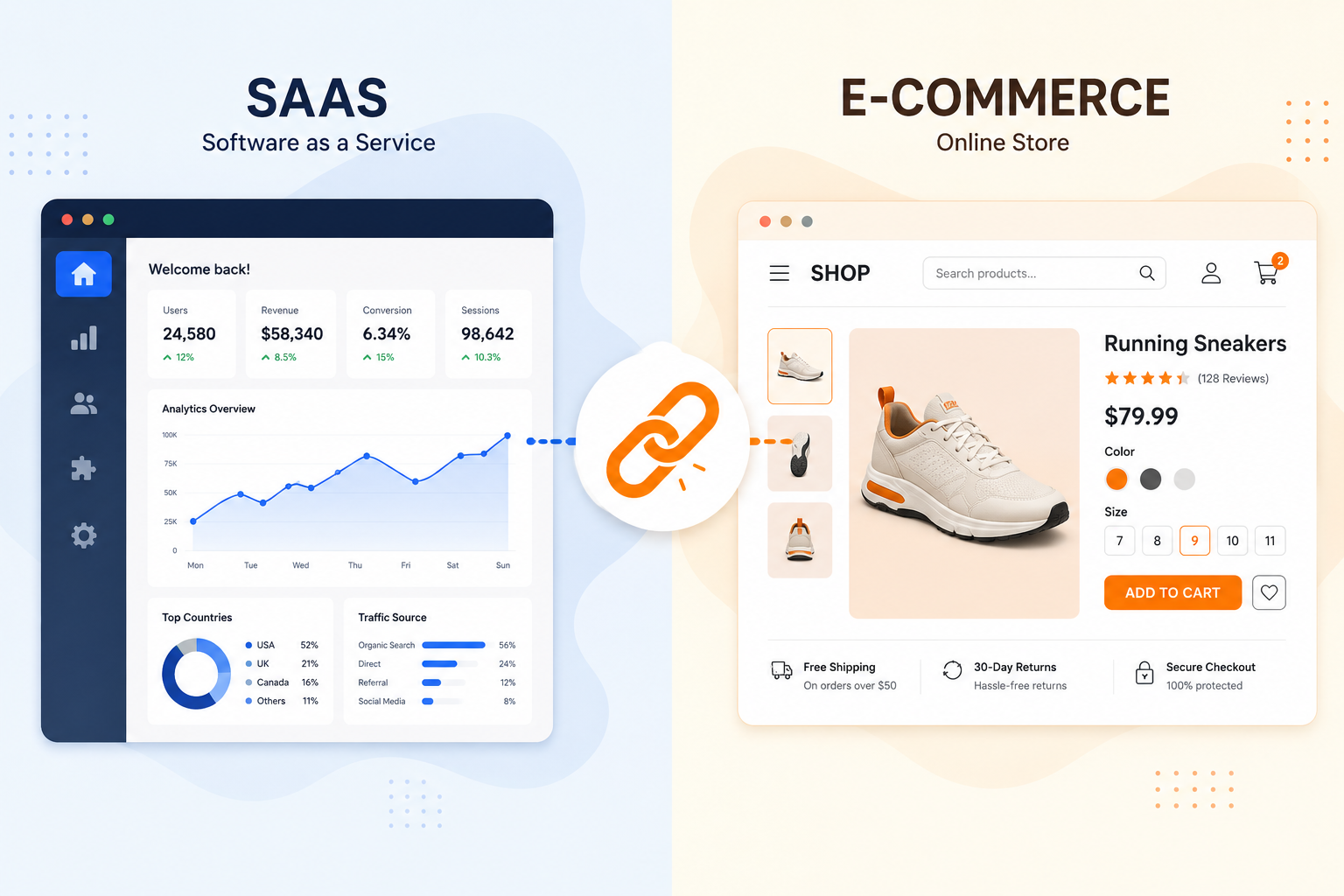
A SaaS founder and an e-commerce store owner can read the exact same “10 Link Building Strategies for 2026” guide, follow it step by step, and get completely different results. One might land a handful of relevant editorial mentions that do nothing for revenue. The other might spend three months on guest posts that never touch a page anyone actually buys from. Neither is doing link building wrong, exactly they’re doing generic link building, applied to two business models that don’t generate, deserve, or convert links in the same way.
This distinction matters more than most link building content admits. Most guides treat “link building” as one discipline with universal tactics: guest post here, get a niche edit there, chase Domain Rating. But the mechanics of what actually earns a link and which pages should receive that link depend entirely on what your site sells and how people buy it. Get this wrong and you’ll spend budget acquiring links that are technically real, technically relevant, and still do almost nothing for the metric you actually care about: qualified traffic that converts.
The Real Difference Isn’t the Tactics It’s What’s Linkable
Every “link building strategy” conversation eventually reduces to one question: what does this site have that a stranger would voluntarily link to? For a content publisher, that’s easy they publish things people cite. For SaaS and e-commerce, the answer is structurally different, and that difference cascades into everything else.
SaaS sells something intangible with a long, considered buying cycle. Nobody links to a feature page or a pricing page editors and bloggers don’t reference abstract descriptions of value the way they’d cite a study or a tool. What SaaS companies do have is expertise, data, and product logic that can be turned into something worth referencing: benchmark reports, free calculators, original research, technical breakdowns. The link goes to that asset, and the commercial pages get the authority secondhand through internal linking.
E-commerce sells something tangible that people actually want to see, review, and recommend but rarely link to directly. A product page reads as an advertisement to anyone in a position to link out, which is exactly why “just get links to your product pages” advice fails so often. What does work is everything adjacent to the product: buying guides, gift guides, comparison content, sourcing/materials stories, and genuine editorial relationships with publications that cover the category. The authority still has to be routed to commercial pages, but it arrives through a completely different set of front doors.
Once you see the problem this way, it’s obvious why a single playbook can’t serve both. The tactics aren’t interchangeable because the linkable surface area of the two business models isn’t the same shape.
What Actually Works for SaaS Link Building
Bridge assets, not blog posts. The highest-leverage SaaS link building move is building something free and genuinely useful a calculator, a benchmark report, an industry data study that earns links on its own merit, then passing that authority to money pages through deliberate internal linking. A project management tool doesn’t get links to its pricing page; it gets links to a free “project timeline calculator,” and that page then links internally to the product.
The comparison-page battlefield. A significant share of high-intent SaaS search volume is “[competitor] alternatives” and “best [category] software” queries. These pages convert extremely well when someone lands on them, but they’re also some of the hardest pages in SaaS to earn links to directly which makes supporting content (methodology posts, “how we tested this” transparency pieces) valuable as a workaround.
Integration ecosystems as an underused channel. SaaS products that plug into a marketplace think Slack’s app directory, HubSpot’s ecosystem, Zapier’s integration list have a link building channel e-commerce and local businesses simply don’t have access to. Every integration partner is a plausible co-marketing and backlink opportunity, and most SaaS teams never mine it systematically.
Digital PR around genuinely technical expertise. SaaS founders and product leads who can speak credibly to journalists about their specific niche (not generic “SEO tips,” but the mechanics of their actual product category) earn commentary links and quote-based backlinks that most e-commerce brands can’t replicate, because journalists are looking for expert sourcing, not product recommendations.
If you want the fuller playbook here, our link building services page breaks down exactly how we run this for SaaS clients, and we’ve written a full GEO case study for a SaaS brand showing how this compounds into AI Overview citations, not just traditional rankings.
What Actually Works for E-commerce Link Building
Content as the entry point, not the product. If your site is 100% product and category pages with no supporting content, you don’t have anything a publisher can reasonably link to even a small library of 10-15 genuinely useful guides (buying guides, care instructions, sizing/fit content, sourcing stories) becomes the foundation the entire link program runs on.
Gift guides and seasonal roundups. These remain one of the few link formats where a publisher directly, unapologetically links to a commercial product because that’s the explicit purpose of the format. Getting into “Best Gifts for X” roundups on relevant publications is one of the highest-ROI, most repeatable e-commerce link tactics that exists, and it scales with the calendar (holidays, back-to-school, Mother’s Day, etc.).
Domain-wide authority, routed downward. Editorial mentions and brand placements even ones that don’t link directly to a specific product lift the whole domain’s authority, which pulls product and category pages up with it. This is the mechanism behind e-commerce link campaigns that report large organic traffic gains without every link pointing at a converting page; the authority lifts the site, and well-structured internal linking does the rest.
Category and collection pages as the real target, not individual SKUs. Individual product pages churn too often (seasonal items, out-of-stock SKUs, discontinued lines) to be a stable link target. Category and collection pages are more durable, rank for the commercial-intent keywords that actually drive revenue, and are what most e-commerce link campaigns should be routing authority toward.
Our e-commerce SEO bundle is built around exactly this pairing link building with the on-page and technical work needed to make category pages rank once the authority arrives, since links alone don’t fix a page that isn’t structured to convert them into rankings.
Where the Two Playbooks Actually Overlap
It’s not that SaaS and e-commerce share nothing. A few fundamentals hold regardless of business model:
- Manual outreach beats automated outreach, every time, in both verticals. Personalized pitches from someone who’s read the target site convert at meaningfully higher rates than templated blasts, whether you’re pitching a SaaS review site or a lifestyle blog for a gift guide.
- Relevance still outranks raw Domain Rating. A DR 45 site in your exact niche is worth more than a DR 70 general-interest site with no topical overlap this is true for a SaaS benchmark report and an e-commerce buying guide alike.
- Niche edits work for both, inserting links into already-indexed, already-ranking content rather than waiting for a new guest post to get indexed and gain authority this is often the fastest lever for either business model when timelines matter.
- Technical foundations have to be in place first. No amount of earned authority compensates for a site that isn’t crawlable, has broken internal links, or has duplicate/thin pages competing against each other. This is true whether the money page is a SaaS pricing page or an e-commerce category page.
Where they diverge sharply is everything upstream of outreach the content strategy, the target page selection, and the type of publisher relationship worth building. That’s the part a generic playbook flattens out, and it’s exactly the part that determines whether a campaign moves revenue or just moves a rankings dashboard.
A Real Example of Why This Distinction Matters
In one of our SaaS campaigns, a B2B software client went from page 4 to position 1 in 11 weeks for a competitive, three-word SaaS term with over 8,000 monthly searches — using 12 contextual links averaging DR 55-70, placed specifically in the SaaS and business software niche, with a +287% organic traffic lift as a result. That result didn’t come from generic “high DR” placements; it came from links built into content genuinely relevant to that product category, pointing at pages structured to convert software buyers, not casual browsers.
An e-commerce brand running the identical playbook — same publisher types, same anchor strategy, same target pages — wouldn’t get equivalent results, because the audience reading those SaaS-adjacent publications isn’t shopping for a physical product, and the pages that needed the authority (category and collection pages, not a software pricing page) weren’t part of the campaign at all. The tactics were sound. The business model mismatch is what would have broken it.
How to Figure Out Which Playbook Your Site Actually Needs
Start with three questions before choosing tactics:
- What does my site have that’s genuinely linkable on its own merit — a tool, a dataset, a guide, a gift-worthy product category? If the honest answer is “nothing yet,” that’s the first thing to build, before any outreach starts.
- Which pages actually drive revenue, and can authority realistically reach them through internal linking, or do they need to be the direct link target? SaaS money pages almost always need the indirect route; e-commerce category pages can often take links more directly through gift guides and roundups.
- Who is the actual buyer, and where do they spend attention before purchasing? A SaaS buyer reads comparison content and technical reviews. An e-commerce buyer reads gift guides, “best of” roundups, and reviews from people who’ve actually used the product. Your outreach targets should mirror where that specific buyer already is.
Most sites don’t need a “SaaS strategy” or an “e-commerce strategy” in the abstract — they need a strategy built from what’s actually linkable about their specific business, applied with the tactics proven to work for that model. That’s a different exercise than running down a generic checklist, and it’s usually where campaigns that stall out went wrong from the start.
If you’re not sure which category your current link profile falls into — or whether your existing links are actually reaching the pages that matter — a free link audit will show you exactly where the gaps are before you spend another dollar on outreach that might be aimed at the wrong pages entirely.
The Bottom Line
SaaS and e-commerce link building fail for opposite reasons when you run them through the same playbook. SaaS campaigns fail when teams chase links to pages nobody will ever link to directly. E-commerce campaigns fail when teams either try the same thing, or give up on content entirely and hope product pages attract links on their own. Both mistakes come from treating “link building” as one universal discipline instead of a strategy that has to be built around what your specific business actually has to offer a publisher.
If you want a strategy built around your actual business model — not a generic template — get in touch and we’ll walk through what’s realistically linkable about your site before recommending a single tactic.
FAQ
What’s the main difference between SaaS link building and e-commerce link building?
SaaS link building targets intangible product pages (pricing, features, comparisons) that publishers won’t link to directly, so it relies on “bridge assets” like calculators or research that pass authority internally. E-commerce link building targets tangible products through gift guides, buying guides, and editorial content, since product pages alone read as advertising to most publishers.
Can I use the same link building strategy for a SaaS company and an e-commerce store?
Not effectively. The underlying tactics (manual outreach, relevance over Domain Rating, niche edits) apply to both, but the content used to earn links, the publishers targeted, and the pages that receive the authority differ significantly. A strategy built for one will underperform when applied directly to the other.
What type of content earns backlinks for SaaS companies?
Free tools, calculators, benchmark reports, and original data studies tend to earn the most links for SaaS brands, because they give editors something concrete and useful to reference. Feature pages, pricing pages, and generic blog posts rarely attract organic links on their own.
How do e-commerce sites earn links to product pages if products aren’t linkable?
Most e-commerce link building doesn’t target product pages directly it earns links through gift guides, seasonal roundups, and buying guide content, then relies on domain-wide authority and internal linking to lift product and category page rankings indirectly.
Is guest posting still effective for SaaS and e-commerce link building in 2026?
Yes, but only when it targets publications the actual buyer reads and prioritizes audience relevance over Domain Rating. One well-placed, relevant guest post consistently outperforms several generic placements on unrelated high-DR sites, for both business models.
How much does link building typically cost for SaaS vs. e-commerce campaigns?
Costs are driven more by placement quality and campaign scope than by business model entry-level programs commonly start in the low thousands per month, with mid-tier and enterprise digital PR programs running considerably higher. Backlinkly’s link building starts from $129/link, with monthly link building programs from $499/month depending on volume and DR targets.
Do integration partnerships actually help SaaS SEO?
Yes. SaaS products listed in marketplaces like the Slack App Directory or Zapier’s integration network can earn genuinely relevant, high-authority backlinks through co-marketing with integration partners a channel that doesn’t have an equivalent in e-commerce or local business link building.
