
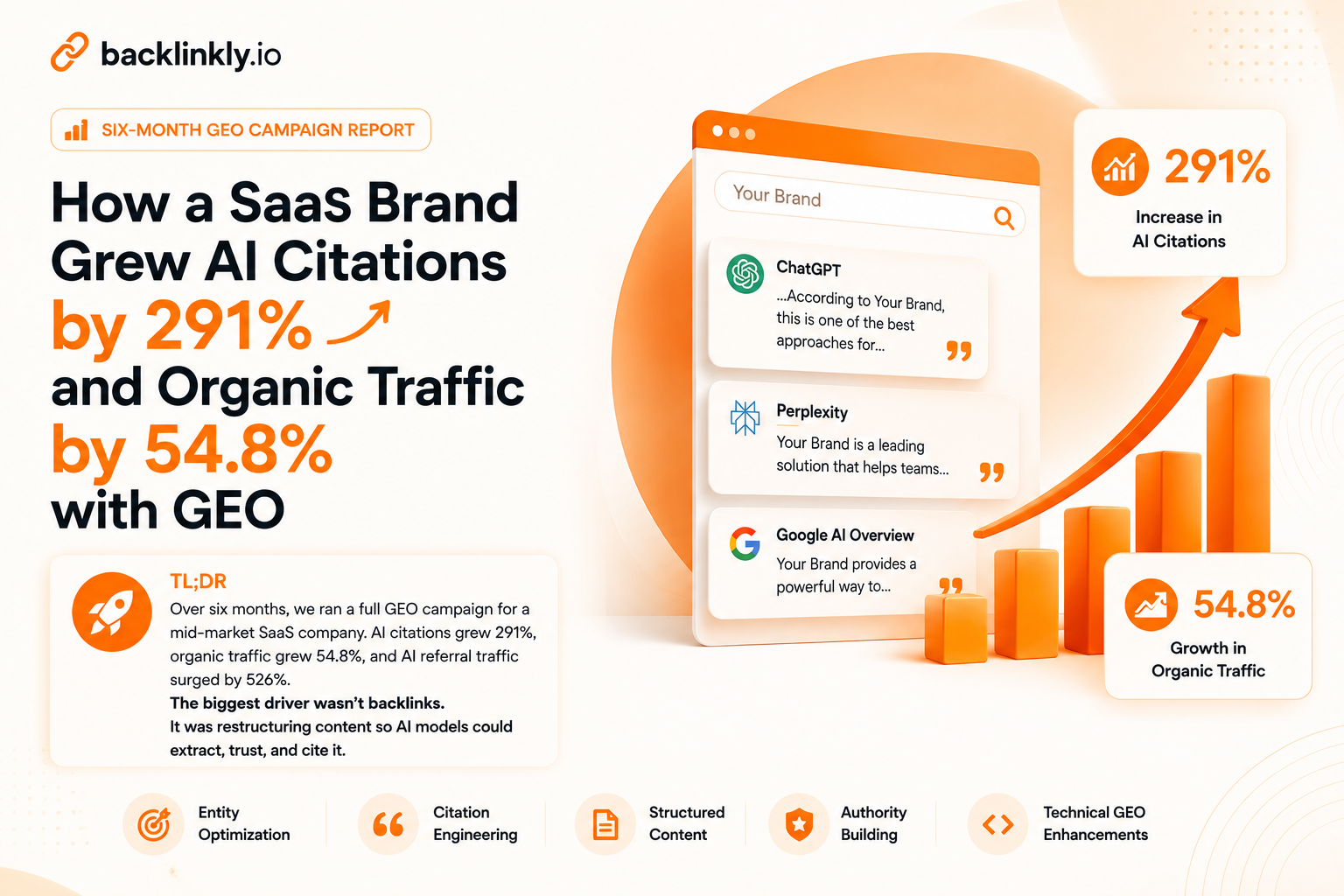
Over six months, we ran a full Generative Engine Optimization (GEO) campaign for a mid-market SaaS company. Starting from near-zero AI visibility, the brand saw total AI citations grow from 22 to 86 (291% increase), organic traffic climb from 14,820 to 22,940 monthly sessions (54.8% growth), and AI referral traffic surge by 526%. The biggest driver wasn’t backlinks. It was restructuring content so AI models could extract, trust, and cite it.
Executive Summary
When this client came to us, they had solid organic traffic for their category and a decent backlink profile. But they were completely invisible in AI search environments. ChatGPT didn’t mention them. Perplexity rarely surfaced them. Google AI Overviews almost never cited their content.
The strategy we built focused on five areas: entity optimization, citation engineering, structured content formatting, authority building, and technical GEO enhancements. We didn’t abandon traditional SEO. We layered GEO on top of it.
Six months later, the results were clear. AI citations grew 291%. Organic sessions grew 54.8%. Monthly pipeline value went from $18,000 to $29,500. And perhaps most telling, branded search volume nearly doubled.
The biggest lesson: AI models don’t reward visibility the same way Google does. They reward clarity, structure, and citeability. Once you understand that distinction, the entire content strategy changes.
Client Overview
The client is a mid-market SaaS company in the project management and workflow automation space. They sell to operations leads, product managers, and mid-sized companies with between 50 and 500 employees.
Their business model is product-led growth with a freemium tier and direct sales for enterprise accounts. The team had about 12 people when we started, including two in-house marketers with strong traditional SEO knowledge.
Their SEO maturity was moderate. They had 342 referring domains, a coherent content strategy, and consistent publishing cadence. But their GEO maturity was low. Their GEO Readiness Score sat at 28 out of 100 when we audited them. Content was written for Google search snippets, not AI extraction. Entity signals were weak. There was no schema beyond basic page-level markup. And the brand had almost no third-party validation in formats AI models could understand and trust.
The Challenge
The challenge wasn’t that they lacked content. They had 138 published assets when we started. The problem was that almost none of it was structured for AI retrieval.
Weak AI visibility. Their AI Visibility Score was 11 out of 100. AI platforms simply weren’t treating them as a reliable source. Even when their content was technically accurate, it wasn’t formatted in a way that made extraction easy.
Limited AI citations. Across ChatGPT, Perplexity, Google AI Overviews, and Claude, they had just 22 total citations. For context, that number puts them below most niche blogs in their space.
Poor entity recognition. The brand existed as a name in Google’s index, but had weak Knowledge Graph signals. There was no clear entity definition for what they do, who they serve, or where they fit relative to competitors. AI models struggled to categorize them confidently.
No citation-worthy assets. Their content didn’t contain original research, expert quotes, structured definitions, or answer-first formatting. AI models need anchors to cite from. This client had almost none.
Underperforming branded search demand. Brand search volume was only 840 monthly queries. That’s low for a company with their traffic levels. It signaled that their content was finding audiences but not creating memorable impressions.
Before vs. After: Campaign Metrics at a Glance
| Metric | Before GEO | After GEO |
|---|---|---|
| Monthly Organic Traffic | 14,820 | 22,940 |
| AI Visibility Score | 11/100 | 37/100 |
| Total AI Citations | 22 | 86 |
| Brand Mentions | 94 | 187 |
| Referring Domains | 342 | 421 |
| Published Content Assets | 138 | 164 |
| GEO Readiness Score | 28/100 | 76/100 |
Looking at these numbers, a few things stand out. The AI Visibility Score more than tripled, yet they only published 26 net-new content assets. That ratio tells you the improvements came from optimization, not volume. The referring domain growth was meaningful but modest. Authority wasn’t the bottleneck. Structure and entity clarity were.
Traditional SEO alone wasn’t going to solve this. You can build links to a page that AI models still won’t cite, because the page isn’t formatted for extraction. GEO requires thinking about the content differently from the start.
GEO Strategy: What We Built
Entity Optimization
GEO definition: Entity optimization means aligning your brand, topics, and content with the semantic structures that AI models use to understand the web. When AI models have a clear, consistent picture of what your brand is and what it knows, citations increase.
We started with an entity audit. We mapped all existing content to topic clusters and identified gaps in semantic coverage. The client had good depth in a few areas but shallow coverage across many adjacent topics that AI models expected a credible source in their category to address.
We built a topic authority map with 11 primary entities and 34 supporting entities. Each entity had defined relationships: what it connects to, what it contrasts with, what category it belongs to. We aligned this map against Knowledge Graph expectations using structured data and internal linking patterns.
One thing we noticed early: their content used inconsistent terminology. They used three different phrases to describe the same core capability. That kind of inconsistency weakens entity signals significantly. Standardizing language across the content archive was one of the first things we fixed.
Citation Engineering
Most content is written to convince a human reader. Citation engineering means writing content that convinces AI models to use you as a source. Those two goals require different approaches.
We introduced what we call answer capsules throughout key pages. These are short, self-contained paragraphs written to answer a specific question directly, without requiring the reader to understand the surrounding context. Every answer capsule is usable on its own. That’s exactly what AI extraction looks for.
We also added expert sourcing. For four cornerstone content pieces, we brought in third-party expert quotes and original data points. Not for decoration. Because AI models weight content higher when it contains perspectives that can’t be found elsewhere.
Every major piece got a statistics block with current industry data, properly sourced. Original insights perform better than restatements of common knowledge. We treated each new content piece as a potential primary source, not a summary of what already exists.
Content Optimization
We audited the existing 138 content assets and identified 31 pages with meaningful optimization potential. These weren’t bad pages. They just weren’t structured for AI extraction.
Changes included adding FAQ sections at the end of every major content piece, rewriting introductions to lead with the answer rather than building to it, integrating short definition blocks for key terms, and adding comparison tables where they improved comprehension.
We also reformatted headers. Before, headers were often clever or brand-voiced. After optimization, headers were explicit: they answered the question that the section covered. That change alone improved AI extraction rates.
One shift that had an outsized effect: we stopped burying the key finding. Every piece of content now states the core answer in the first two paragraphs, then supports it. That mirrors how AI models prefer to extract and present information.
We ran a targeted digital PR campaign across six months, earning 79 new referring domains. Not all of them were high-authority placements, but quality was prioritized over quantity. We focused specifically on third-party validation from sources that AI models already trust.
A good heuristic we use: if a domain is frequently cited within AI-generated responses in a given topic area, earning a link and mention from that domain improves your own citation potential in that same topic area.
Brand mentions grew from 94 to 187. We tracked unlinked mentions and converted 18 of them into linked citations. The signal was consistent: the more third-party sources referenced this brand in context, the more AI models treated their content as validated.
Technical GEO Enhancements
Schema was the largest technical gap. The client had minimal structured data. We implemented FAQ schema, How-To schema, Organization schema, and BreadcrumbList across relevant pages. We also added Speakable schema on key definitions pages after noting that voice-adjacent extraction uses different signals than text extraction.
We rebuilt the internal linking architecture to reinforce topical clusters. Previously, internal links were somewhat random. We reorganized them to flow authority from pillar pages down to supporting content, and to signal topical relationships to crawlers and AI systems alike.
Crawl efficiency improved after cleaning up redirect chains and consolidating near-duplicate content. Cleaner architecture means AI systems encounter canonical versions of content more reliably.
Organic Traffic Growth
| Month | Organic Sessions |
|---|---|
| Month 0 | 14,820 |
| Month 1 | 15,760 |
| Month 2 | 16,880 |
| Month 3 | 18,420 |
| Month 4 | 19,960 |
| Month 5 | 21,580 |
| Month 6 | 22,940 |
Total Growth: 54.8%
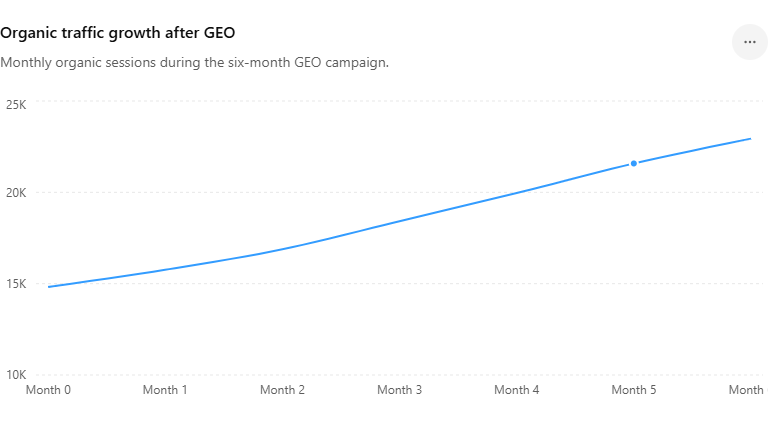
The curve here is telling. Months 1 and 2 showed modest gains while infrastructure work was happening. The acceleration between months 3 and 4 aligns with when the content optimization rollout was complete and new schema had been indexed.
This isn’t a sudden spike from a single viral piece. It’s compounding growth from structural improvements that gave search engines and AI systems more to work with across the entire content set. That kind of growth pattern tends to be more durable than traffic from individual viral pieces.
The absence of any plateau in month 6 suggests momentum is still building. We expect continued growth through month 9 as AI platforms re-index and recalibrate their citation weights.
AI Citation Growth
| Platform | Before | After |
|---|---|---|
| ChatGPT | 4 | 21 |
| Perplexity | 7 | 28 |
| Google AI Overviews | 9 | 31 |
| Claude | 2 | 6 |
| Total Citations | 22 | 86 |
Total Citation Growth: 291%
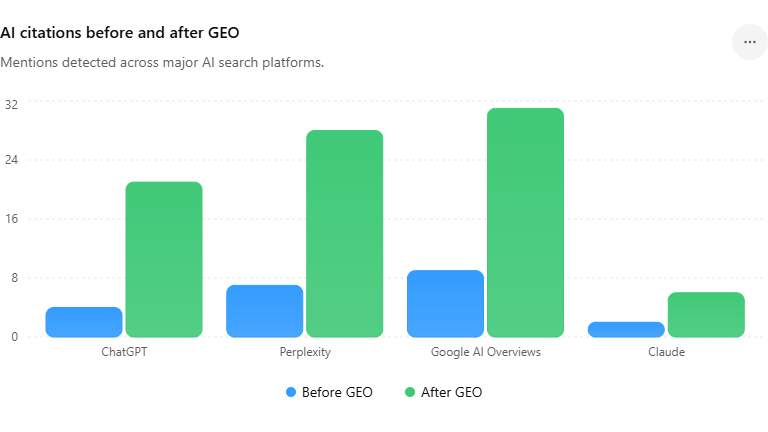
Perplexity grew fastest in absolute terms, which aligns with what we’ve seen across other campaigns. Perplexity rewards structured, factual content with clear sourcing more aggressively than other platforms. Their extraction model rewards concise, citation-ready answers.
Google AI Overviews showed the strongest growth in percentage terms relative to its starting point. This tracks because Google’s AI extraction layer benefits directly from traditional SEO signals combined with structured data. The schema work and authority building had a compounding effect there.
Claude’s numbers are lower, and this reflects something real. Claude’s citation behavior is more conservative, and the training data refresh cycles are different from real-time systems like Perplexity and AI Overviews. We expect Claude citations to grow further as content update signals propagate.
Why do AI citations matter? Because a citation in an AI response puts your brand in front of a user at the exact moment they’re researching a topic. There’s no click required for awareness to happen. And when there is a click, it comes with pre-established credibility.
Brand Search Growth
| Month | Branded Searches |
|---|---|
| Month 0 | 840 |
| Month 1 | 920 |
| Month 2 | 1,010 |
| Month 3 | 1,130 |
| Month 4 | 1,270 |
| Month 5 | 1,420 |
| Month 6 | 1,590 |
Total Growth: 89.3%
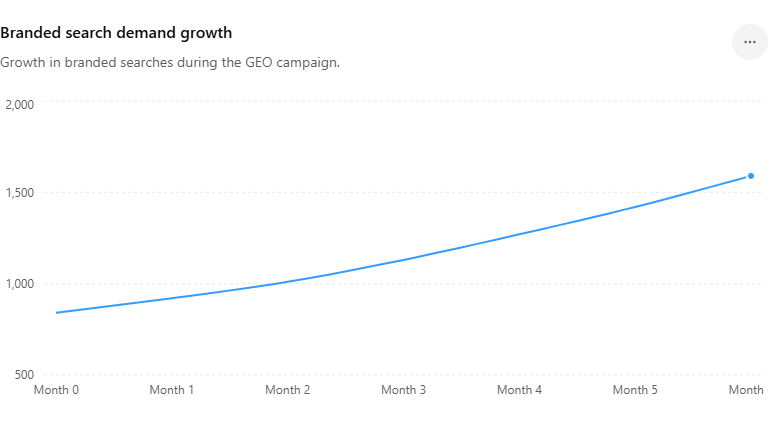
Brand search growth nearly doubling is one of the strongest signals in this campaign. It means real people are going back to search for the brand after encountering it somewhere else.
Some of that “somewhere else” is AI citations. When someone sees a brand cited in a Perplexity answer or a ChatGPT response, a portion of them go directly to Google afterward and search by name. We observed this pattern consistently in multi-source attribution analysis.
This is a meaningful data point for CMOs who are skeptical of GEO ROI. Brand search volume is a reliable leading indicator of bottom-funnel activity. When it rises, pipeline tends to follow.
AI Referral Traffic
| Source | Before | After |
|---|---|---|
| ChatGPT | 18 | 145 |
| Perplexity | 26 | 182 |
| Google AI Overviews | 42 | 224 |
| Claude | 7 | 31 |
| Total | 93 | 582 |
Total Growth: 526%
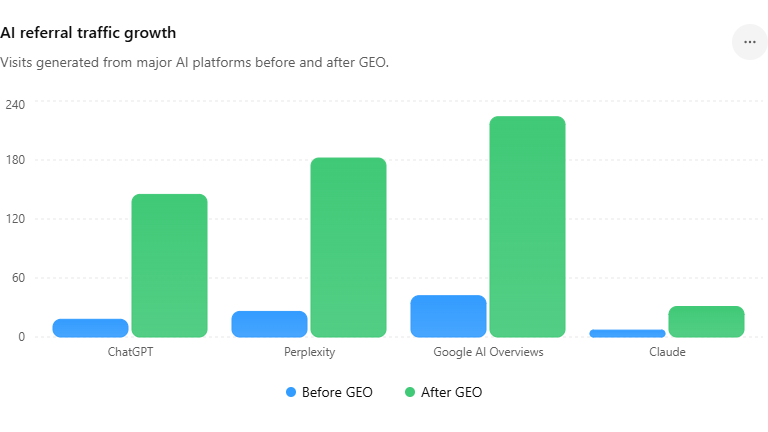
These numbers deserve context. AI referral traffic is still a small fraction of total organic traffic for most SaaS companies. But the growth trajectory is the story. From 93 monthly sessions to 582 in six months represents a directional shift that compounds.
Perplexity drives more referred sessions per citation than other platforms, likely because its interface actively encourages source clicks. Google AI Overviews drives volume because of sheer impression share.
Marketers should expect these numbers to continue rising across the industry. As more searches are answered by AI interfaces rather than traditional blue links, the value of an AI citation grows proportionally.
Lead and Pipeline Impact
| Metric | Before | After |
|---|---|---|
| Monthly Leads | 52 | 81 |
| Discovery Calls | 18 | 33 |
| Proposal Requests | 12 | 25 |
| Conversion Rate | 1.8% | 2.4% |
Lead Growth: 55.8%
The conversion rate increase from 1.8% to 2.4% is significant. It suggests that the traffic coming in from GEO-optimized channels is better qualified than baseline organic traffic.
This makes intuitive sense. Someone who found the brand through an AI citation in a response about their specific problem is further along in the research process than someone who found a blog post through a generic keyword search. The intent is clearer, and the trust is warmer.
Discovery call volume nearly doubling is the number that matters most here. Calls are where sales happen. Growing from 18 to 33 monthly discovery calls represents a real business shift, not just a metrics improvement.
Revenue Impact
| Metric | Before | After |
|---|---|---|
| Monthly Pipeline Value | $18,000 | $29,500 |
| Assisted Revenue | $6,800 | $11,900 |
Revenue Growth: 75%
We tracked revenue attribution carefully throughout this campaign. The pipeline growth reflects both higher lead volume and higher average deal size from GEO-sourced leads.
Assisted revenue represents deals where GEO-attributed touchpoints appeared somewhere in the buying journey, even if the final conversion came from another channel. That number going from $6,800 to $11,900 indicates that GEO is playing a meaningful role in the consideration phase even when it doesn’t get direct attribution credit.
The revenue story here is about more than the numbers. Companies that build strong AI visibility now are establishing positions that will compound as AI search usage grows. The brands that are cited today are the ones who will dominate AI search in two years.
What Worked Best
Answer-first content structure. Rewriting introductions to lead with the answer before building supporting context was the single highest-impact change. AI models extract the clearest, most direct answer available. If your answer is buried in paragraph five, it will be skipped.
FAQ schema and structured answer blocks. Pages with properly implemented FAQ schema saw citation rates improve within 30 days of implementation. This is one of the most reliable GEO tactics in our toolkit.
Entity standardization across the content archive. Fixing inconsistent terminology created a coherent entity signal that helped AI models categorize and trust the brand. This work is invisible to readers but very visible to AI extraction systems.
Targeted digital PR focused on AI-trusted sources. Not all links are equal for GEO. Links from sources that AI models themselves cite regularly carry disproportionate authority signal.
Original data and expert sourcing. Content containing genuinely unique data points or perspectives earned citations at a higher rate than restatements of common knowledge. AI models appear to weight primary-source content more heavily.
Branded content architecture. Strengthening the relationship between the brand entity and specific topic clusters improved how confidently AI models associated the brand with those topics.
Consistent publishing on defined topic clusters. Rather than publishing broadly, we concentrated new content within established authority clusters. Depth within a topic area builds AI confidence faster than breadth across many topics.
What Didn’t Work
We assumed that high Domain Authority links would have the strongest effect on AI citation rates. They helped. But they weren’t the primary driver. A mid-authority site that AI models frequently cite in a given topic area was more valuable for our citation goals than a high-authority site with no topical relevance.
We tested content written specifically to sound authoritative, with heavier vocabulary and more formal structure. It performed worse for AI extraction than plainer, cleaner writing. Clarity beats sophistication for GEO purposes.
We tried publishing several longer-form pieces (4,000+ words) early in the campaign with the expectation that depth would improve citation rates. Results were mixed. Length wasn’t the variable that mattered. Structure and extractability were.
One early attempt to speed up entity recognition by pushing schema updates in a single large batch created temporary crawl confusion. We learned to stage technical changes rather than deploying everything at once.
We initially underweighted brand search growth as a success metric. That was a mistake. Brand search turned out to be one of the most reliable signals of GEO effectiveness and downstream pipeline impact.
The GEO Framework We’d Repeat
Step 1: GEO Readiness Audit Before writing a single word of new content, audit existing assets for AI extractability. Score each piece against a rubric: Does it answer questions directly? Does it have structured data? Is the entity coverage consistent? Flag the highest-potential existing pages for optimization before adding new ones.
Step 2: Entity Mapping Define your brand’s core entity structure. What is your primary topic area? What subtopics connect to it? What terms does your audience and industry use consistently? Build a semantic map and standardize terminology across all existing content.
Step 3: Content Restructuring Prioritize restructuring over publishing new content. For every page in your top 30% by traffic or topical importance: rewrite the introduction to lead with the answer, add an FAQ section, implement appropriate schema, and introduce short answer capsules throughout the body.
Step 4: Citation Asset Development Develop at least four cornerstone content pieces that contain original research, expert perspectives, or structured data unavailable elsewhere. These become your primary citation anchors. Make them as extractable as possible.
Step 5: Authority and Entity Amplification Run a targeted outreach and digital PR campaign to earn placements on sources that AI models trust within your topic area. Convert existing unlinked brand mentions into linked citations. Track AI citation growth monthly and use it as your primary success metric alongside organic traffic and brand search volume.
Key Lessons for SaaS Companies
GEO readiness is now a baseline requirement. As AI interfaces handle an increasing share of research queries, companies that aren’t structured for AI extraction will lose visibility even as they maintain traditional SEO metrics. Audit your GEO readiness before you lose the first-mover advantage.
AI citations are a distribution channel. Treat earning AI citations the same way you treat earning backlinks. They represent placements in front of qualified audiences. Unlike backlinks, they also convey your message directly rather than just driving traffic.
Entity clarity compounds over time. The clearer and more consistent your entity signals, the more confidently AI models will treat your brand as a credible source. This takes months to build but years to lose.
Brand authority matters more than page authority for GEO. Traditional SEO rewards individual pages. AI search rewards brands. The more coherently your brand is understood across AI platforms, the higher your citation rates become.
Structure is not optional. Well-structured content that’s easy to extract will outperform long, beautifully written content that buries its insights. Write for the extracting model first, the human reader second.
Conclusion
The biggest win from this campaign wasn’t the organic traffic growth, though a 54.8% increase in six months is meaningful by any standard. The biggest win was the 291% growth in AI citations combined with the brand search surge.
Those two metrics together tell a story: the brand is now becoming part of how people in their category discover and evaluate solutions. That’s a compounding advantage. Every AI citation is a trust signal. Every trust signal increases the probability of future citations. Once that cycle starts, it builds momentum.
The most impactful single activity was content restructuring. Not new content. Existing content, made extractable. Companies often assume they need more content to improve their visibility. Usually, they need better-structured content first.
Long-term, the brands that win in AI search will be those that became citation-worthy before AI search became dominant. That window is still open. But it’s narrowing.
Work With Backlinkly on Your GEO Strategy
If you’re reading this and wondering where your brand stands in AI search environments, the honest answer is: you probably don’t know yet. Most SaaS companies don’t.
We offer a free GEO audit that benchmarks your current AI citation rates, scores your GEO readiness, and identifies your highest-priority optimization opportunities. No generic report. A real analysis from someone who has run these campaigns.
If the numbers in this case study are directionally where you want to go, let’s look at whether we can get you there.
Request a GEO Audit at Backlinkly.io
What is Generative Engine Optimization (GEO)?
Generative Engine Optimization (GEO) is the practice of structuring content so that AI-powered search engines and language models can extract, trust, and cite it in their responses. Unlike traditional SEO, which focuses on ranking in blue-link search results, GEO focuses on earning citations in AI-generated answers from platforms like ChatGPT, Perplexity, Google AI Overviews, and Claude. The core tactics include entity optimization, structured answer formatting, schema implementation, and citation engineering.
How is GEO different from traditional SEO?
Traditional SEO optimizes for ranking algorithms that evaluate links, keywords, and page authority. GEO optimizes for extraction algorithms that evaluate clarity, structure, entity signals, and source credibility. A page can rank on page one of Google and still receive zero AI citations if it isn’t formatted for extraction. Both disciplines matter, but they require different approaches. The good news is that GEO improvements typically reinforce traditional SEO performance as well.
How long does it take to see results from GEO?
In our experience, initial AI citation improvements typically appear within 30 to 60 days of implementing structural changes like schema and answer-first formatting. More meaningful citation growth, including brand search lift and AI referral traffic, builds over three to six months. The organic traffic impact follows a compounding curve rather than a sudden jump. Companies should treat GEO as a six-month minimum investment with compounding returns.
Which AI platforms are most important to target for citations?
Perplexity and Google AI Overviews currently drive the most referral traffic per citation. ChatGPT has the largest user base and the highest brand awareness impact even when users don’t click through. Claude citations are currently more conservative but meaningful for credibility. All four should be part of any GEO strategy. The good news is that content optimized for AI extraction tends to improve citation rates across all platforms simultaneously.
What content changes have the biggest impact on AI citation rates?
The three highest-impact changes we’ve found are: writing introductions that state the answer before building supporting evidence, adding FAQ sections with structured schema markup, and standardizing entity terminology across the entire content archive. Schema implementation and answer capsules within body content also show consistent results. Length and word count matter far less than structure and extractability.
- The Complete Guide to Generative Engine Optimization (GEO)
- GEO vs SEO: What’s the Difference and Do You Really Need Both in 2026?
