
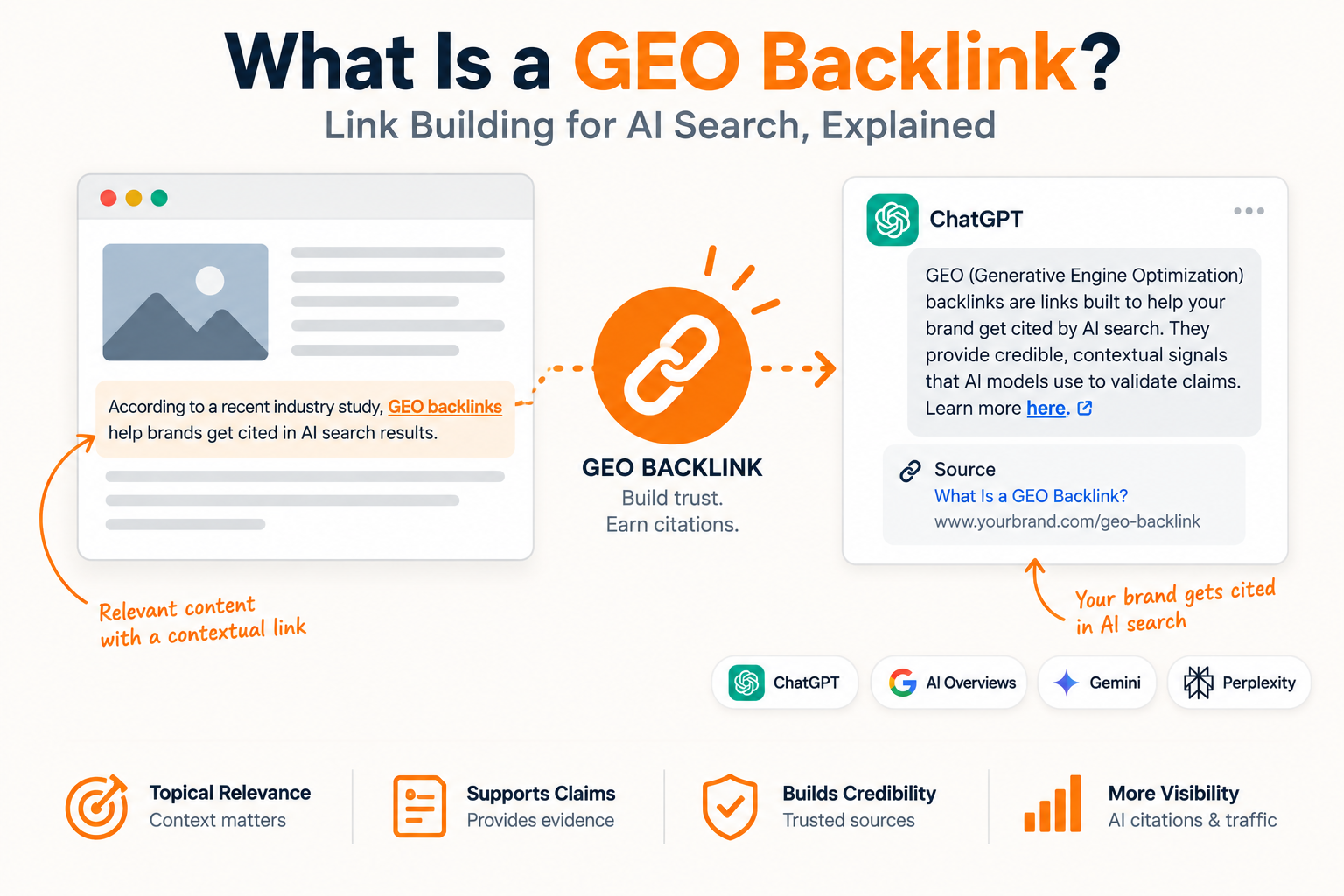
“GEO backlink” is a term that’s started showing up in search without a clear, consistent definition attached to it partly because generative engine optimization (GEO) itself is still a young enough discipline that terminology hasn’t fully settled. Here’s a straightforward answer: a GEO backlink is a link built and placed specifically to help an AI model ChatGPT, Google’s AI Overviews, Perplexity, Gemini treat your brand or claim as trustworthy enough to cite in a generated answer, rather than a link built purely to move a page up Google’s traditional ranking list.
The two overlap heavily. A genuinely good backlink often serves both purposes at once. But they’re not automatically the same thing, and understanding the difference changes which links are actually worth prioritizing in 2026.
The Core Difference: Ranking Signal vs. Citation Evidence
A traditional SEO backlink primarily works as a popularity and authority signal Google’s ranking algorithm has spent two decades refining how to weigh the volume and quality of links pointing at a page. A GEO backlink is evaluated by a different kind of system solving a different problem: an AI model deciding, often on the fly, whether a specific claim on your page is corroborated well enough to summarize or cite directly in an answer.
That distinction changes what “good” looks like. A high-Domain-Rating link sitting in a generic resource list still helps traditional rankings. It does comparatively little for AI citation if it isn’t sitting near actual corroborating text a specific, related claim made independently by someone else, in content the AI model can parse as genuinely relevant context.
What Actually Makes a Backlink “GEO-Ready”
Not every link qualifies, even from a strong site. A backlink functions as a genuine GEO asset when it has:
- Topical relevance in the surrounding text, not just a matching keyword. The paragraph around the link should be discussing the same subject as the page it links to.
- A specific, checkable claim nearby, rather than a vague brand mention. AI models weigh corroborated facts more heavily than generic references.
- Placement inside the body content, not a “further reading” list bolted onto the end of an article embedded context reads differently to a model parsing the page than an afterthought link does.
- A credible host page, with real editorial standards and genuine organic traffic the corroboration only counts for as much as the source making it.
Where GEO Backlinks Come From
A few link building formats naturally produce GEO-qualifying links more often than others:
Niche edits placed with genuine topical relevance. Inserting a link into an already-indexed, already-trusted article specifically where the surrounding paragraph makes a related, corroborating claim is one of the fastest ways to build this kind of context, since it borrows an existing page’s established credibility rather than waiting for a new one to earn its own.
Digital PR and expert commentary. When a journalist or industry writer quotes your team directly and links back, that combination of an attributed claim plus a link is exactly the kind of corroboration AI models are built to weigh heavily arguably more so than a standard guest post backlink.
Original data and research citations. If your brand publishes a genuinely original statistic or study, other sites citing that data point (and linking back to the source) create a very specific, high-value form of GEO backlink, since the claim being corroborated is uniquely yours.
Common Misconceptions About GEO Backlinks
“Any high-DR link works for AI search too.” Not necessarily. Domain Rating is a decent baseline credibility signal, but a topically loose link on a high-DR site can underperform a more modest, tightly relevant placement for AI citation specifically.
“GEO backlinks are a completely separate strategy from regular link building.” In practice, a well-built traditional link building program already produces plenty of GEO-qualifying links, especially when relevance and content quality are prioritized over pure volume. GEO adds a layer of intent to placement decisions rather than replacing the underlying fundamentals.
“There’s a way to guarantee AI citation.” No provider can promise this, since AI models retrain and re-crawl on inconsistent schedules and weigh sources in ways that aren’t fully transparent even to the platforms themselves. What’s realistic is building a consistent base of genuinely relevant, corroborating links over time improving the odds, not guaranteeing the outcome.
How This Fits Into a Broader Link Building Strategy
GEO backlinks aren’t a replacement for a solid overall link profile they’re what a well-built link profile increasingly needs to account for, on top of the traditional ranking fundamentals that still matter. Our AI Search & GEO service is built around exactly this layered approach, evaluating both traditional ranking value and AI-citation context when recommending a placement, rather than treating them as two separate campaigns.
If you’re specifically looking at niche edits as a link building format, the placements that work best for GEO purposes tend to be the same ones that work well for traditional rankings too genuinely relevant, well-placed, and sitting inside real editorial content rather than a link farm. If you’d rather build authority on a recurring basis instead of one-off placements, our monthly backlink service covers ongoing programs across every tier.
The Bottom Line
A GEO backlink isn’t a fundamentally different product from a traditional backlink it’s a traditional backlink evaluated against a slightly different, more specific standard: does the surrounding context genuinely corroborate a claim in a way an AI model would treat as meaningful evidence, not just an incidental mention. As AI-generated answers take up more of how people find information, that distinction is worth building for deliberately rather than hoping it happens as a byproduct of unrelated link building work.
If you’re not sure whether your current backlink profile is doing this work already, a free SEO and link audit covers both the traditional and AI-search side of your link profile in one report.
FAQ
What is a GEO backlink in simple terms?
A GEO backlink is a link placed specifically in content that corroborates a claim on your page in a way AI models (ChatGPT, AI Overviews, Perplexity) can recognize as genuine supporting evidence, increasing the odds your brand gets cited in an AI-generated answer.
Is a GEO backlink different from a regular SEO backlink?
Not entirely a GEO backlink is usually a subset of good SEO backlinks, specifically ones placed with genuine topical relevance and a corroborating claim nearby. Many well-built traditional backlinks already qualify; the difference is intent and placement quality, not a separate link type.
Do I need a high Domain Rating site for a GEO backlink to work?
Domain Rating helps as a baseline trust signal, but topical relevance and genuine editorial context tend to matter more specifically for AI citation. A moderately-authoritative, highly relevant placement can outperform a high-DR but topically loose one for GEO purposes.
Can niche edits function as GEO backlinks?
Yes, when placed with genuine topical relevance inside content that makes a specific, related claim. Niche edits are one of the more efficient ways to build GEO-qualifying links since they borrow an already-trusted page’s established credibility rather than waiting for new content to earn its own.
How do I know if my current backlinks are helping with AI search citation?
There’s no single dashboard that confirms this definitively yet, since AI platforms don’t publish full citation-source transparency. The best available approach is auditing your existing link profile for topical relevance and corroborating context, and testing whether your brand shows up when you ask AI tools questions your content should be able to answer.
