
TL;DR: A link building agency for startups should follow a sequenced strategy built for zero existing authority, not a scaled-down version of an enterprise package. This guide covers realistic startup budgets, what to look for in an agency, common mistakes, and a real case study of a brand-new domain that reached DR 49 in six months. Want to see where your domain stands? Get a free link audit to find out.
94% of published content never earns a single backlink, according to DemandSage’s 2026 link building report. For a brand-new startup with zero domain authority, that statistic hits harder. You’re not just competing for links. You’re competing from a standing start.
Most startup link building guides hand you a list of 15 tactics and tell you to “pick what feels right.” That’s not useful advice when you have a lean budget, no PR relationships, and one early bad link could set the wrong tone for your entire backlink profile.
A link building agency for startups needs to work differently than one built for established enterprise sites. We’ve taken brand-new domains from zero authority to real rankings, and this guide walks through exactly what that process looks like, what it costs, and what to watch out for.
What Makes Link Building Different for a Startup?
Startup link building needs a sequenced approach because a new domain has no existing trust signal for Google to build on. Every early link sets the tone for the whole profile, so the goal isn’t volume. It’s getting the anchor mix, publisher relevance, and pacing right from link number one.
An established site with years of history can absorb an occasional mediocre link without much risk. A brand-new domain can’t. The first 10-15 links a startup earns largely decide whether the profile grows cleanly or plateaus later. That’s why agencies built only for scale often struggle with startup clients: they’re used to building fast on top of existing authority, not building authority from nothing.
This also means competitive niches aren’t necessarily harder for startups to break into. More competitors in your space means more outreach targets have already proven they’ll link to companies like yours.
How Much Should a Startup Budget for Link Building?
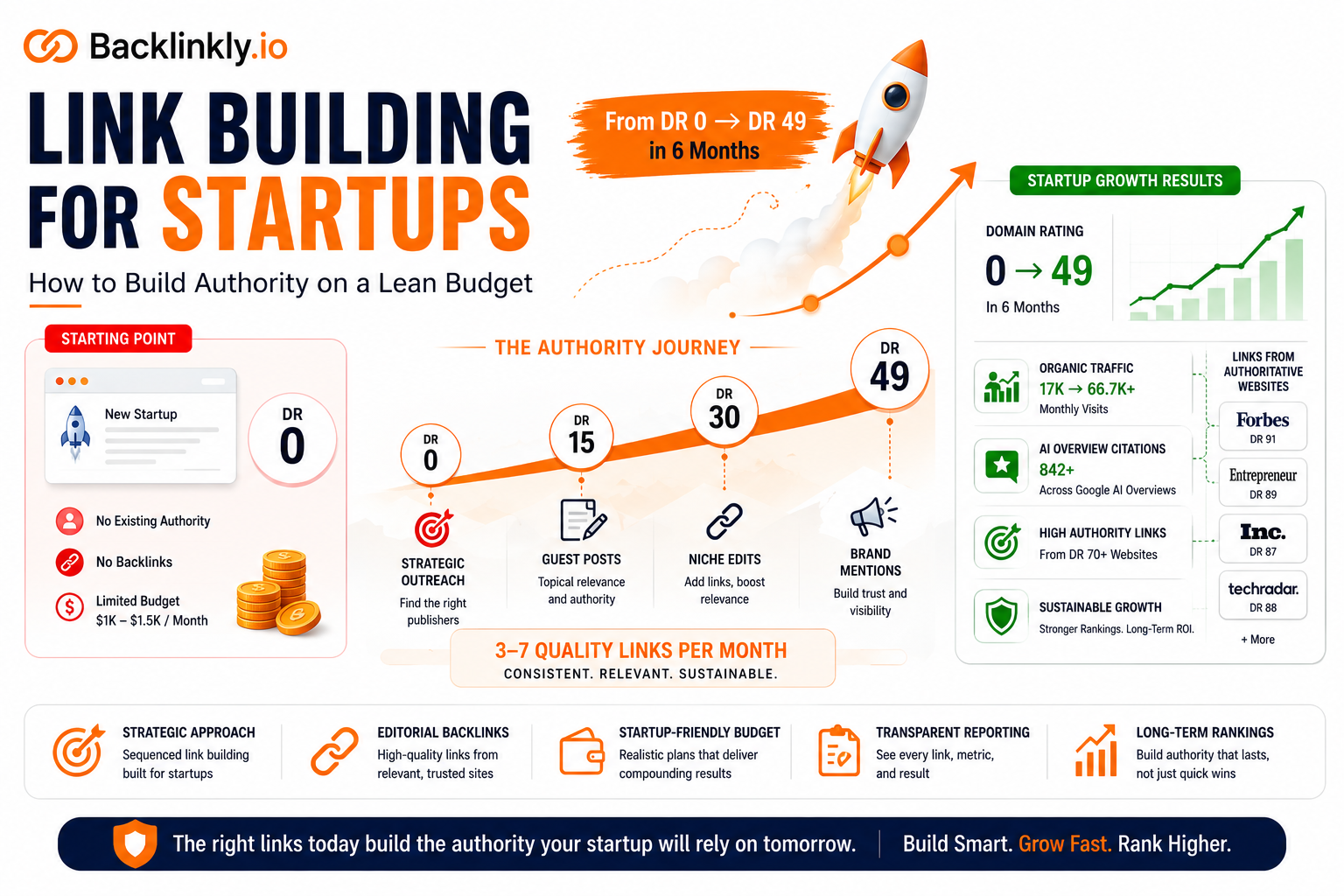
A startup should budget $1,000 to $1,500 per month as a realistic entry point for link building, scaling up as the domain gains authority and revenue grows. Minimum viable campaigns at this budget focus on consistent, smaller-volume placements rather than chasing link counts.
For context, a single quality backlink averages $508.95 across the broader market, and startup-specific packages often start around $1,750 for five links. Niche edits run $141 to $361 per placement, while guest posts (which include content creation) run $220 to $609. At a $1,000-$1,500 monthly budget, that means 3-7 quality links per month, not 50.
It’s not a small spend, but the return compounds. Most marketers now allocate 28% to 36% of their total SEO budget specifically to link building, and 78.1% of SEO professionals report positive ROI from their campaigns. One IT security SaaS startup ran a consistent campaign at 8-9 links per month for seven months and grew traffic from 17,000 to 66,700 monthly visits, earning 842 Google AI Overview citations along the way, according to Above Apex’s 2026 startup link building data. That’s not a fifty-links-a-month sprint. It’s steady, compounding consistency.
If you want to see what that kind of budget looks like for your specific site, you can see startup pricing options before committing to anything.
Real Results: Taking a Startup From DR 0 to DR 49 in 6 Months
Numbers from established clients are one thing. The harder test is starting from absolute zero. We took on a brand-new domain with zero backlinks and zero authority, the hardest starting point in link building. There’s no existing trust signal to build on, and one bad early link can set the wrong tone for the whole profile.
We treated it as a system problem first, not a link-buying problem. Before placing a single link, we set the rules the entire campaign would follow:
- A repeatable SOP for publisher selection, relevance scoring, and anchor assignment, built before outreach even began.
- A safe anchor ratio from link number one: branded, naked URL, and partial match, blended the way authority earns itself naturally instead of leaning on exact-match keywords that read as manipulative.
- A guest post and niche edit hybrid, using guest posts for topical relevance and niche edits to add link velocity without diluting quality.
In about six months, that domain moved from DR 0 to DR 49, entirely white-hat, with no manual actions. The resulting profile is clean and diversified: no single anchor type or publisher category dominates it.
The lesson for early-stage founders: the first 10-15 links your domain earns set the trajectory for everything after. Getting the anchor mix right from link #1 beats trying to clean up a messy profile two years later.
What Should a Startup Look for in a Link Building Agency?
A startup should look for an agency that treats relevance and fit over raw scale, offers transparent reporting on every placement, and is willing to start with a smaller test campaign before asking for a long-term commitment. Size of publisher network matters less than whether that network actually fits your industry.
Ask to see 3-5 sample links from recent client work, ideally from startups at a similar stage to yours. A guest posting service that lands you in a relevant SaaS or fintech publication is worth far more than ten random placements in unrelated niches, no matter how high the Domain Rating looks.
Also ask how they handle a brand-new domain specifically. An agency that gives the same playbook to a Series A startup and a pre-revenue founder probably isn’t thinking about your situation carefully enough. The right partner should be able to explain, in plain terms, how their approach changes based on your current authority and budget.
5 Mistakes Startups Make With Link Building
Watch for these common missteps before you commit budget or sign with an agency:
- Chasing Domain Rating over relevance. A DR 70 site with zero readers in your niche helps less than a DR 40 site your actual buyers read.
- Using exact-match anchors too early. A brand-new domain with heavy exact-match anchors looks manipulative to Google’s spam systems, even if every link is editorially earned.
- Going too cheap, too fast. Bulk link packages at rock-bottom prices usually mean low-quality placements that can stall growth instead of building it.
- Skipping an anchor strategy entirely. Without a planned ratio of branded, naked URL, and partial-match anchors, a profile grows unnaturally and can plateau.
- Quitting after one or two months. Link building compounds. Most campaigns take 3-6 months to show measurable ranking impact, so judging a campaign at week 6 misses the real results.
How Long Before a Startup Sees Ranking Results?
Most startup link building campaigns take 90 to 180 days to produce meaningful ranking movement, with stronger compounding growth appearing in months 6 through 12. Patience matters more than speed here, since editorial links take time to earn and time for Google to factor into rankings.
This timeline also applies to AI search visibility, not just traditional rankings. Only 16% of brands currently track their AI search visibility, which means most startups building links today are also ahead of the curve for tomorrow’s ChatGPT and Perplexity citations, even if they’re not measuring it yet. If you want a deeper look at how that works, our AI search visibility guide covers the mechanics in full.
Conclusion
Link building for a startup isn’t a smaller version of an enterprise campaign. It’s a different sequence entirely, built around the fact that your domain has no existing trust signal yet. Get the anchor mix and publisher relevance right from your very first link, budget realistically, and give the process 90 to 180 days before judging the results.
We’ve taken a brand-new domain to DR 49 in six months using exactly this approach. If you want to know what that timeline and budget would look like for your own startup, get a free link audit or check out our full guide to choosing a link building agency for the broader picture.
FAQ
Is link building worth it for a pre-revenue startup?
Yes, especially because the first links a domain earns set the trajectory for everything after. Waiting until after revenue arrives often means competing from a weaker starting position once budgets do open up.
How many backlinks does a new startup need per month?
There’s no universal number, but 3-7 quality links per month is a realistic starting pace at a $1,000-$1,500 monthly budget. Consistency over time matters more than hitting a specific count each month.
Should a startup do link building in-house or hire an agency?
It depends on bandwidth. Manual prospecting and outreach can take 10-20 hours a week, and most startups don’t have a dedicated SEO hire in the early stages. An agency brings existing publisher relationships that take years to build from scratch.
What’s a realistic Domain Rating (DR) goal for a startup in year one?
DR 30-50 within the first 6-12 months is achievable with consistent, white-hat link building, based on real campaign timelines. Reaching DR 49 from zero in six months, as in our own case study, sits toward the faster end of that range.
It’s possible but less common early on, since AI tools tend to favor pages that already show editorial backlinks and brand mentions. Building both from the start gives a new domain a better shot at AI citations as authority grows.
- Link Building Agency: How to Pick One That Actually Grows Your Rankings in 2026
- Niche Edits vs. Guest Posts: Which Link Building Strategy Wins in 2026?
