TL;DR: A good link building agency builds real editorial backlinks, not shortcuts, and reports on every placement so you can see exactly where your money goes. This guide covers what agencies do, what they cost, the red flags that signal trouble, and how AI search is changing what counts as a “good” link. We’ll also show you real before-and-after numbers from our own SaaS client work. Ready to see where your site stands? Get a free audit and find out.
94% of published content never earns a single external link, according to DemandSage’s 2026 link building report. That’s not a typo. Almost everyone who hits “publish” is shouting into an empty room.
A link building agency exists to fix that. It finds the publishers, writes the pitches, and earns the backlinks your content needs to actually rank, instead of sitting unread on page 9 of Google.
We’ve spent 3.5+ years doing exactly this for SaaS, fintech, and AI brands. We’ve seen what works, what wastes a client’s budget, and what gets sites penalized. This guide walks you through all of it: what a real agency does, what it should cost, the red flags to run from, and how AI search engines like ChatGPT and Perplexity are quietly rewriting the rules of what a “good” link even means.
Let’s get into it.
What Does a Link Building Agency Actually Do?
A link building agency finds relevant, high-authority websites in your niche and earns you backlinks from them through outreach, guest content, or editorial placements. The process covers prospecting, pitching, content creation, and reporting, all aimed at building links that move rankings instead of links that just look good on paper.
Here’s the breakdown of a typical campaign:
Prospecting. The agency builds a list of publishers in your niche that have real traffic, not just a high Domain Rating (DR) number. A site can have great DR and zero readers. That’s a wasted link.
Outreach. This is where most agencies fall apart. Reply rates for cold outreach have dropped to 3.43% on average in 2026, down from 8.5% just a few years back. Editors get flooded with AI-generated pitches now, so personalization matters more than ever. Our outreach team runs a 9% reply rate across our 200+ publisher network, roughly three times the 2026 industry average, because we lead with relevance instead of templates.
Content and placement. Whether it’s a guest post or a niche edit inserted into existing content, the link needs to sit somewhere a reader would actually click it. Anchor text should look natural, not stuffed with your target keyword.
Reporting. You should see every link the moment it goes live: the DR, the anchor text, the placement date, and the live URL. If your agency only sends a PDF once a month, you’re not getting real visibility into your own link building service.
Is Hiring a Link Building Agency Worth It in 2026?
Yes, link building still delivers strong ROI in 2026, with 78.1% of SEO professionals reporting positive returns from their campaigns. Pages ranking #1 on Google have on average 3.8 times more backlinks than pages sitting in positions 2 through 10, so the correlation between links and rankings hasn’t gone away. It’s just gotten more selective about which links count.
The ROI math backs this up at the channel level too. SEO delivers a median 748% return, and organic leads close at a far higher rate than outbound marketing. Link building is one of the biggest levers inside that channel, since 67% of agencies rank it in their top 3 SEO investments by perceived ROI.
What we’ve seen in our own client portfolio backs this up with real numbers, not industry averages. One HR and payroll SaaS client we’ve worked with since 2023 sits at DR 79 with 146,700 monthly visits. A billing and subscription SaaS client reached DR 82 with 80,000 monthly visits using a brand mention and variable anchor strategy. Neither happened overnight. Both happened through consistent, editorial-first link building, not a one-time sprint.
How Much Does a Link Building Agency Cost?
A link building agency typically costs between $3,000 and $10,000 per month for a managed retainer, or $100 to $1,200+ per individual link depending on the publisher’s authority and traffic. Low-tier links (DR 20-40) run $130-$220, while premium placements on major sites (DR 80+) can hit $700-$1,200 or more, according to LinkBuildingHQ’s 2026 pricing data.
If you’re seeing offers for 100 links at $500, that’s not a deal. It’s a liability. Real outreach, content, and editorial review take time, and the average price SEOs consider acceptable for one quality backlink sits at roughly $509, per editorial.link’s 2026 survey of 518 professionals.
White-label options exist too if you’re an agency reselling to your own clients. Our white-label link building program currently supports a digital marketing agency client at DR 51, handling outreach and reporting fully under their brand.
Whatever you spend, weigh it against the value of the publisher network behind it. A pricier agency with 200+ pre-vetted editorial relationships will usually out-earn a cheap one buying from the same recycled link farms everyone else uses.
Real Results: From Zero Authority to DR 49 in 6 Months
Numbers from established clients are one thing. The harder test is starting from nothing. Late in 2024, we took on a brand-new domain with zero backlinks and zero authority, the hardest starting point in link building. There’s no existing trust signal to build on, and one bad early link can set the wrong tone for the whole profile.
We treated it as a system problem first, not a link-buying problem. Before placing a single link, we set the rules the entire campaign would follow:
- A repeatable SOP for publisher selection, relevance scoring, and anchor assignment, built before outreach even began.
- A safe anchor ratio from link number one: branded, naked URL, and partial match, blended the way authority earns itself naturally.
- A guest post and niche edit hybrid, using guest posts for topical relevance and niche edits to add link velocity without diluting quality.
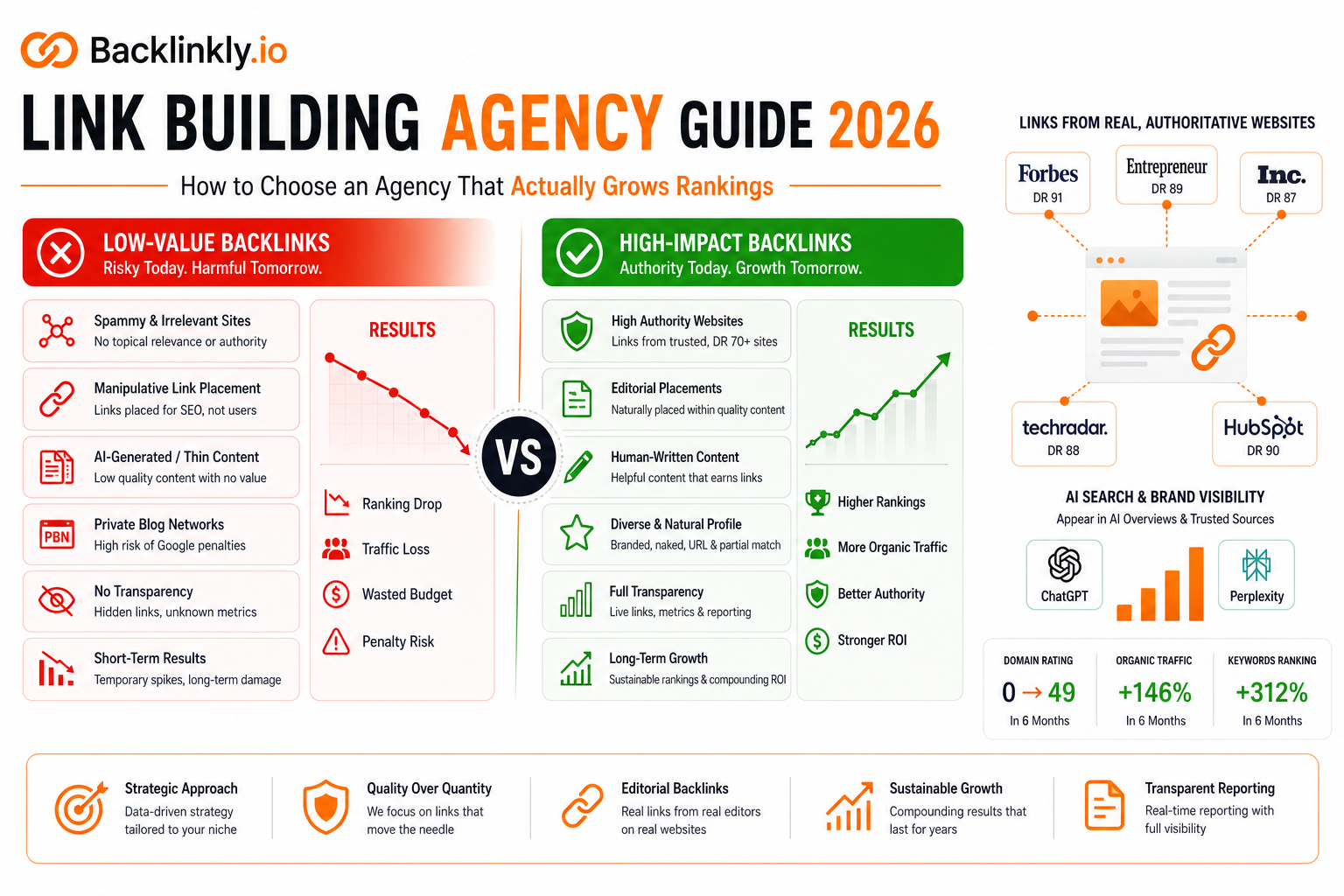
In about six months, that domain moved from DR 0 to DR 49, entirely white-hat, with no manual actions. The resulting profile is clean and diversified: no single anchor type or publisher category dominates it.
The lesson for early-stage founders: the first 10-15 links your domain earns set the trajectory for everything after. Getting the anchor mix right from link #1 beats trying to clean up a messy profile two years later.
7 Red Flags That Mean You Should Walk Away From an Agency
Not every agency selling link building services is worth your budget. Watch for these warning signs before you sign anything:
- Guaranteed rankings. No agency controls Google. Anyone promising a specific ranking position is selling something they can’t deliver.
- Suspiciously cheap bulk packages. 100 links for $500 means low-quality link farms, AI-generated filler content, or both.
- PBN ownership. Private blog networks exist purely to pass link equity, and agencies that own the sites they place your links on are a clear PBN signal.
- Vague reporting. If you can’t see the live URL, the anchor text, and the publisher’s real traffic, you’re not getting transparency.
- Instant turnaround promises. Real outreach, content, and editorial review take weeks, not days. Fast bulk delivery usually means automated, low-quality placements.
- Exact-match anchor stuffing. A natural backlink profile blends branded, generic, and partial-match anchors. Heavy exact-match usage reads as manipulation to Google.
- No examples of their own backlink profile. If an agency can’t show quality links pointing to its own site, it likely can’t build them for yours either.
How Are AI Search Engines Changing What a “Good” Backlink Looks Like?
AI search engines like ChatGPT, Perplexity, and Google’s AI Overviews weigh backlinks differently than traditional search does. They lean heavily on brand mentions, editorial context, and topical relevance rather than raw link volume or Domain Rating alone. A link from a relevant, trusted publication carries more weight for AI visibility than ten generic guest posts ever will.
The data backs this up. Brand mentions correlate more strongly with appearing in Google’s AI Overviews than backlinks do, and 76% of pages cited in AI Overviews also rank in Google’s traditional top 10. That overlap matters: the same editorial, relevant links that help your Google rankings are largely the same signals helping you get cited by AI tools.
Yet only 16% of brands currently track their AI search visibility, which means most companies are running 2026 campaigns against dashboards built for a different era. If you want a deeper breakdown of how this shift works, our generative engine optimization guide covers it in full.
How Do You Choose the Right Link Building Agency for Your Business?
Choose a link building agency based on five things: transparency about their process, niche relevance to your industry, real reporting (not vanity metrics), a track record with case studies you can verify, and a willingness to start with a smaller test campaign before you commit long-term.
Ask to see 3-5 sample links from recent client work. Check whether the placements sit editorially within relevant content, whether the linking sites have real organic traffic, and whether the niche actually matches your industry. A guest posting service that places you in a relevant SaaS publication is worth far more than ten random placements in unrelated niches.
Also ask directly how they handle quality control: do they check publisher traffic and spam scores before pitching? Do they let you review or veto placements before they go live? A trustworthy agency answers these questions clearly, without dodging.
Conclusion
Link building still moves rankings in 2026, but the game has shifted from volume to quality, and from pure backlinks to backlinks plus brand mentions that AI search engines can cite. The agencies worth hiring are the ones who show you their process, their publisher network, and their actual results, not just promises.
We’ve taken a brand-new domain to DR 49 in six months and grown established SaaS clients to DR 89 with zero manual actions along the way. If you want to see exactly where your site stands and what’s holding back your rankings, book a free strategy call and we’ll walk you through it.
FAQ
How long does link building take to show results?
Most link building campaigns show measurable ranking movement within 1-6 months, with 89.2% of practitioners reporting impact in that window. Editorial links take time to earn and time for Google to factor in, so patience matters more than speed.
What’s the difference between guest posts and niche edits?
A guest post is a brand-new article written and published specifically to earn a backlink, while a niche edit inserts your link into an already-published, already-indexed page. Niche edits often pass authority faster since the page is already trusted, while guest posts build topical relevance through fresh content.
Can I do link building myself instead of hiring an agency?
Yes, but it’s time-intensive. Manual prospecting alone can eat 10-20 hours a week, and outreach reply rates have dropped to around 3.43% industry-wide in 2026. An agency brings existing publisher relationships that take years to build from scratch.
What’s a normal Domain Rating (DR) for a quality backlink?
DR 40 and above is generally considered a solid quality threshold, with DR 60+ used for stronger authority reinforcement in competitive niches. Pricing scales with DR: expect $130-$220 for DR 20-40 links and $700+ for DR 80+ placements.
Do backlinks still matter if Google AI Overviews are taking over search?
Yes. Backlinks combined with brand mentions remain a strong signal for AI visibility, and most pages cited in AI Overviews also rank in Google’s traditional top 10 results. The two systems lean on overlapping signals, so a solid backlink strategy still supports both.
