Most startups waste money on enterprise SEO platforms they’ll never fully use. This guide breaks down the best affordable SEO tools for startups in 2026, covering everything from free essentials to paid options under $50/month. Whether you’re in the US, UK, Europe, or Dubai, you’ll find the right tool stack to grow organic traffic, track rankings, and outpace competitors without burning through your runway. Start with free tools, then add one paid tool that solves your biggest gap.
You launched your startup. You built the product. Now nobody can find you on Google.
Sound familiar? You’re not alone. Organic search drives 53.3% of all website traffic across every industry, yet most early-stage founders treat SEO like a luxury they’ll “get to later.” That’s a costly mistake.
Here’s the reality: SEO tools for startups don’t need to cost hundreds of dollars a month. The right stack costs less than a Netflix subscription. And the payoff? A well-executed SEO campaign delivers a median ROI of 748%, meaning you get $7.48 back for every $1 you put in. For SaaS startups specifically, that figure sits at 702% ROI with a break-even point as short as seven months.
This guide is built for founders, solo marketers, and small growth teams who need real results on a real budget. Let’s get into it.
Why Do Startups Need SEO Tools in the First Place?
Startups need SEO tools because guessing doesn’t scale. Without tools, you’re publishing content nobody searches for, targeting keywords you can’t rank for, and missing technical issues that tank your visibility.
The right tools tell you exactly what your audience is searching for, which pages on your competitors’ sites drive them traffic, and where your own site is leaking organic visitors. They turn SEO from a guessing game into a repeatable, data-driven process.
SEO leads close at a 14.6% rate compared to just 1.7% for outbound marketing. That’s not a small gap; that’s a completely different league. For a startup where every lead counts, organic search traffic is one of the highest-quality sources of customers you can build.
The good news? You don’t need a $500/month enterprise platform to tap into this. There are outstanding tools available for $0 to $50 per month that cover everything a growing startup needs.
What Are the Best Free SEO Tools for Startups in 2026?
The best free SEO tools for startups are Google Search Console and Google Analytics 4. These two tools, built directly by Google, give you accurate first-party data on how your site performs in search, where your traffic comes from, and which pages users actually engage with.
No third-party tool can replicate the accuracy of Google Search Console because the data comes straight from Google itself. You’ll see which keywords bring people to your site, which pages rank in positions 8 to 20 (your quickest ranking wins), and any technical issues Google found while crawling your site.
Here’s what to set up on day one, at zero cost:
Google Search Console shows impressions, clicks, average position, and crawl errors. Set it up, verify your domain, and check the Performance report weekly. Focus on queries ranking in positions 8 to 20 first. These are your quick wins.
Google Analytics 4 (GA4) connects your organic traffic to actual business outcomes. You’ll see whether SEO visitors sign up, buy, or bounce. Install the tracking code and set up conversion events for form fills and button clicks.
Screaming Frog SEO Spider (Free Tier) crawls up to 500 URLs for free, making it perfect for startups with smaller websites. It identifies broken links, missing meta tags, duplicate content, and redirect chains.
AnswerThePublic surfaces the real questions people type into Google around any topic. Use it to find blog ideas and FAQ content that matches genuine search intent.
Master these before spending a single dollar on paid tools.
Which Affordable Paid SEO Tools Deliver the Most Value Under $50/Month?
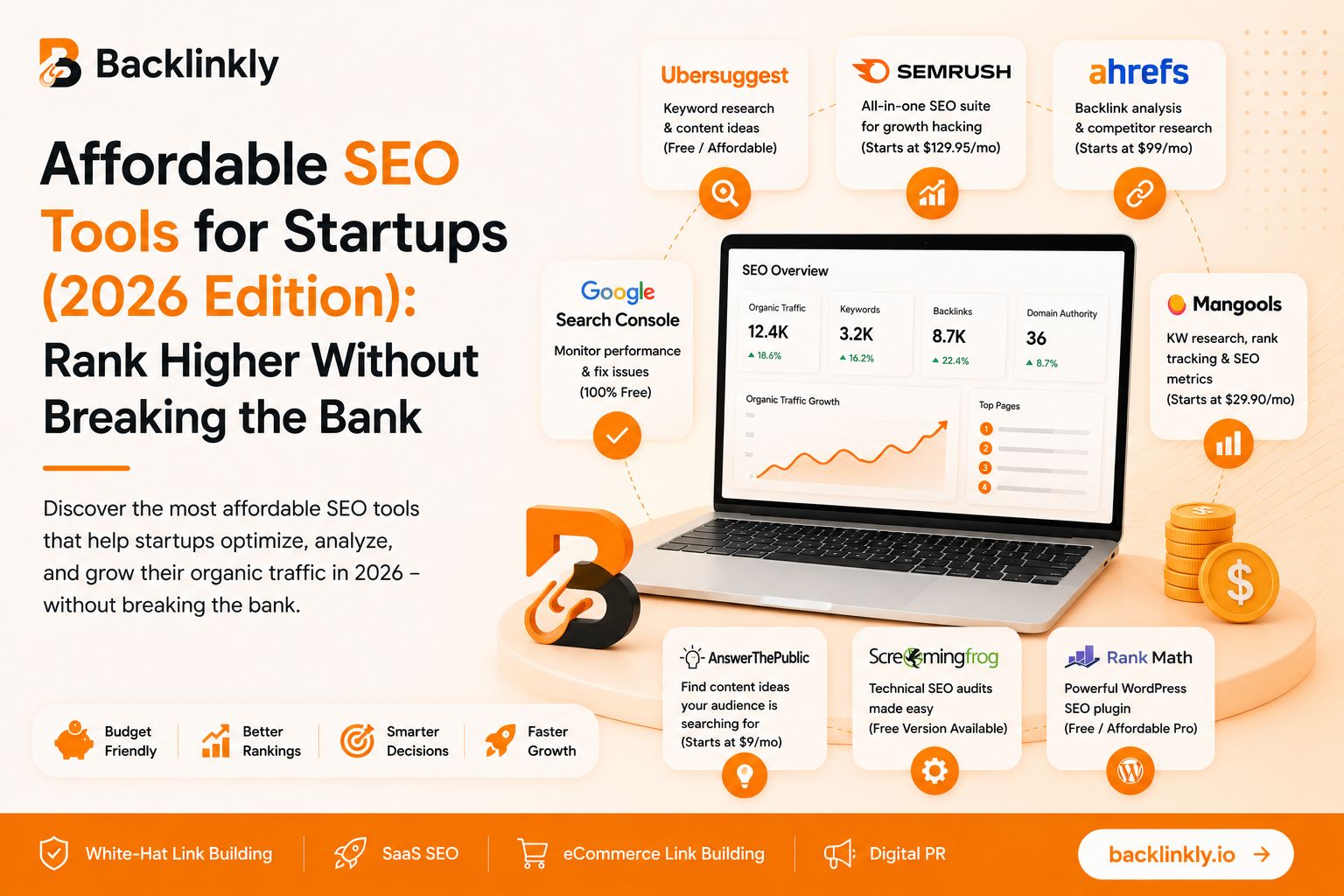
The best affordable paid SEO tools for startups under $50/month are Mangools ($29/month), Ubersuggest ($29/month), and SE Ranking (starting around $44/month). Each covers keyword research, rank tracking, and competitor analysis at a fraction of what enterprise tools like Semrush or Ahrefs charge.
Here’s what each tool does best:
Mangools ($29/month) is a suite of five tools: KWFinder for keyword research, SERPChecker for SERP analysis, SERPWatcher for rank tracking, LinkMiner for backlinks, and SiteProfiler for domain analysis. Its KWFinder tool is especially beginner-friendly, displaying search volume, keyword difficulty, and trend data in a clean visual layout. For a startup focused on keyword research and competitor tracking, it’s hard to beat at this price.
Ubersuggest ($29/month) covers keyword ideas, content suggestions, backlink tracking, and site audits in one clean dashboard. It also includes a lifetime access option, so you pay once and stop the subscription treadmill. It’s ideal for founders who are new to SEO and don’t want to get overwhelmed by feature bloat.
SE Ranking (from ~$44/month) punches well above its price point. It combines keyword tracking and backlink monitoring with detailed site audits, plus flexible pricing that scales with your team’s needs. It’s also one of the few budget tools with AI visibility monitoring built in, helping you track whether your startup shows up in ChatGPT and Perplexity answers.
How Should Startups Build Their SEO Tool Stack Step by Step?
Startups should build their SEO tool stack in three phases tied to growth stage: start free, add one paid tool after 90 days, then evaluate and adjust at the six-month mark. Buying too many tools too early is one of the most common mistakes early-stage founders make.
Here’s the exact phased approach:
Months 1 to 3: Start Free. Set up Google Search Console, Google Analytics 4, and the free version of Screaming Frog. Use AnswerThePublic for content ideas. Most businesses don’t fully use free tools before buying paid alternatives. Don’t make that mistake. Get comfortable with the data before spending anything.
Months 4 to 6: Add One Paid Tool. Choose based on your biggest bottleneck. Need keyword ideas and competitor research? Start with Mangools or Ubersuggest. Need to monitor rankings daily and get site health alerts? SE Ranking is the better fit. Don’t buy two tools solving the same problem.
Month 7 and Beyond: Evaluate and Adjust. A $130/month tool collecting dust beats nothing, but a $30/month tool you actually use weekly beats everything. Only upgrade when you’ve genuinely outgrown your current stack. At this stage, Search Atlas, which offers 70 to 80% of Ahrefs’ features at roughly half the cost, becomes worth evaluating.
What Should Startups Look for in an SEO Tool Before Buying?
Before buying any SEO tool, a startup should evaluate five things: pricing transparency, ease of use for small teams, accuracy of keyword and ranking data, automation capabilities, and whether the tool integrates with your existing stack.
Complex enterprise tools assume you have a dedicated SEO specialist. Most startups don’t. Choose platforms with intuitive interfaces and responsive support that understand startup constraints.
Watch out for tools that charge premium rates for basic collaboration features like adding a second user seat. Your tool needs to scale as you hire, not punish you for growing.
Also pay attention to data freshness. For rank tracking in 2026, it’s no longer enough to check one desktop position. Rankings vary by device, city, language, and whether AI Overviews appear. A tool showing only national desktop rankings gives you an incomplete picture.
Are AI-Powered SEO Tools Worth It for Startups in 2026?
AI-powered SEO tools are worth it for startups in 2026, but only when they sit on top of solid SEO fundamentals. AI tools accelerate research, content optimization, and technical monitoring. But they can’t replace a genuine understanding of search intent, on-page structure, and link building basics.
Traditional SEO traffic has declined 30 to 50% as generative AI search grows, which means visibility in ChatGPT, Perplexity, and Google AI Overviews is becoming just as important as traditional Google rankings. AI Overviews now appear for over 13% of all queries, and that number keeps growing.
For budget-conscious startups, Keywordly at $14/month is one of the most affordable ways to get into AI-assisted keyword research and basic ChatGPT visibility tracking. It clusters keywords semantically and pulls real questions from Reddit and Quora, helping you create content that answers problems people are actually talking about right now.
SE Ranking also includes AI visibility monitoring at its affordable price point, making it a smart all-in-one choice for startups wanting both traditional SEO data and AI search coverage in a single dashboard.
Building a Lean, Effective SEO Stack: The Startup Recommendation
You don’t need six tools. You need the right three. Here’s a lean startup SEO stack that covers all your bases without draining your budget:
Free tier (Months 1 to 3): Google Search Console, Google Analytics 4, Screaming Frog (free up to 500 URLs), and AnswerThePublic.
$30 to $50/month starter stack: Add Mangools for keyword research and rank tracking, or SE Ranking if you want site audits and AI visibility in one place.
When you’re ready to scale: Consider Search Atlas for deeper backlink analysis and competitor intelligence at roughly half the cost of Ahrefs or Semrush.
A practical budget SEO stack should cover research, tracking, technical health, and content without too much overlap. Every tool should earn its place in your workflow.
Conclusion
SEO is no longer a “we’ll get to it later” strategy. It’s the highest-ROI growth channel available to startups, and the barrier to entry has never been lower. You can build a complete, professional-grade SEO setup for under $50/month and start generating organic traffic that compounds month after month.
Start with the free tools. Master them. Then add one paid tool that solves a specific problem you’re actually facing. The startups winning at SEO in 2026 aren’t the ones spending the most. They’re the ones being the most consistent with the right tools.
Ready to get started? Set up Google Search Console today, spend 30 minutes reviewing your search performance data, and find the three keywords you’re almost ranking for. Those are your first wins waiting to happen.
-
What are the best SEO tools for startups on a tight budget in 2026?
The best budget SEO tools for startups are Google Search Console and Google Analytics 4 (both free), Mangools and Ubersuggest (both at $29/month), and SE Ranking (from around $44/month). Start with the free tools for the first 90 days before adding any paid plan. Most founders pay for tools they never fully use, which is a bigger problem than using a slightly less powerful free option.
-
How much should a startup spend on SEO tools per month?
Most startups should spend $0 to $50/month on SEO tools in their first year. Free tools like Google Search Console cover the essentials well. One paid tool in the $29 to $50/month range is usually enough to handle keyword research, rank tracking, and basic site audits. Only upgrade to higher tiers when you’ve genuinely outgrown what you’re using.
-
Can a startup rank on Google without paying for SEO tools?
Yes, a startup can rank on Google using only free tools. Google Search Console, GA4, AnswerThePublic, and Screaming Frog’s free tier give you keyword data, technical audit capabilities, and performance tracking at no cost. The limitation is scale and speed, not possibility. Free tools work well. They just require more manual effort and come with lower data limits than paid alternatives.
-
How long does it take for SEO to show results for a startup?
Most businesses see measurable ROI from SEO within six to twelve months. The first three months are about fixing technical issues and publishing content. Months four through six typically bring meaningful ranking movement. B2B SaaS startups specifically reach their SEO break-even point in about seven months on average. SEO is a compounding channel; results get stronger the longer you stay consistent.
-
What’s the difference between Semrush/Ahrefs and affordable startup SEO tools?
Semrush starts at $139.95/month and Ahrefs at $129/month. They offer larger data sets, more advanced reporting, API access, and features built for agencies managing multiple clients. Affordable tools like Mangools, SE Ranking, and Ubersuggest offer 70 to 80% of those features at roughly half the cost or less, which is more than enough for a startup focused on a single website and a defined set of target keywords.
-
Do startups need to track AI visibility alongside traditional SEO in 2026?
Yes, tracking AI visibility is increasingly important in 2026. AI-driven search features now appear in over 13% of all Google queries, and tools like ChatGPT and Perplexity are becoming primary research channels for buyers. Traditional SEO traffic has declined 30 to 50% as AI search usage grows. SE Ranking and Keywordly both offer basic AI visibility monitoring at affordable price points, making them smart choices for startups who want to future-proof their organic strategy.
-
Is Ubersuggest better than Mangools for startups?
Both are excellent at the same $29/month price point. Ubersuggest is the better pick if you want a simpler all-in-one dashboard and the option to pay once with a lifetime deal. Mangools is the better choice if keyword research depth and SERP analysis are your priorities, as its KWFinder tool is one of the clearest and most beginner-friendly interfaces in the market. Try both free trials and pick the one that matches how your team actually works.